Monday, July 07, 2008

The Truth about Horse and Buggy Days

Pollution before the automobile


On one of the internet forums I read, someone suggested that we should all go back to horses and buggies like the Mennonites and Amish. She wasn't entirely serious but she wasn't entirely joking, either. The manure and the flies would be terrible problems, I reminded her.

How bad could it be? In cities, manure problems were horrendous, according to one source.

Of the three million horses in American cities at the beginning of the twentiety century, New York had some 150,000, the healthier ones each producing between twenty and twenty-five pounds of manure a day.  These dumplings were numerous on every street, attracting swarms of flies and radiating a powerful stench.  The ambiance was further debased by the presence on almost every block of stables filled with urine-saturated hay.

During dry spells, the pounding traffic refined the manure to a dust, which blew "from the pavement as a sharp piercing powder, to cover our clothes, ruin our furniture and blow up into our nostrils."

Source: The Good Old Days -- They were Terrible! by Otto L. Bettmann.  Published by Random House, New York, 1974.
Bettmann also notes that the "15,000 horses of Rochester, NY, produced enough manure in 1900 to cover an acre of ground with a layer 175 feet high." A few pages later, when he writes about Pittsburgh, he mentions the "steamy cesspools around the hitching posts where flies plagued man and beast and a vile odor abounded."

No, I don't want to revert to the horse and buggy.  I think I'll just practice conservative driving techniques.

Sunday, July 06, 2008

The Body as an Industrial Palace

Man's internal machinery


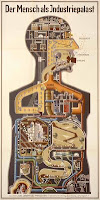
Several years ago, I came across an interesting old illustration on the National Institute of Health (NIH) website. It shows the human body as a factory -- literally, as an "industrial palace." I saved the image because I liked it, and then I quickly forgot about it.

Tonight, I came across the "Industrial Palace" again, and looked at it a little differently, due to my recent (small) study of the modernistic architecture of the early and middle 20th century.

Here are the details of this piece of art, according to the NIH:

Der Mensch als Industriepalast (Man as Industrial Palace)by Fritz Kahn (1888-1968)Stuttgart, 1926. Chromolithograph. National Library of Medicine.Kahn’s modernist visualization of the digestive and respiratory system as "industrial palace," really a chemical plant, was conceived in a period when the German chemical industry was the world’s most advanced.

Source: Dreaming the Industrial Body

It seems that, in the 1920s and 1930s, people were extremely excited about machines. It was the Machine Age. The assembly line had been invented, enabling many people to own personal machines -- automobiles. High speed travel was possible via big ocean liners and streamlined trains. Electricity, produced by generators and turbines, was transforming everyday life. Mechanized factories were churning out many new, inexpensive consumer goods. Machines even made it possible for people to fly.

I've been reading that modernists thought of schools as machines for learning, houses as machines for living, and hospitals as machines for healing. Designed for speed and efficiency, the architecture sometimes seemed cold. Unnecessary frills were stripped away, and the design was streamlined just as a train or an airplane might have been. This was modern!

Given all that, it's not too surprising to see the human body portrayed as a factory, in a drawing from 1926. Fritz Kahn, a doctor, was just creating a bit of modernistic medical art.

Thursday, July 03, 2008

Happy 4th of July

Celebrate!


I wish you a happy (and safe!) celebration of freedom and democracy. I hope your day includes a slightly blackened hot dog and a slice of watermelon -- or whatever food you enjoy on this holiday. (Hmm. I wonder if it's too late to start a 4th of July cheesecake tradition in my family?)

This fun fireworks page is perfect for celebrating the 4th of July or any other day. The sparks won't set any fires, and you control the show. (Thanks for sending the link, Gloria.)

My cousin Elaine sent an interesting link that's also appropriate for the holiday. It's the homepage of an Ames, Iowa artist whose ongoing project is Freedom Rock. At Memorial Day each year, he paints a new patriotic mural on the rock. It's quite impressive. To see ten years of murals, visit the link that's titled "The Rock."

Patriotic heart My mother's cookouts

My mother loved to cook out on the 4th of July. When I was little we didn't have a barbecue grill, so Mama prevailed upon my dad every year to create a cooker with cement blocks and oven racks. Later on, I remember Mama cooking on an iron grill that my dad welded for her in his shop.

One 4th of July evening, I stepped on a hot rack that had been taken off one of Mama's outside cookers. It was twilight, and I was running around barefoot with my sparkler -- probably not a wise thing to do, all in all.

My mom coated the sole of my foot with slightly-beaten egg white. She had read that egg white was a good home remedy for burns.

The egg white must have worked because I honestly don't remember my foot hurting at all. It's likely that it was just a minor burn. I didn't like to wear shoes in the summer time, so my foot leather was pretty tough.

Love of country

Don't forget what we're celebrating on the 4th. It's a day to remember our national history and to show gratitude and respect for those who've worked and fought to keep our country free.

I don't express my love for the United States as often as I should. I remember the times I returned to the U.S. after many months of living elsewhere. I had a lump in my throat and tears of joy in my eyes when my feet touched American soil again. I do understand why people kiss the soil of their homeland when they return from their wanderings.

My Other Car is a Golf Cart

One way to save on gasoline


Fred Bishop, Prairie Bluestem reader and internet friend, recently sent some interesting photos of golf carts used on the streets around Sun City, Arizona (northwest Phoenix.) Fred, who knows his old cars much better than I do, has identified the little buggy below as a "1932 Ford." In explanation, Fred wrote:

We followed this Golf cart into the Shopping Center to get these photos.

There are a lot of Golf Carts operating on the streets in the Sun City - Pop. 38k, Sun City West - Pop. 28k and Sun City Grande - Pop. 35k (and growing) communities. (Three communities alone, Sun City, Sun City Grand, and Sun City West, together have a population of approximately 100,000 residents who are 55 or older). >> AGS Newsletter :: 2007 First Quarter - Arizona Geriatrics Society

Wife's cousin lives in Sun City Grande. I have not seen coyotes in Sun City west, but they roam and hunt rabbits and house pets, especially in new area Sun City Grande. Coyotes will walk on the top of block fences peering into the backyards looking for lunch. Fences are not used to separate backyards. Fences are only on major streets or used to separate sub-divisions. Backyards are defined by landscaping.

(Back to Golf Carts). Golf Carts are legally State Licensed to operate on the streets in these and other close by retirement areas. Have been told insurance cost less than $100.00 per year. All but in the older area of Sun City are required to be Electric.

Most will only run maybe 25-28 miles per hour. Of course, some of those old guys have geared their cart up so they will run maybe 31-35 mph. Many Golf Carts are used as a 2nd car. Some are designed to be just transportation vehicles as the one [at left.] That's wife Chris at the drivers door.

Note the more conventional cart at top right of photo. Many carts will have canvas/clear plastic panels to keep rain and cold out. Lot's of women , singly and in pairs, run about the area in a cart. Have noticed a lot of women driving with a male companion along for the ride.

Source: Email, June 23, 2008


And regarding this six-seater, Fred writes,

Took the photo last week. Sales person said it would be about $14K out the door. Background is Sun City West looking across Bell Road. There are lots of Palm Trees in the Sun Cities.

Source: Email, June 30, 2008


What does a golf cart need to be legal on Arizona streets?

In Arizona, all street-legal golf carts must be registered with ADOT. Because some are intended for private use only, the ADOT golf cart registry is not an accurate representation of how many vehicles are in the state. ADOT spokeswoman Cydney DeModica said she believes the number is much higher.

To be street-legal, the carts must be equipped with the same safety features as cars: headlights, taillights, turn signals and windshields, DeModica said. They must have license plates, and operators must be licensed. The carts must stay on streets with speed limits of 35 mph or less.

Source: "Souped-up golf carts taking to the streets," by Erin Zlomek, The Arizona Republic, Nov. 30, 2006 12:00 AM


A golf cart isn't a viable solution for everyone, but I can certainly see some benefits -- they're economical to operate, easy to park, and fun to customize.

Tuesday, July 01, 2008

June's Last Sunset

Orange and purple


We've had some wonderfully cool weather for a few days. Last night, the temperatures were in the upper 50s. We slept with the windows open, and I actually got cold enough to pull the blanket over me.

The temperatures are supposed to be a little higher today, but just in the 80s. In fact, we are supposed to stay in the 80s for the next week. I'm sure this won't last, but for now, I'm loving it.
Related Posts Plugin for WordPress, Blogger...

CONTENTMENT: Keep your heart free from hate, your mind from worry, live simply, expect little, give much, sing often, pray always, forget self, think of others and their feelings, fill your heart with love, scatter sunshine. These are the tried links in the golden chain of contentment.
(Author unknown)

IT IS STILL BEST to be honest and truthful; to make the most of what we have; to be happy with simple pleasure; and to be cheerful and have courage when things go wrong.
(Laura Ingalls Wilder, 1867-1957)

Thanks for reading.