Showing posts with label pests and vermin. Show all posts

Thursday, February 01, 2007

Rat Stories

Life in Christian County, Kentucky... Life In Bolivia... Life In Missouri... More About Birds and Animals... Some Interesting News...


I read an interesting article about rats in Anchorage, Alaska. No rats are allowed in Anchorage. If a rat is sighted, it's tracked down and killed. Even pet rats are illegal.

"Anchorage is the only certified rat-free port in the world that we know of," said Ramone Wallace, an environmental specialist with the city health department. "We don't want rats in Anchorage."

Source: "Anchorage airport rat pack down by two" by Katie Pesznecker, Anchorage Daily News, February 1, 2007.


My husband will be interested in this article because he despises rats. When he saw them in the barn when he was a kid, they scared him. His family lived just a few miles from the Missouri River and the river-bottoms industrial area in Independence, Missouri (greater Kansas City, MO). Dennis says the rats were extra big, and I don't doubt that they were.

When we lived in Bolivia, he went in the bathroom one morning and found a rat swimming in the commode. He slammed down the lid and yelled, "There's a rat in the toilet. What shall I do?" "Flush the toilet," I yelled back, and so he did, about 20 times. I refused to go near the bathroom, but after a time, Dennis did lift the lid cautiously and peek inside. The rat was gone, presumably down the drain from whence it came. Its memory inspired a degree of caution in us, as you can imagine.

Dennis says that the rats were everywhere at Camp Doha in Kuwait. The story he heard was that the base had a huge population of stray cats and the commander didn't like it. He had the cats exterminated or otherwise removed, and soon there was a huge population of rats that the cats had previously kept under control.

I have seen twice seen a rat in Kentucky. One time when I went on a school picnic with Isaac's class, there was a white rat running around under the picnic tables at the far end of the shelter. He was picking up food scraps in his little paws and eating it, and the kids thought he was really cute. I thought he was too close for comfort. I wondered if he was a pet rat that had been released. He wasn't scared of people at all.

The other time I saw a wild rat, I didn't see all of him. I just saw his white head and his pink tail which Skittles left lying by the front step. Presumably she ate the rest of him. I couldn't believe how big his head and tail were -- Skittles surely had quite a battle with him. I have convinced myself that she caught him around our neighbor's barns, where there is corn, cattle feed, etc. that a rat would like.

I have just one wildlife guide -- Reader's Digest North American Wildlife, edited by Susan J. Wernert published in Pleasantville, NY and copyrighted in 1982. It says that there are several species of rats in this part of Kentucky. They include the Hispid cotton rat, the Norway rat ("the world's most destructive mammal," according to the guide), the eastern woodrat and the marsh rice rat. None of these rats are nearly as white as the rat head that Skittles left on the doorstep, but maybe it was a some other woodrat subspecies.

The big rats Dennis saw as a child were probably Norway rats, but he says that the rats he saw in Kuwait were the biggest rats he's ever seen. They had long brown hair, and he called them "Fred" because he got to know them so well. (Dennis-type humor, here.)

When I told my brother about the rat that Skittles caught, he talked about working in grain fields late at night in Missouri. He was amazed at the hundreds of rats that he saw in the headlights. Maybe those rats were Hispid cotton rats which my book says are common in farmlands and a serious agricultural pest. There is documentation of up to 500 rats per acre in heavily infested fields.

The behavior of the eastern woodrat seems to be more benign. "Adult woodrats feed on fruit, seeds, and nuts, and do man no economic harm, although some people dislike them merely because of their name and appearance." (Quoted from the above-cited Readers Digest book.)

The marsh rice rats swim as easily as they run around on land. Something like a marsh rice rat was swimming around in the toilet that morning in Bolivia when Dennis had such a shock. I suppose it was a Bolivian species, though.

Bar

Technorati tags:


What do you think about rats? Do you have any rat stories?

Friday, January 19, 2007

Chigger Territory

Life in Christian County, Kentucky... Life In Missouri... Another Trip Down Memory Lane...


From late spring until soil temperatures finally cool again in the fall, it's chigger season in Kentucky.

The chigger is the parasitic larva form of a tiny mite. Chiggers are so tiny they can't be seen without a magnifying glass. They live in damp shady areas and when a host (such as a human) pauses there for a moment, they climb on and search for a place to attach themselves.

If you bathe with hot water and plenty of soap soon enough, you may wash them off before they hook into your skin. But if you don't, the chigger will find a place where the clothing is tight (such as the waistline) or where the skin is thin (such as the ankles) or wrinkled (such as the folds behind the knee). Then it will pierce the skin with its mouthpart and inject some enzyme-laden saliva to liquify the skin so it can be sucked out.

ChiggerNot surprisingly, the area where the chigger is at work becomes inflamed and itchy within a few hours. If the chigger is not killed with soap and hot water (recommended treatment) or knocked off by scratching (not recommended!) it will feed for several days. Then it will finally detach itself and drop back to the ground where it will become a nymph and finally an adult.

A few careless hours spent in a chigger-infested area can put you into a hell of unimaginable itching for a couple of weeks. The first time I ever got chiggers, I fished all afternoon in a Missouri farmpond. I had never heard of chiggers before, so I sat for hours on the big rocks along the water's edge. The next day, I was in agony with dozens of itchy welts -- and I suffered for many days thereafter. Welcome to Missouri!

And then there's the interesting combination of chiggers and poison ivy. I've had that all over my feet and ankles. I did that here in Kentucky, fishing again! I've learned to be very dilligent about using insect repellant and showering promptly, but even a single chigger bite can itch like crazy.

It's amazing to me that when my sister and I were little girls in northern Nebraska, we played in the tall grass (chigger heaven) all the time and we never got chiggers. We didn't get ticks either. (Ticks are another parasite we have in Kentucky.)

On summer afternoons, we made "houses" by mashing down circles in the tall grass under the trees in the shelter belts. We played for hours there, sitting and lying on the ground in the shade.

If there had been chiggers in the grass, we'd have been eaten up by them. There simply weren't any. After living in chigger territory for much of my adult life, it's so hard to imagine that!

Sunday, December 31, 2006

Mouse Nest in the Woodpile

More About Birds and Animals...


Mouse NestWarm and cozy mouse nest


We found this beautiful little mouse nest yesterday while we were restacking the woodpile. I was much impressed with the skill with which the little creatures had made it. The nest was a warm, dry and cozy home in the woodpile, covered over above with split logs and a tarp. It was uninhabited, but I'm sure it's been full of baby mice at least once -- probably many times.

The nest is made mostly of chewed leaves and grass and some sort of hair (or something that looks like hair.) I don't know if they tear hair from their own bodies as some rabbits do or if they found some other source of hair or a hair-like substance.

Mind you, I don't like mice in my house, but they have their place in the ecosystem outside and I respect that. That being said, I've looked at a few dozen webpages about mice and their nests today, and I think this is the nest of a house mouse, a Central Asian species, that was introduced to the U.S. many years ago and is now one of the most problematic rodents in Kentucky (and the rest of the world.) One of their common nesting places is woodpiles!

Still, I felt a twinge of shame as we removed the nest and laid it on the ground. It was constructed so well that it held together when it was moved. I remembered the Robert Burns poem, To A Mouse. On turning her up in her nest with the plough.

I'm sure you've heard a phrase from one of the last stanzas of the poem:
The best-laid plans of mice and men often go awry.


There's much more to the poem, though, so if you haven't read it in full recently, it's well worth reviewing.

Technorati tags:


Wednesday, September 27, 2006

Ash Trees in Peril

Life in Christian County, Kentucky... More About Trees and Plants...


Green ash treeAsh Tree

When I went out the door with Isaac this morning to take him to school, the sun was shining on and through the ash tree. It's a handsome tree, but I think it has a hollow in its trunk with a yellow-jacket nest in it. Also, it's got poison ivy vines growing up its trunk. All in all, it wouldn't be a good tree to climb.

I am concerned for the long term health of our six ash trees. The emerald ash borer, an Asian insect that apparently arrived in the U.S. as a resident in the wood of shipping crates, has established itself in "lower Michigan, northwest Ohio, and northern Indiana. Infestations were recently found in the Chicago area." (Source: U.S. Forest Service). Emerald ash borers have also infested areas of Ontario, Canada.

Tree experts beg everyone to use ash firewood in the area where it was cut. Don't transport it to other places! If the firewood is infested with borer larvae, you may infect a new area with the pests. For example, don't bring firewood from home when you go camping, and don't bring your summer cabin's leftover firewood to your house to burn.

Other tree problems such as gypsy moths and Dutch Elm disease can be spread through firewood too, so it's never a good forestry practice to move firewood a long distance from where it was cut.

The U.S. Forestry Service has stockpiled ash seed, just in case the emerald ash borer decimates the ash tree population across the entire nation. I hope we never see that sad situation!

Technorati tags:


Tuesday, August 29, 2006

No More Slugs!

Life in Christian County, Kentucky... The Rural Life...


We've had a rainy summer here in Kentucky's Pennyrile. It hasn't been an extremely wet summer, but the rains have been regular. In fact, we had rain showers again today. Many years, we stop getting rain sometime in July and it's dry until sometime in late September or even October.

I'm glad that the farmers are harvesting a good corn crop and that they have a good crop of soybeans still growing, but I'm ready for dryer weather myself. For one thing, I'm tired of mowing the lawn. I started mowing regularly in early April, and it looks like I'll be mowing regularly through October.

I'm also afraid all this regular moisture might get the slugs started again. We used to have an unbelievable slug problem here, and I don't want a recurrence.

slugWhen we first moved out here, the slugs were everywhere, and there were lots of them. It was impossible to walk outside at night without stepping on them. One night I forgot and went outside barefoot. I felt a slug under one foot, recoiled in disgust, and stepped on another slug with my other foot.

These were not tiny creatures. Many of them were two inches in length, and some were three and even four inches long. In the garden, they wreaked havoc on the lettuce and other tender leaves and vegetables, and sometimes, I even found one inside the house, always in the catfood dish. Wherever they slithered, they left a shiny slime trail behind.

Some people said to shake salt on them to kill them, but after doing that I felt like a murderer. It seemed a horrible death, even for a slug. Yeast-water traps attracted them in the garden, but there was no end to the hordes. I've never wanted to use pesticides on the scale it would have taken to seriously decrease the population. We just accepted that the yard was full of slugs. I figured that all of Kentucky was like this.

Then we had a terribly hot, dry summer. The leaves turned brown on many trees before the first of August. Some trees even died from the drought, and we certainly didn't have to worry about lawn mowing. We were afraid that our well might go dry. Apparently the lack of moisture was hard on the slugs and they either died or weren't able to lay eggs because I haven't seen a slug in the yard since.

I think the reason the slugs got so overpopulated was that the farmland around us was in the CRP (Crop Reduction Program) for years. It was mowed once a year, and the hay was left lying on the ground. All that overgrown vegetation with the rotting underlayer of hay made a cool, damp habitat for slugs to breed and shelter in. I base this theory on something I read about slugs getting bad in fields that were no-till farmed for many years. Plowing the ground every five years or so is recommended to keep the slugs under control.

The land is now in active use, partly plowed and partly grazed, so we probably won't have another slug infestation even if the weather is wet for a year or two. At least I hope not!


- - - - - - - - - -

University of Kentucky fact sheet on slugs
CDC fact sheet about a parasitic disease you can get from raw slugs and snails


Technorati tags:


Tuesday, May 16, 2006

Tenacious thistle

Life in Christian County, Kentucky... More About Trees and Plants...


SowthistleReally, the nerve of this thistle! It is growing in a tiny crack between a concrete wall and the asphalt of a parking lot. I have tentatively identified it as a sowthistle (sonchus oleraceus.) If I am incorrect, please let me know.

I estimate that this plant is about 4-1/2 feet in height -- close to the top of the normal height range of sowthistles. It is doing quite well despite the confines of its existence.

Sowthistles are members of the aster family. The flower of this plant does look like an aster bloom. The tenacious and prolific ways of the sowthistle have put it on the noxious weed list in 20 U.S. states and 5 Canadian provinces.

Sowthistle bloom

Technorati tags:

Tuesday, March 14, 2006

Muscari and An Unknown

Life in Christian County, Kentucky... More About Trees and Plants...


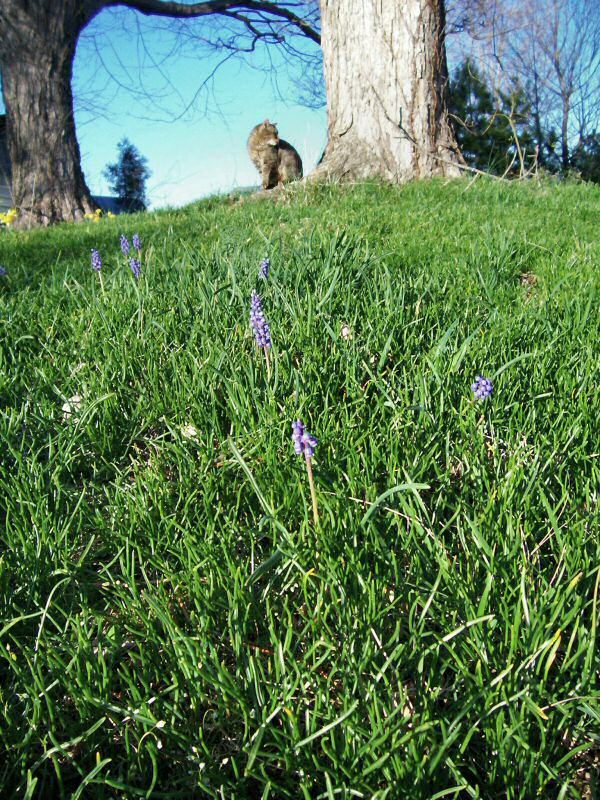
Some folks call these little spring flowers "grape hyacinths". I call them "muscari" because I first learned their name from flower catalogs rather than from talking to people. Muscari is the Latin name for this flower's family, and it's a more melodic and exotic name than grape hyacinth, in my opinion.

I think these are muscari armeniacum, though they seem a bit more purple than many of the photographs I see online. The ones that grow on our hillside are closer to the purple-blue color of the muscari in this photo.

These muscari were planted by the lady who lived here before us. I think she planted a forsythia bush and daffodils and muscari all at the same time, hoping for a little spring color. As time has passed, the bush has grown large and now the flowers come up under its draping branches. I have dug out some of the daffodils and moved them, but I've never tried to dig out the muscari. Some have decided on their own to move out, and they're climbing the hillside.

Some of the green foliage in the photo is grass and some of it is leaves of a small white spring flower that one long-time local resident calls "snowdrops". I think that's an old-time local name. They are different than the flowers called snowdrops on horticulture websites. One of the Mennonite ladies calls them "Star of Bethlehem".

Whatever their real name is, they have naturalized on our 2 acres to the point that I consider them a nuisance. There are hundreds of tiny bulbs in each clump. It has taken me 15 years to get most of them out of my vegetable garden and flower beds.

When I first started digging them out of my areas of cultivation, I tenderly transplanted them thinking they must be a precious little wildflower. Now I callously toss the bulbs out of my garden onto the lawn where the sun can shrivel them up. It's amazing the changes that can occur in one's thinking over the years.
Related Posts Plugin for WordPress, Blogger...

CONTENTMENT: Keep your heart free from hate, your mind from worry, live simply, expect little, give much, sing often, pray always, forget self, think of others and their feelings, fill your heart with love, scatter sunshine. These are the tried links in the golden chain of contentment.
(Author unknown)

IT IS STILL BEST to be honest and truthful; to make the most of what we have; to be happy with simple pleasure; and to be cheerful and have courage when things go wrong.
(Laura Ingalls Wilder, 1867-1957)

Thanks for reading.