Showing posts with label trains. Show all posts

Sunday, October 20, 2013

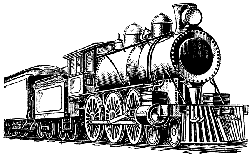
Railroad Building, 1875

Old engraving


I found this image of railroad building in America, Our Country by Smith Burnham and Theodore H. Jack, published by the John C. Winston Company of Philadelphia in 1934. I searched but couldn't find any copyright renewal for this title, so I decided the image was in the public domain now (as well as already being in the public domain when included in this book.)

(Large image: 736 KB)

After doing all that research on the copyright, I drug the picture into a Google image search and learned that there's a zillion copies of it on the internet already. I should have googled it first!

Originally, the image was a wood engraving by Alfred Rudolph Waud (1828-1891,) printed in Harpers Weekly on July 17, 1875. Images like this helped eastern readers imagine the West and the challenge of railroad building.

The Library of Congress describes the scene as a "...large work crew laying tracks for railroad, several covered wagons and other carts and wagons, work camp in the distance, and some soldiers and Natives resting in the foreground." My husband says that if anyone lived in those house-cars, it was the bosses.

Beaumont, Kansas: Railroad Town

A ghost town full of history


Beaumont's wooden water tower held
50,000 gallons of water!
Trains don't pass through Beaumont, Kansas, anymore. After it lost the trains, the little town died, bit by bit, and today, it is a genuine ghost town.  But in the days of steam engines, Beaumont was an important stop on the St. Louis, Wichita & Western Railway. Every train clanked and chuffed to a stop in front of the water tower. The steam engines' boilers had to be refilled, and Beaumont was the place to do it.

Beaumont was created by and for the railroad. The tracks were installed as far as Beaumont in about 1879. The train depot was the first building in town, followed by a general store. In 1880, a post office was established and the Summit Hotel was built. The water tower was built in 1885 (supplying water to the hotel as well as the trains,) and a roundhouse was built in 1890.

 A spur of the railroad ran from Beaumont south to Arkansas City ("Ark City") and into Oklahoma, and the main rail line ran from St. Louis to Wichita and westward.

If a locomotive needed service, it was moved into the Beaumont roundhouse, and a fresh locomotive was moved out and attached to the train. Up to 90 men worked at the roundhouse, servicing train engines and cars. Inside the roundhouse, the locomotives were parked on a giant turntable. The turntable moved the locomotives aside for work or storage and returned them to the tracks when it was time for them to leave.

Across the tracks from the roundhouse and depot, the Summit Hotel welcomed any travelers who needed a hot meal or a room for the night. The trains brought a lot of traffic to and through Beaumont. Homesteaders came west on the trains to settle in the area, and cattle from the Flint Hills were driven to Beaumont, loaded onto the train, and sent east. And there were many other travelers and freight going in both directions. The rails were modern transportation at its best.

The Beaumont Hotel today. I am not sure if the structure
still contains elements of the original Summit Hotel.
The hotel would be at far left in this photo, across the road
from the old store buildings, if I had been able to include it all.

Steam engines were used on the St Louis, Wichita & Western Railway through the early 1950s. In a curious overlap of transportation technology, the hotel added a grass airstrip during that same decade. A customer of the hotel liked to fly from Wichita to Beaumont in his small plane. It was dangerous for local drivers when he dropped out of the sky onto the road, so the airstrip kept everyone safe and happy. After he landed, he taxied into Beaumont, just like any other vehicle. (Keep in mind that Wichita, just 50 miles away, has been a manufacturing center for small planes for many years.)

My sister and I stopped at Beaumont and looked around last summer when we went out to Kansas last summer to visit my brother. These pictures are from that visit. (I admit that I'm "one of those tourists" who is always taking photos of the historic markers.)


Welcome to Beaumont
Story of the landing strip

Historic info about the tower
Hotel renovation in the 1990s

The water tower is listed on the
National Register of Historic Places.
Maybe the pipe was hooked to a
big hose to put water in the boilers?


I haven't come across any information about when the roundhouse ceased operation, but as a casual explorer, I saw no remaining trace of it. A hundred yards of train tracks still lie in front of the water tower, but the rail line was discontinued around 30 years ago.

The airstrip is still there, and the Beaumont Hotel holds a monthly "Fly-In" for small planes. They also hold monthly bike-ins for motorcyclists. They have a  formal dining room as well as the 50s-style cafe pictured below. And they have the great outdoors as well, so they can host all sorts of events. But I think staying at the hotel would be a nice get-away anytime. And if I ever do stay there, I hope the biggest event while I'm in Beaumont will be the tremendous peace and quiet we saw, felt, and enjoyed during this visit.


Tracks that go nowhere
Inside the hotel's restaurant

The Beaumont Hotel lobby has rustic wood furniture and accents.

Hotel boardwalk
The only ghost I saw.
Big shady lawn north of the hotel
Old store buildings
across from the hotel
I always hate to see
an abandoned church.
This handsome little building
may have been the post office.
More about Beaumont:


5 Feb 2014
Scott Shogren of Wichita, Kansas, shared this link to a 1905 map that shows the location of the Beaumont roundhouse. Thanks, Scott!

http://www.historicmapworks.com/Map/US/499092/Union+Township++Cassoday++Beaumont++Page+073+++Right/

The map also shows the location of the hotel and the water tank so I'm able to orient myself from those. The roundhouse was located a couple of blocks east of the hotel, on the north side of the tracks. Livestock pens were located just west of the hotel also on the north side of the tracks.

Scott added, "I remember the Frisco trains. They really sped through that part tracks line."

Wednesday, February 15, 2012

The Dangerous Railroad in 1890

Thousands killed and injured


Passenger Train of the Atchison, Topeka and Santa Fe Railway,
around 1895. Image from Wikimedia.
In 1890, my great-great grandfather Almus Hill, a railroad brakeman, was killed on the job. He slipped while pulling a pin between moving train cars, fell under the train, and was run over.

It was a hideous accident, but not an uncommon one. Coupling and uncoupling cars was part of the job for brakemen, and it was dangerous. 

Researcher Evgenia Shnayde reports that brakemen often lost fingers when the couplings jammed or the cars lurched.
Lost fingers did not end careers. They became the mark of a brakeman; you could recognize one by their missing fingers. Considering the fact that one out of every 120 trainmen—-a railroad category that mostly included brakemen-—died on the job each year, it is not surprising that the majority of trainmen considered the loss of a finger to be a "minor" injury.

Source: A 2010 report, "When the Loss of a Finger is Considered a 'Minor' Injury", by Evgenia Shnayde for the Stanford University Spatial History Project

The truth is that all railroad work was dangerous, including railroad construction. And of course, it was dangerous to jump onto a moving train (as tramps did). But it was also dangerous to ride a train properly or even to be on railroad property. I'm not exaggerating. Here are some astounding statistics about railroad accidents in the United States during the year before Almus Hill was killed:
During the year 1889, accidents on railroads involving human life were:
   Passengers killed: 315
   Passengers injured: 2,138
   Employees killed: 2,070
   Employees injured: 20,148
   Other persons killed: 2,997
   Other persons injured: 8,602
   Total persons killed: 5,282
   Total persons injured: 25,888

But the reports do not cover the total mileage of the country; only 92.792 per cent of it. If the accident rate was the same on the roads not reporting, the total number killed was 5,693, and the total injured 27,888. These are the returns made by the railroad companies themselves, and they cannot well be suspected of exaggeration.

Source: I didn't record (and can't relocate) the source of this clipping, but I saved it from an old newspaper while I was searching for a report of my grandfather's accident.

Saturday, December 31, 2011

The Whistlestop Flasher

Efficient advertising


On the east side of the train tracks in Hopkinsville, when you're waiting for a train to go by at night, you can see the Whistlestop Donuts sign between the cars as they pass. As the train picks up speed, the bright yellow sign flashes at an increasingly urgent rate: "Whistlestop Donuts! Donuts! Donuts!" This phenomenon is not quite a subliminal message (it's not below the threshold of conscious thought), but it does very effectively lure the mind into sugary, deep-fried fantasies.

Sunday, October 23, 2011

The Whistle Stop

And the old freight depot


Whistle Stop Donuts in Hopkinsville (KY) now has two buildings, near each other and (of course) near the train tracks. (In this photo, you can't see the original little Whistle Stop that's right next to the tracks, but it's marked by the yellow sign.). I don't know if they're going to move everything to the building on the left which has a larger parking lot, or if they're going to keep both locations.

On the other side of the train that's whizzing through town, you can see some scaffolding on the old freight depot. The exterior of the building is being restored to its original appearance. Jim Coursey, a local architect and historian, recently wrote in  the Kentucky New Era that the depot is still structurally sound -- in fact, as solid as when it was first built. The metal roof on the building dates back to its construction in 1905, and it still doesn't leak. The Hopkinsville water department owns the property.

Sunday, October 09, 2011

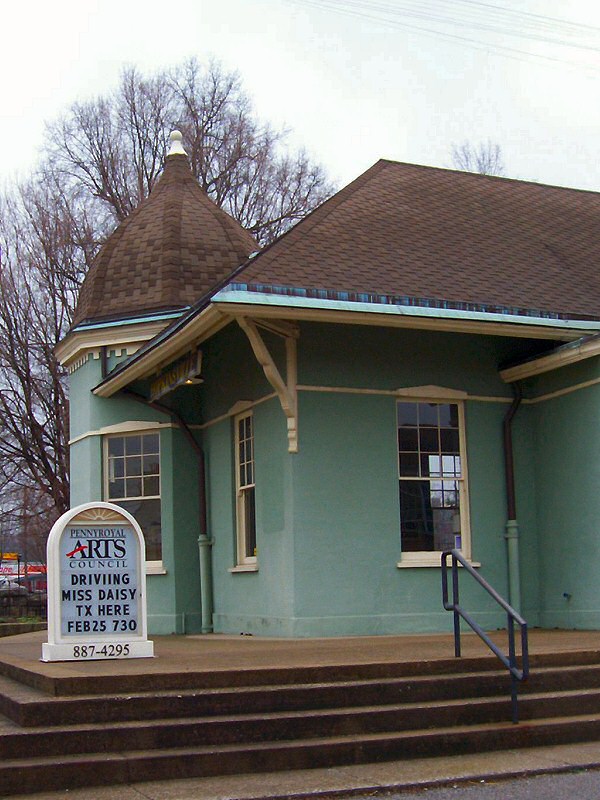
L&N Passenger Depot at Hopkinsville, KY

The depot's floor plan


I found the following description of the L&N passenger depot in Hopkinsville, KY, in Buildings and Structures of American Railroads by Warren Gilman Berg. It was published in 1893, just one year after the Hopkinsville depot was built. Many details mentioned by Berg can still be observed today, but the stucco on the building's exterior seems to have been added since then.

I believe the floor plan of the depot was accidentally reversed in the book, so I changed it (image appears below) to what I think the building is in real life. Readers from Hopkinsville, please correct me if I'm wrong. Also, I altered some of the original punctuation of this passage, and I divided some of the paragraphs to make them easier to read on a screen.  

Tower at the corner of
the ladies waiting room
The passenger depot of the Louisville & Nashville Railroad at Hopkinsville, Ky. is a single-story frame building, roofed with slate.

The main feature of the exterior is the tower at the corner of the ladies' waiting-room and the large circular bay-window projection of the agent's office at the centre of the building, which, combined with the cupola on the corner tower, the ridge-cresting and ornamental gable fronts, together with the general finish of the building, causes it to present a very handsome appearance.

The "circular bay-window projection"
of the agent's office next to tracks


The ground-floor is divided into:
  • a ladies' waiting-room, 17 ft. X 20 ft., with an octagonal alcove inside the tower at the corner of the room;
  • a ladies' toilet-room, 5 ft. X 8 ft. 6 in.;
  • an agent's office, 14 ft. X 17 ft., with ticket-windows leading into the ladies' waiting-room, the general waiting-room, and the colored waiting-room;
  • a colored waiting-room, 14 ft. X 14 ft.; 
  • a general waiting-room, 20 ft. X 24 ft.; and 
  • a baggage-room, 16 ft. X 18 ft. 

Note: The platform and train tracks were on the east side of the building.
"Colored" people had to walk around the bulding to reach the boarding area.


The exterior of the building is sheathed with horizontal and upright ornamental boarding, in panels, ornamental shingles and square panelling frieze-work and gable fronts. The doors leading into the ladies' waiting-room and the general waiting-room are double doors, 5 ft. X 7 ft. 6 in., with transom overhead. The lower sash of the windows have one large pane of glass, while the upper sash are surrounded with a border of small stained-glass lights.

Double doors with transom
in the baggage room
Ticket office window seen from
ladies' waiting room
These photographs have appeared on Prairie Bluestem previously. See related posts:
Seen at Hopkinsville's L&N Depot
Hopkinsville's Railroad

Monday, November 30, 2009

I Hear the Train A Comin'...

It's rollin' round the bend.


The CSX crossing on Skyline Drive in Hopkinsville, KY

When the railroad crossing arms drop in front of me, I consider it a challenge to get a photo of the train. This freight train was traveling fast. I was surprised that I got my camera out of my purse, rolled down the window, and clicked the shutter in time to catch the locomotive.

The title and subtitle of this post are the first two lines of "Folsom Prison Blues", a song Johnny Cash wrote in 1951, the year I was born. On YouTube, I found over 5000 search results for "Folsom Prison Blues." Many have sung the song; some sang it better than others.

Here's a good, undated video of Johnny Cash singing "Folsom Prison Blues".  It's an interesting contrast to a younger Johnny Cash singing "Folsom Prison Blues"  in 1959.  He picked up steam with that song as the years went by.

In a video of Johnny performing "Folsom Prison Blues" at the Tennessee State Penitentiary in 1974, he appears to be using the Martin guitar that I photographed at the Country Music Hall of Fame museum.

Well if they freed me from this prison,
If that railroad train was mine
I bet I'd move it on a little farther down the line
Far from Folsom prison, that's where I want to stay
And I'd let that lonesome whistle blow my blues away...

(Johnny Cash, 1932–2003)

Johnny Cash's guitar
Johnny Cash's battered and scratched Martin guitar

Saturday, August 15, 2009

CSX at Skyline Drive

Freight train, freight train, goin' so fast


Many of the freight trains that roll through Hopkinsville seem to be several miles long. The tanker cars above were near the end of a northbound train. The hopper cars below rolled by a bit earlier.

It was a long train. I waited at the railroad crossing for quite a while. Finally, I decided to try photographing the cars as they passed. I always think that if I missed the engine, I missed the best photo I could have had. That might be a wrong idea. I like the industrial look of these photos.

Tuesday, January 06, 2009

Missionary in a Cow Town

Wild days on the Nebraska frontier


Whitman, Nebraska, the end-point of the B. & M. railroad in the late 1880s, was a rough little frontier town with stores, saloons, dance halls, corrals, and a train station. All the ranchers for many miles around drove their cattle to Whitman to ship them to market.

In his 1921 memoirs, Trails of Yesterday, pioneer rancher John Bratt tells an interesting story about Whitman. An elderly preacher came to the little prairie outpost with deep concern for the souls of the cowboys, railroad workers, gamblers, outlaws, fallen women, drifters, and others who frequented the town's establishments.

Mr. Bratt describes a rowdy scene in a dance house. The old preacher was being forced to dance with a drunk woman, and cowboys were shooting at his feet to make him step higher.

[The old preacher] stood it all good-naturedly until completely exhausted. He got into one corner of the hall and sat down on the floor. After resting a while and during a lull in the dancing, the old man got upon a gambling table and commenced to talk to the crowd. He said he had attended their dances every night and done everything they wanted him to do, including many things that were not right. "Now," he said, "with your permission and God's help, I will hold service in this hall to-morrow, Sunday night," and asked them all to come. They told him they would be present. I could not help but admire the old man and told him I would remain with the cowboys from our round-up camp and would personally help him all I could.


The next morning, Mr. Bratt borrowed an organ from the stationmaster's wife and pursuaded her to play it for the service. He also cleaned up the dance hall and secured a promise from the owner not to sell liquor during the service.

A crowd gathered in the dance hall that evening. The preacher stood at a table with a lamp, a Bible, and a hymnbook, and spoke from his heart. Then the hymn, "Rock of Ages", was sung.

Tears came to the eyes of some of the women and all seemed deeply interested, until some one shot the lamp to pieces on the table. This mean act incurred the displeasure of nearly all present. Another lamp was secured and "Doc" Middleton walked up to the side of the old preacher and said, "Whoever did that was damn mean and if he does it again, I'll kill him." The man who shot the lamp left the hall and the service proceeded without further interruption.

At the end of the service, the group passed a hat for the old fellow, and $130 was given. The next morning, having accomplished his mission, the preacher got on the train and went back east.

Doc Middleton was well known as a horse thief, of course, but many people liked and respected him. He was gifted with natural charm, and he enjoyed a Robin Hood reputation of stealing from the rich and giving to the poor. This story speaks well of him, I think.

About the others who attended that Sunday service, Mr. Bratt wrote:

The cowboys and I came on to the round-up camp on the Dismal River where we had left it. On the way some of the boys talked freely and regretted what they had done and promised to do better.

- - - - - - - - - -

Quotations in this post are from Trails of Yesterday (pages 275-277) by John Bratt. Published in 1921. Try the "Flip Book" of this text.

Thursday, July 24, 2008

Seen at Hopkinsville's L&N Depot

Old depot in Hopkinsville, KY


I took care of two neighbor ladies' flowers and their seven dogs for several days over the past weekend, When the ladies arrived back home again, they insisted on taking me out to eat. We went to the Thai restaurant (the Main Street Grill on Ninth) in Hopkinsville .

After lunch, we stopped at the old L & N Depot, now the Pennyrile Arts Council building, and viewed the photos on exhibit. Three photographer friends have put together a show: "A Yank, A Canuck and A Southern Belle." (The Yank is Jeremy Easley, a native of Illinois; the Canuck is Judy Campbell, a native of Canada; and the Southern Belle is Nancy Stalls, a native of Murray, Kentucky).

I enjoyed the photographs and equally enjoyed looking around the old train depot. (It was built in 1892.) I've been in the depot before to buy tickets for the Alhambra Theater, but it's been a while. Out of respect for copyrights, I didn't do any closeups of the photos, but here are some general views around the depot.

The photography exhibit was held in the depot's southmost room. The windows in the east wall look out onto the platform and train tracks.  A large door facilitated the loading and unloading of  luggage and parcels.

On the opposite wall in the exhibition room, the windows look out onto the parking lot. With large windows on both the east and west sides of the building, the depot has an abundance of natural light. I didn't have to use a flash for these photos.

A setting of  L&N dinnerware and a diner-car menu are displayed in a glass case in the lobby.In the reflection, you can see one of the neighbor ladies, making a call on her cell phone. She was arranging to purchase one of the photographs in the exhibit.

The Wikipedia entry for Hopkinsville's L&N depot says the ticket office connected to three waiting rooms -- the ladies' waiting room, the colored waiting room, and the general waiting room.  One of the ticket windows can be seen in the photos at left.

The rooms in the north end of the building are used for offices. The depot has two of these little rounded-out rooms on its train-tracks (east) side.  Photos of the building's exterior can be seen in a 2006 Prairie Bluestem post, "Hopkinsville's Railroad".

Saturday, April 19, 2008

Old L & N Freight Depot in Hopkinsville, KY

Where the cats hang out


L&N freight depot in Hopkinsville, KY

This is the east side of the old L&N freight depot in Hopkinsville, Kentucky. Most recently, a portion of it was used as a video store. As far as I know, the building is now unoccupied.

When the depot was in active use, the docks on the east side of the building (photo above) were used for loading freight that was leaving the depot and for unloading freight that was arriving to be shipped.

L&N freight depot in Hopkinsville, KYThe train stopped beside the freight docks on the opposite side of the building to load and unload. It appears that the docks had big sliding doors that could be closed and locked (photo at right.)

The L&N passenger depot was a little farther down the tracks -- the gray-green building on the right. When the train stopped, passengers could get on and off while the freight was being handled.

A soft heart for cats


On the morning that I took these pictures, I saw ten or so feral cats gathered at the rear of the building. Soon, a man pulled up in a Jeep Cherokee and filled some water and food dishes under the steps (left photo below.) Then I realized that the cats were waiting for him.

The cats and their caretaker reminded me of an article that was in the newspaper a couple of years ago. When I got home, I looked it up. The man whom I saw is surely the man whom the newspaper article was about -- Wallace Henderson, who feeds the feral cats of downtown Hopkinsville in several locations. One of the places the newspaper article mentions is the old L&N freight depot:

Next, from Clay Street, Henderson heads for the old L&N freight station on Ninth Street. The cats slink behind a fence and hurdle across the railroad tracks when he arrives.

Henderson is content to let the cats watch him from a distance. They are too wild to trust him.

"I have not named any of them, but I am concerned if I don't see one that I am used to seeing," he says.

At this spot, the cats eat from a dry spot below a set of metal steps. It looks like rain today, so Henderson pushes the food bowl well beneath the steps.

Quoted from "Feline Feed" by Jennifer P. Brown, Kentucky New Era, December 19, 2006. (Subscription required.)


At the time the article was written, Mr. Henderson said he had been feeding the cats for ten years. If you look closely at the small photo above, at right, you can see one of the cats crossing the railroad tracks after he has had his morning snack.

Feral catsFeral cats


Related post: Hopkinsville's Railroad

Saturday, September 22, 2007

Changing Trains in Guthrie, KY

Guthrie's passenger train days described in old stories


TrainI've happened upon a couple of interesting passages about changing trains at Guthrie, KY.

"A Special Providence" is the story of Mrs. Melissa Allgood, who is on the train alone. She's a 34-year-old widow who has been traveling with a Holiness band, singing in the towns of central Kentucky. She listens sympathetically to the problems of another traveler, an old gentleman, and before long, he announces that God wants him to marry her when the train stops in Guthrie. The tale of his pursuit and her escape appear in an amusing book, Stories of a Sanctified Town, written by Lucy S. Furman and published in 1896 by the Century Company, New York.

Lucy S. Furman was a Kentucky writer. She wrote Widow Allgood's story in a dialect that is amazingly authentic, to this day. (Let me just be blunt: I mean that some people still talk that way!)
Lucy Furman (1870-1958) was a novelist whose writing has considerable charm even today. Born in Henderson and graduated from Sayre Institute in Lexington, she spent much of her life in Hindman as a house-mother at the Hindman Settlement School. After she left Hindman she became a crusader against cruelty to animals. The Lonesome Road (1927) is often cited as the strongest of her five novels.

Source: KYLIT - A site devoted to Kentucky Writers


The other story of changing trains in Guthrie is not so funny. Two Tennessee lawmen are transporting a prisoner to Nashville, but they must change trains at Guthrie, KY, just across the state line. As they wait for the Nashville train to arrive, they discuss whether they have any legal authority while they are out of the state of Tennessee. This chapter is titled, "A Noted Individual Shuffles Off This Mortal Coil and Leaves the World None the Poorer", and it is part of The K. K. K., a fiction written by C.W. Tyler and published in 1902 by the Abbey Press, New York.

C.W. Tyler was a judge in Clarksville, TN, just 30 miles or so from where I live. He would certainly have known all about going to Guthrie to get on the train to Nashville. His book, according to a 1904 New York Times review, demonstrates the flaws of vigilante groups and of conventional law enforcement, but suggests that a responsible K. K. K. "is at least excusable in exercising a sort of fatherly care over the community." I wonder how many times Judge Tyler stretched or ignored the law in favor of the Klan.

I am sure that all sorts of people passed through the depot at Guthrie.

Related post: Guthrie, KY: A Railroad Town

Technorati tags: , , , ,

Friday, September 21, 2007

Guthrie, KY: A Railroad Town

How trains have shaped the history of Guthrie, KY


R.J. Corman railroad at Guthrie, KYFreshly painted locomotives in Guthrie, KY


Railroads made Guthrie, Kentucky. Several major rail lines intersected in southern Todd County, on the Kentucky and Tennessee state line, and the city of Guthrie grew around the tracks.

The beginning of the railroad era


The Tennessee Encyclopedia of History and Culture gives the following information about railways that ran through Guthrie, even before the Civil War.

Nashville gained rail access to the North through Kentucky. Louisville city subscriptions and Tennessee state aid financed the Louisville and Nashville (L&N), incorporated in Kentucky in 1850... Completed in 1859, it hosted an excursion intended to preserve the Union... The Edgefield and Kentucky (E&K), completed in 1860, ran from the Nashville suburb of Edgefield to Guthrie on the Kentucky boundary.

Memphis also established railroad access to Louisville: the Memphis and Ohio (M&O) ran from Memphis to Paris; the Memphis, Clarksville, and Louisville ran from Paris to Guthrie; and the L&N constructed a branch from Bowling Green to Guthrie."

Quoted from The Tennessee Encyclopedia of History and Culture


Shortly after the L&N completed its line to Nashville in 1859, the Civil War disrupted the region. During the war, the Union controlled the area in which the L&N operated, and the railroad made a lot of money transporting U.S. troops and supplies.

Guthrie becomes a railroad boomtown


Opera House, Guthrie, KentuckyOpera House, Guthrie KY
When the war ended and reconstruction began, the L&N Railroad had plenty of cash on hand to expand dramatically throughout the South. The surge of investment in infrastructure paid off in an immense increase in traffic on its lines, bringing many trains through Guthrie at all hours of the day and night. Businessmen recognized the opportunity to provide goods and services to travelers and shippers, and Guthrie became a railroad boomtown.

In 1879, the city of Guthrie was chartered. It was named for John James Guthrie, the L&N Railroad President. The railroads prospered for many years, and Guthrie also prospered. Fine homes were built, and the business district was lined with stores, saloons, a hotel, and even an opera house.

Five railroad lines that met in Guthrie were:
- the L&N St. Louis-Evansville-Nashville line
- the L&N Louisville-Memphis line
- the L&N Guthrie-Bowling Green branch
- the Edgefield and Kentucky Railroad
- the Guthrie-Elkton (KY) spur (chartered in 1883)

Hard times for the railroads


Rail travel and shipping declined during the mid-1900s. The rail companies labored under out-of-date FCC regulations, a loss of travel and shipping to the new Interstate highway system, an increase in air travel, and the loss of railway post offices. These problems led to major restructuring and consolidation. Many railroad lines closed in the 1960s. 1970s and 1980s.

Congress could not agree whether to subsidize, nationalize, or deregulate the remaining passenger lines, so nothing was done. Finally, in 1970, Amtrak was formed and most of America's railroads turned their passenger service over to it. In 1980, an important railroad bill, the Staggers Rail Act, was passed, and with deregulation, freight lines were able to operate at a profit again.

R.J. Corman locomotive in Guthry, KYR.J. Corman locomotive
in Guthrie KY
The Elkton-Guthrie line closed in 1957. The L&N was merged into the Seaboard Coast Line Railroad in the early 1970s and eliminated its few remaining passenger lines in 1979. After another merger, the CSX railroad company assumed control of the former L&N rail system. The City of Guthrie's website states that the population of Guthrie dropped by 50% in a single year, sometime (no year given) during all this restructuring.

Railroads in Guthrie today


I've become quite curious about Guthrie lately, and this has led to my research of its history. We bought a used car for Keely in Guthrie, so we've made several trips there in the last month. I've had a chance to loiter about the town, admire the old houses and buildings, and note the presence of the train industry to this day.

R.J. Corman locomotive in Guthrie, KY
Front end of an
R.J. Corman locomotive
The R.J. Corman Railroad Company has a shop in Guthrie. They usually have a freshly painted locomotive on the tracks in front of it. R.J. Corman operates a short-line railroad from Bowling Green, KY, to Zinc, TN, that passes through Guthrie.

The CSX Railroad Company, heir to the L&N railroad, has an office and shop in Guthrie also. Trains still rumble through the town regularly.

L&N caboose in Guthry, Kentucky
L&N Caboose in Guthrie, KY
The L&N Railroad's role in Guthrie history is honored in a little downtown park where a cheery red L&N caboose is displayed. The depot was torn down long ago.

I'll write more later about some of the efforts Guthrie is making to revitalize itself after enduring the changes in the railroad industry.

Related:
"Southbound in the Snow" -- train pictures taken near Guthrie
Songs by Mickey Newbury that mention Guthrie
More train pictures from Guthrie
Many L&N Railroad photos

Technorati tags:, , , , , , ,

Thursday, July 19, 2007

Railroad Bridges of St. Louis in 1920

St. Louis, a shipping and industry center of the Midwest in 1920


This description of the city of St. Louis, Missouri, is from my 1920 geography book:

The largest city on the rivers, corresponding to Chicago on the lakes, is ST. LOUIS, the fourth in size among our cities. It has a very favorable position in the center of the Mississippi Valley, on the Mississippi River near the mouths of its two largest tributaries.

The railway bridges across the Mississippi at this point have also had great influence on the growth of the city. It is an important shipping point both by water and by rail.

Like Chicago, St. Louis is one of our leading markets for grain and live stock; but being so far south, it handles Southern products also, especially cotton and tobacco.

Besides this, it is a great manufacturing center. It manufactures immense quantities of tobacco, beer, flour, clothing, iron, steel goods, and is the greatest manufacturing center of boots and shoes in the United States.

Source: World Geographies: Second Book (pp. 125-126) by Ralph S. Tarr and Frank M. McMurry. Copyrighted in 1920 and published by the MacMillan Company, New York, in 1922,


It's hard to imagine a big city like St. Louis depending on ferry boats to bring goods across the river, but that was the case until the Eads Bridge was built in the 1870s. In those days, ferry and steamboat companies fought against river bridges, fearing that their business would suffer.

In 1866 (just after the Civil War), Congress passed a law that specified minimum bridge height and span requirements to insure that river traffic would remain unobstructed by bridges. One of the bridges authorized in the act was the St. Louis Bridge that later became known as the Eads Bridge for its builder, James Eads.

Eads Bridge, completed in 1874, was the world's first steel truss bridge, a masterpiece of civil engineering. Its foundations were set on bedrock, and the length of its three spans (two are 500 feet and one is 520 feet) were unprecedented. It could carry two trains simultaneously on its lower level, and it carried vehicular and pedestrian traffic on the upper level. The Eads Bridge has been renovated and is still in use today.

The Terminal Railroad Association (TRRA) acquired ownership of the Eads Bridge shortly after it was built. For about 15 years, TRAA enjoyed a monopoly over rail traffic across the Mississippi for about 15 years. Finally, Merchants Bridge was built by a group of merchants who were tired of exorbitant freight rates. It opened in 1890.

For a few years, freight rates were more reasonable. However, following the Panic of 1893, Merchants Bridge was acquired by TRAA, and freight rates regained their former heights. In fact, freight rates were so high that ferries remained an alternative method of getting goods across the river into the 1920s. (Source.)

Merchants Bridge and its approaches were renovated in 1998 and 2005 to accommodate the heavy, tall freight of today's trains. It remains in service.

The McKinley Bridge opened in 1910. It is named for its the president of the company that built the bridge. It joined north St. Louis and Venice, Illinois. Automobile lanes were added to it during the 1930s (for the famous Route 66), but it was built as a railway bridge. It remained an important railroad crossing over the Mississippi until rail traffic decreased in the 1960s. Currently, McKinley Bridge is closed for renovation, but it is supposed to reopen for highway, bicycle, and pedestrian traffic in late 2007.

These are some of the early bridges that enabled St. Louis, Missouri, to become an major Midwestern crossroads of shipping by rail as well as by water. The ability to ship goods encouraged the growth of industry, and industry fueled the expansion of shipping. This is why the geography book's authors wrote, "The railway bridges across the Mississippi at this point have ... had great influence on the growth of the city."

Interesting links:
McKinley Bridge
Merchants Bridge
Eads Bridge
The Eads Bridge
Antique St, Louis Bridge Company stock certificate
Bridging the Ohio, Mississippi, and Missouri
Library of Congress Exhibit on Eads Bridge
St Louis Fun Facts and Trivia at about.com
Old Merchants Bridge postcard
PBS Video tour of the Eads Bridge in St. Louis

Interesting bit of trivia: The first bridge across the Mississippi at Hannibal, MO., was completed 3 years before the first bridge at St. Louis.

Tuesday, July 10, 2007

Hopkinsville, Kentucky, in 1907

Hopkinsville, 100 years ago


The following paragraphs about Hopkinsville, Kentucky, were written 100 years ago for the Handbook of Kentucky ("The Seventeenth Biennial Report of the Bureau of Agriculture").

I've added some relevant photos from past Prairie Bluestem posts. The notes below each photo are linked to the post the photo originally came from.

It's interesting to think how advanced Hopkinsville was in 1907, when many homesteaders of the Great Plains were still proving up on the land they obtained through the 1904 Kincaid Act.

Bar
HOPKINSVILLE
Revised 1907 by Chas. M. Meacham, Mayor


Hopkinsville, the county seat of Christian County, KY, is two hours travel by Louisville & Nashville railroad from Evansville Ind., and Nashville, Tenn., and seven hours from Louisville.

The Louisville & Nashville and Illinois Central railroads intersect here, traversing the best coal, grain and tobacco lands in western Kentucky.


The white graded schools, three buildings, have 1400 pupils; colored public schools, 1300 pupils. Two flourishing colleges, Bethel Female, for young ladies and South Kentucky, for both sexes, and other private schools and also a college for colored people. There are ten white and seven colored churches, representing the leading denominations.

Hopkinsville has one national, three State and one savings bank; capital, $380,000, deposits July 1, $1,800,000. Seven tobacco warehouses, four stemmeries and rehandling houses, branch factories of two of the largest tobacco companies in the world; wagon factory, lawn swing factory, three cigar factories, and one canning factory.


We have a handsome opera house and a brick tabernacle for large gatherings, seating 5,000 people.

Hopkinsville has water works, gas works, electric lights and an automatic alarm system, the best in the State. The waterworks for fire, by pressure, throws two streams 100 feet. We have also a wagon, two ice, brick and lime factories, large planing mill, four merchant flouring mills turning out 2000 barrels a day, a steam laundry and dye works and two telephone exchanges.


The hotels are excellent and unsurpassed anywhere in the State. We have prosperous home building and loan associations, six newspapers and the handsomest business houses in Western Kentucky.

Western Asylum for the Insane, with a population of 1,300, is located within one mile of the city and spends $150,000 annually.

A belt line railway has just been completed through the manufacturing district.


The dry goods and grocery trade amounts to $250,000 annually.

The city is famous for culture, good order and healthfulness. New manufactories are free from city taxes for five years. There are over twenty miles of excellent macadamized streets, 110 miles of free turnpikes, extending into fine farming sections, and at least eight miles of sewerage system.

Source: Handbook of Kentucky by Hubert Vreeland, Kentucky Bureau of Agriculture, Labor and Statistics. Published in 1908 by the Globe Printing Company of Louisville, KY.

Bar
Related posts:
Mogul Wagons
More About Mogul Wagons
Signs of Days Goneby
Peace Park in Hopkinsville
Prejudice and Segregation
Also check the "Local history" tag below.

Technorati Technorati tags: , ,

Related Posts Plugin for WordPress, Blogger...

CONTENTMENT: Keep your heart free from hate, your mind from worry, live simply, expect little, give much, sing often, pray always, forget self, think of others and their feelings, fill your heart with love, scatter sunshine. These are the tried links in the golden chain of contentment.
(Author unknown)

IT IS STILL BEST to be honest and truthful; to make the most of what we have; to be happy with simple pleasure; and to be cheerful and have courage when things go wrong.
(Laura Ingalls Wilder, 1867-1957)

Thanks for reading.