Showing posts with label trees. Show all posts

Monday, July 22, 2013

Messages from our Mennonite Neighbors

Bible verses along the roads


"Remember thy Creator in thy youth."


"Choose this day whom you will serve."
Over the past year or so, several signs with Bible verses have been posted along local roads by our Mennonite neighbors. I don't know whether the signs are a church project or individual efforts. Some of the signs are similar in size and style, so maybe they came from the same supplier.

The signs are written in English so they can be read by most people who pass by.  But actually, the Mennonites usually read the Bible in German.  Their Heilege Schrift (Holy Scriptures) is/are written in "Bible German," a form of High German that's different from the Pennsylvania Dutch they speak at home. Mennonite children learn Bible German along with English, as part of their education.

"Honor thy father and mother."
A young Mennonite neighbor lady once told me that "sometimes we look in the King James Bible" if a passage in the Mennonite Bible is hard to understand. I am not sure if she was speaking for all or just speaking for her own household.  The archaic English of the King James Version is surely as difficult as Bible German, but the Mennonites probably assign extra virtue to the KJV simply because it is old.

But let me get back to the signs around the neighborhood. I respect our neighbors for trying to "be a good light". (A Mennonite neighbor lady, telling me how Mennonites should live, used that phrase.) But I do wish they'd put the signs on posts instead of nailing them to trees. These trees growing wild in the fence rows aren't particularly valuable, and they'll probably survive the nails, but it still bothers me. I hate to see things nailed to living trees, no matter who does the nailing.

"Repent & be converted that your sins may be blotted out."
"God will judge the world in righteousness."

Sunday, February 01, 2009

Ice Storm Photos

We're OK, but the trees aren't.


Our electricity went out about 11:00 a.m. on Tuesday, January 27, after the first night of freezing rain. Rain continued to fall throughout the day, melting the ice on the road, but forming icicles 4 to 6 inches long on tree branches that were already encrusted with half an inch of ice.

Breaking tree branches


The electricity came back on for about 45 minutes late in the afternoon and then went out for good. The temperature remained at 32°, and the rain continued to fall. As it grew dark, ice began to freeze on the roads again and the trees began breaking. It was terrible to hear the thunderous cracks and snaps, like gunshots, as the limbs broke. The breaking continued all night.

Some tree limbs hit our house, but fortunately, we don't think we have any damage. I've heard several stories of trees that went through roofs and windows. The bottom left photo above was taken Wednesday morning through our big living room window.

I didn't go to work on Wednesday because we had tree limbs blocking the way out of our yard and a tree down between our house and the highway. Dennis and the neighbors got all that cleared out Tuesday afternoon after the snow quit.

Some electricity restored

A retired electrical worker who was summoned back to work came through the neighborhood on Thursday, fixing what he could from the ground. He replaced the fuse in a transformer at the head of our power line, and our neighbor Clarence's power came back on.

However, the repairman couldn't help the other three families on this line. The main power line that serves us is broken and on the ground, in the field past Clarence's house. We also have an electric pole that is leaning, and the wire that leads to our house is damaged where it hooks onto the pole.

On Friday, Clarence (bless his heart!) ran an electrical line to our house from the old barn where he has his workshop, near one edge of our little property. We brought the line into the house through the dryer vent so we wouldn't have to keep a window or door open. There's a breaker box on the barn end of the line, and on this end, an outlet.

We plugged a heavy-duty GFCI/circuit breaker outlet (like construction guys use) into the outlet. If it starts to get hot because we have too many things plugged in, the circuit will break immediately. So far, no problems. We are running the refrigerator, one lamp, and at times, the computer. We have also run the washing machine, with everything else unplugged.

The simple life

We don't know when our "real" electricity will be back in service, but what we have is a great improvement from not having electricity at all. We are in pretty good shape compared to many. We have both wood and propane heat, and our water has not had any problems. We can heat water and our food on the wood stove.

Life after dark has been centered in the single room that has light. While we were using the oil lamps, I went through a big stack of magazines and clipped what I want to save. Now that we have an electric light, we've been doing a jigsaw puzzle. The radio was a vital source of information during and after the storm. Now that we can run the computer, we feel less isolated and better informed.

Keely's power came on Saturday morning about 10:00 a.m. Her house got down to +25° inside on the coldest night, but she didn't want to leave the cats. She survived with lots of blankets, but she was very, very happy when the electrical crew showed up at her house at last.

Recovery

We have a terrible mess in our yard -- many branches on the ground and more dangling from the trees. There's also a limb on our roof. Dennis worked a little on Saturday with the chain saw, but it was too dangerous with the ice falling from the trees. Now all the ice is down and melted, so we're going to work hard on the branches tomorrow.

School is cancelled again on Monday in Christian County and neighboring counties. I believe a couple of the schools still don't have electricity and Dennis said the school-cancellation phone call said something about secondary problems in some other schools after the electricity was restored.

Much more could be told, but this post is long enough. I'll try to write about the ice storm stories I've heard from other people in another post.

Saturday, January 17, 2009

Make Your Photo into a Jigsaw Puzzle

One more way to waste time and have fun online


Dogwood in January, Christian County, KY


I uploaded this photo to Jigzone and made a 48 piece puzzle of it. I've linked to the puzzle at the end of this post, and I hope you'll give it a try. I guarantee that solving it will take your mind off the economy for a few minutes.

Thanks, Gloria, for sending the Jigzone link. I'm not going to say how long it took me to solve the Puzzle of the Day. My time was a little more than average, but after all, it was my first attempt.


Dogwood Jigsaw Puzzle

Saturday, November 15, 2008

Autumn Color

Maple leaves


It's a bleak, damp day in western Kentucky, but the maple leaves are still glowing with color. The dark redcedar is a perfect backdrop.


Saturday, October 18, 2008

Audubon State Park

Camping at Henderson, KY


Another pleasant outing in the faithful Coleman tent


John James Audubon, noted American ornithologist, lived at Henderson, KY, from 1810-1819. Today, the Audubon State Park preserves some of the old-growth forest where Audubon roamed along the Ohio River, observing the birds and collecting specimens to paint.

Isaac and I camped two nights at Audubon State Park, while we were sightseeing at Henderson, KY, and Evansville, IN, last week. Isaac had just three days free from both work and school. Dennis was still obligated at his job for part of that time, so Isaac and I went by ourselves.

The Audubon State Park campground is near the Ohio River, just off Highway 41 at Henderson. In fact, the traffic on the busy highway is clearly heard at the campground. Nonetheless, it's a beautiful site with tall trees and many squirrels. We were the only tent-campers there, and there were only about half a dozen RVs.

Isaac really likes camping, and Boy Scouts deserves the credit for it. I'm glad that he has a wholesome hobby that he can pursue all his life. When I camp with him, we don't rough it too much. We get a site with electricity so we can hang the "trouble light" in the tent for reading after dark.

This time, I also brought along a tiny television set, so I could see the McCain vs. Obama debate. To my surprise, half a dozen stations came in clearly with the small antenna. I watched most of the debate while reclining on my air mattress in the tent. Near the end, rain began falling, so it seemed prudent to unplug the extension cord and listen to my little radio instead.

Our campsite was under several black walnut trees. We set up the tent at the edge of the walnut area, but we still had to clear a spot by kicking dozens of black walnuts out of the way.

Whenever the squirrels ran through the treetops, the walnuts rained down. We weren't hit by any of them, but one did fall on my car's hood so hard that it made a little chip in the paint. Oh, well. That's a hazard of parking near walnut trees this time of the year.

The museum in the park has some of the Audubon sketch books, original paintings, and early prints. It's quite interesting. I didn't take any photos because there's a sign at the museum entrance that says, "No Cameras."

One interesting thing I learned at the museum was that Audubon set very high standards for himself. He went through his work every year on his birthday and destroyed everything that was not up to his current level of painting skill.

Like every other Kentucky state park I've visited, much of the infrastructure at Audubon State Park was put in place by CCC and WPA workers. The museum (photo below) was built in 1938 as a WPA project.

Next time we camp at Audubon, I want to hike some of the trails to see more of the forest. This park deserves more time than we were able to give it on this trip.

Wednesday, July 30, 2008

Homeowner Regrets We Don't Have

Houses we didn't buy


When Dennis was transferred to Fort Campbell, we became first-time home-buyers.  We were living out of suitcases in a hotel room with two little children, and Dennis was working midnights.  And we had a limited number of days that we could stay in the hotel with our expenses paid.  Naturally enough, we were desperate to find a place quickly.

Could have moved to Dover...
 
After our first session with a realtor, we thought about buying a little house near Dover, TN. It was an older home, but the owner had remodeled it nicely. It sat on five acres, and it had a small horse barn. A little creek ran through the back yard, barely fifty feet behind the house. We liked the house, but it just didn't have enough bedrooms for us.

Now that I'm enlightened about how streams can rise in this country, I am thankful that we didn't buy that house. I'll bet that little stream gets out of its banks frequently. Every time it rained heavily, I would have worried about the kids falling into that flooded creek!

Could have moved to Lafayette...

We looked at another group of houses with another realtor, and we liked a little house in southwest Christian County, near Lafayette, KY. In some ways, it was the house I'd always wanted. It was white with a big front porch. The rooms were fairly large, and there was an old-fashioned feel to the place. However, there was hardly a tree on the five acres, and the neighbor just over the fence had the most junk piled in his yard that I've ever seen around a dwelling.

Despite its shortcomings, we tried to bid on that little white house, but someone else got a bid in first and bought it. It's just as well. The junky neighbor next door would have been a perpetual irritation, and without trees, that little house must have been like an oven in the summer sun.

But here we are, instead

Instead, we bought the house where we live -- a brick ranch house built in the 1960s. We've had various homeowner problems, but one thing we've never worried about is flooding. Our little property is located on the edge of a broad ridge. A steep quarter-mile downhill slope starts at the edge of our front lawn. Excess surface water can't help draining away. It gets soggy up here sometimes, but we'll never be flooded. 

Another thing we've never worried about is junky neighbors. Our two nearest neighbors are Mennonites. Their farmyards are quite tidy. We try to keep our grass mowed so they won't be embarassed when their Mennonite friends visit. Thank goodness we only mow about an acre. I wonder why we ever thought we wanted five acres?

When our children think back about their childhoods, I think they'll remember the trees here. Their playhouses were under the big old trees where the log house once stood. Their swing, hung from a high branch, carried them over the bank and high into the open air. They lay on the trampoline on summer evenings and watched the hummingbirds in the mimosa blossoms. They raked huge leaf piles in the fall and played in them.  And how could they forget all the acorns and tree seedlings their dad has planted and how the new trees have grown over the years?

This is the story of how God led us to a house that was right for us. It's not a palace, but it was a good place for our kids to grow up.  We hope to continue living here for quite a while.  Now that we own the place free and clear,  Dennis says the only way they're moving him out of here is in a pine box.

Saturday, April 12, 2008

Wild Cherry Blossoms?


Spring blossoms?

I think that these may be wild cherry blossoms. They grow on a spindly, scrubby tree, about 15-20 feet tall, on a dry hillside in the fence row. The blossoms look very similar to wild plum, but I don't think it's a plum bush/tree because it's so much taller than they usually grow. If the little tree ever has fruit, the birds apparently get it before I notice it.

Thursday, October 25, 2007

Yellow Maple Leaves Make Me Happy

How does yellow make you feel?


Yellow sugar maple leavesOur old sugar maple has taken on its autumn color. It's always very, very yellow.

I am mildly fond of yellow, in subdued tints and shades, but I do not like a lot of intense yellow in my clothing or my home. However, I think this tree is beautiful, and when I stand beneath it and bathe in its golden glow for a few minutes, I feel happy.

The yellow color of these leaves brings back some nice memories of the kids raking up huge heaps of leaves and jumping into them from their swing. Our old kitty, Happy, who was young then, loved playing in the leaves too. He liked to be covered up, and then to spring out and "surprise" everyone.

My happy feelings about these yellow leaves made me wonder what the psychological effect of yellow is supposed to be. I won't claim that I conducted exhaustive research, but I did read a few webpages on the topic of color psychology, and here's what I found. Negative effects are noted in italics.

  • Yellow in the American culture: Sunny, cheerful, inspiring, high spirit, caution, cowardice (Source)
  • Connotations of yellow in Western cultures: Happy, friendly, optimistic, cowardly, annoying, brash (Source)
  • Yellow in the home: Sunny, energetic, creative, intellectually stimulating, friendly, inviting. Deep shades "can enhance feelings of emotional distress." (Source)
  • Effects of yellow: Feelings of optimism, enlightenment, and happiness, a promising future, energy, creativity (Source)


See also:
All About Yellow
The Psychology of Color

Maple leaves, with brilliant yellow autumn colorThis photo also appears in a post on my tree blog.


Technorati tags: , , , ,

Wednesday, April 04, 2007

Late Freeze

Life in Christian County, Kentucky... More About Trees and Plants...


Early leaves may be frostedAn image from our walk tonight


Isaac and I walked after supper tonight, and the sun was setting by the time we got home. Along the way, we could hear the wind in the treetops and feel it cold against our faces. It's going to freeze tonight. The overnight temperatures are supposed to be in the 20's for the next four nights.

The freezing temperatures will be hard on the trees. Some are blooming (the oaks and others) and if those blossoms are killed by a hard frost, that means they won't have their fruit this year -- acorns or elm seeds or maple seeds or whatever. That would make it hard for the birds and animals that depend on those foods.

Some of the trees have already put on their leaves. The tender little leaves may be frozen, and if so, they'll probably die and drop off, and the trees will have to start again.

We had a similar spring six or seven years ago with a late freeze that killed back the leaves. I remember that all the new little leaves on the privet bushes in the yard dried up and fell off.

It's a shame, but it's a fairly minor natural disaster compared to tornadoes and 30-foot tsunamis.

UPDATE:

On my tree blog, I've posted some links to recent articles about caring for freeze-damaged trees and shrubs.

Technorati Technorati tags: , , ,

Saturday, February 10, 2007

Ads on the Blog

Blogs and Blogging...


Dear hearts and gentle people (all of you who read regularly!), I have decided to add some Google text-link ads to this blog. I am adding them for the 100-150 page hits per day that come mostly from search engines. They are not aimed at you!

In fact, please do not click on them repeatedly as a favor to me because Google frowns upon that. They will even block a site from running Google ads if there are suspicious levels of clicks from a handful of IP addresses.

I don't think this blog is focused enough to run Google text ads very effectively, but I decided to try it and see what happens. If the ads turn out to be too random or too ugly or if they are pointless because no surfer ever clicks on them, I will probably remove them.

I am going to start a tree blog soon, and I'm going to try to keep it focused mostly on trees. I plan to run ads on it because people who come to a tree site from a search for tree information might actually click on a tree ad. (I don't know if anyone who comes to the very random Prairie Bluestem site will click on a very random ad or not!)

I became rather obsessed with trees 15 years ago when we bought this place and we could finally plant anything we wanted. I did a tremendous amount of research, and finally I wrote an extensive native trees website that still resides on my computer though it's not on the internet anymore. I will be drawing upon it for the blog from time to time.

I also have a large personal library of tree reference books and an unlimited number of local trees to photograph in all seasons, so I'm ready for this, I think. I just need to get the layout figured out.

Friday, February 09, 2007

Early February

Life in Christian County, Kentucky...


Icy puddles

We've had the coldest February of this century, I'd guess. According to my unscientific research on Weather Underground for Hopkinsville, KY, it's been colder than average most days since the 16th of January. It's not that common for us to see ice in the puddles --that's why I took this photo.

Old oaks

These beautiful big oaks grow along the driveway of a big old farmhouse that is standing empty. These trees must be at least a century old -- very possibly more than that. I am not good at identifying the species of oak at this distance, but I don't think they are white oaks because their bark is too dark. Southern red oaks are very common here, so that would be my guess.

Rural landscape

These barns belong to a Mennonite farm. The Mennonite farmers here often buy silos that are no longer being used, tear them down, move them and reconstruct them. That works out well for both buyer and seller.

Keeling Hill

Keeling Hill rises out of the farmland northeast of Fairview, KY, just a mile or two out of town. It's on the southern tip of one finger in a group of ridges. I wrote a little about this land formation last July in the post, "Pilot Rock."


Long Pond

This is the Long Pond of Long Pond Road, I assume. At any rate, Long Pond Road passes over the dam that creates this pond, and there are no other ponds of size along the way. I can never drive by it without taking a photo. (See the pond in autumn in the post, "Seen on Long Pond Road.") It's a lovely place, and I have often wondered whether it is a good fishing spot!

Bar

On February 9, 2006, I posted photos of a light snow and wrote about "Happenings in the Night."

Friday, January 26, 2007

Rural Skyline

Life in Christian County, Kentucky...


SkylineArms stretched to the morning

There are some trees I really enjoy seeing without their leaves in the winter. This is one of them.

The scarlet robe of autumn
Renounced and put away,
The mystic Earth is fairer still, --
A Puritan in gray.
The spirit of the winter,
How tender, how austere!
Yet all the ardor of the spring
And summer's dream are here.

From "Winter Twilight" by Bliss Carman

What do you think? Comments are welcome.

Wednesday, January 17, 2007

Planting a Love for Trees

Ten reasons trees are important


In an essay directed to schoolchildren of New Jersey, Joseph S. Illick listed ten reasons why we need trees.

He wrote that trees are our friends because they provide:

  • Beauty
  • Shade and shelter for people
  • Purification of the atmosphere
  • Wholesome water (through tree-covered watersheds)
  • Protection against drought and flood (by moderating the amount of run-off)
  • Food and shelter for wildlife
  • Nuts and fruits
  • Enrichment of the soil (through leaf-fall)
  • Environment for play and recreation
  • Wood for lumber, paper, and much more

This list comes from a booklet of 108 pages, titled Common Trees of New Jersey, by Joseph S. Illick, published by The American Tree Association, Washington, D.C., in 1926. The book was written for and provided to the Schools of New Jersey by The American Tree Association.

It is interesting to think of the historic context in which this little book was written. By the late 1800's, much of America's primeval forest had been cleared, and America began to realize that its trees were not an inexhaustible resource.

Arbor Day, on which every school child was urged to plant a tree, was first held in 1872 in Nebraska and was soon observed by other states (on various schedules: occasionally, regularly, and sometimes nationally.)

Illick's booklet, provided to New Jersey schools by the American Tree Association in the late 1920's, was addressed to school children with the intent of capturing their interest and enlisting their efforts for a lifetime, just as Arbor Day did.

The children of the 1920's became the CCC tree planters of the 1930's. Certainly, they had more pressing reasons than the love of trees to join the CCC, such as the need to earn money so their families at home could eat! Still, sometimes they must have remembered their study of trees in school and felt encouraged that their work was important to the nation.

I am most familiar with the history of forestry in Missouri but I believe many forested areas in Kentucky and throughout the South and West endured similar treatment by logging companies and farmers:

Around 1870, the citizens of Missouri had begun to use natural resources for profit. Timber mills flourished and vast forests of pine and oak were leveled, sawed, sold and shipped. Over-fishing of streams was common (dynamite became a new fishing tool) and an almost total annihilation of game turned the land lean. By the 1930's the lumber mills were gone as were the forests and game. Soil erosion and water pollution had begun due to the clear-cutting, slash-burning, and continued farming of slopes. This was the condition of the land when the forest service began restoration in the early 30's. When the Great Depression rolled across the United States, thousands of young, unemployed men joined the Civilian Conservation Corps (CCC). CCC camps were established in the newly formed national forests. During the 10 years the Civilian Conservation Corps was active, Corpsmen planted thousands of acres trees, built fire lanes, and constructed recreational facilities across the national forests. Much of their work is still evident.

Source: History of the Mark Twain National Forest

My husband's father worked in a CCC forestry camp in Minnesota during the Depression. He planted trees, and he also learned how to cut a tree with dead-eye accuracy using cross-cut saws, as the workers cleared the way for roads, campgrounds, and buildings in what became today's national and state parks and forests.

- - - - - - - - - - - - - - - - - - - -
Festival of the Trees
This is my first submission to
Festival of the Trees.
- - - - - - - - - - - - - - - - - - - -

Technorati tags:


"If the Nation saves the Trees,
the Trees will save the Nation."

(Slogan at the bottom of one of the dedication pages
in the front of Common Trees of New Jersey)


Thursday, January 11, 2007

Pennyrile State Forest

Life in Christian County, Kentucky...


Pennyrile Forest

This morning Dennis and I went over to the Pennyrile State Forest, some 15 miles northwest of Hopkinsville. Dennis was looking for a few future camping spots for the Boy Scouts. (I don't remember if I've mentioned that he is the Scoutmaster of Isaac's troop this year.)

The forester was very helpful. He showed us around the headquarters area where the boys will be camping one weekend soon for their "Freeze Out" and pointed out some potential campsites on the forest map for warmer weather.

Pennyrile ForestHe said we'd be able to drive one of the forest roads with no trouble in our car, so we gave it a try. Recent rains have washed the road down to bedrock on some of the steep inclines, but we were able to get through all right. Eventually the road reached the top of a ridge and stayed there for a while.

There's a fairly new hiking trail (Pennyrile Nature Trail) that leads from somewhere near the State Park headquarters, through the Pennyrile Forest and on to the edge of Dawson Springs, a little town that lies north of the forest. The trail meanders through 13 miles of woodlands, and according to Dennis's hiking book, it is a fairly strenuous trek, but the scenery is great.

Dennis got excited when we saw some of the little black-and-white PNT (Pennyrile Nature Trail) signs on the trees where it crossed our road. He has been entertaining the idea of taking his backpack and spending a few days walking the trail and camping this spring. I think Isaac should go with him. He doesn't need to push his luck, especially since cell phones don't work in the forest. (Yes, I'm paranoid!)

The Pennyrile Forest (approximately 14,500 acres), the Tradewater Wildlife Management Area (approximately 725 acres) and the Pennyrile Forest State Resort Park (approximately 850 acres) share custody of Kentucky's largest state-owned woodland area. During the Depression, these rocky ridges were purchased from impoverished farmers under the New Deal. The people were re-settled elsewhere, and pines were planted on the land they had cultivated. The ridges were left in their native hardwoods. Two manmade lakes lie within the area: Pennyrile Lake and Lake Beshear.


Pennyrile Forest

Related website: Pixel's Travels. (Scroll down the page to "05 June 19: Pennyrile State Resort Park", and click the link to view 37 photos.)

Technorati tags:


Friday, December 15, 2006

Washington Hawthorn in Winter

More About Trees and Plants...


Hawthorn berriesWashington hawthorn berries in December

About a dozen years ago, I decided to take the Arbor Day Foundation's offer of 10 free trees with a 1 year, $10 membership. The trees they sent were tiny and half of them didn't make it, but we do have two Washington hawthorn trees and three redbuds that survived.

Two of the redbuds have begun blooming every spring, and one has not yet bloomed. I suppose it's fighting too hard just to survive, because it's planted within the root system of an ancient sugar maple.

The hawthorn trees are covered with little white blossoms in late spring, and in fall and winter, they're loaded with red berries. The fruits stay on the branches fairly well through the winter and are eaten by birds, squirrels, mice, rabbits, possums, raccoons, deer, etc. They are supposed to be edible for humans as well, but I am not sure what is made from them -- jelly, maybe?

Hawthorn trees don't tolerate shade well, but they do tolerate poor drainage, moderate drought, heat, air and mine pollution, occasional floods, and most wind and ice storms.

Hawthorns grow slowly, but since they are a small tree (20-35 feet), they don't have too far to go. Our trees are at least 15 feet tall, so they've been growing a little faster than the average rate of 6-12 inches per year. They have full sun and a fairly damp, heavy soil where they grow. In heavy rain, water collects in a boggy area nearby though the hawthorns rarely stand in water.

The one thing that I don't really enjoy about these little trees is their thorns! They are densely branched, and each branch is densely thorned. This makes it hard to mow around them. We could prune off their lower branches, of course, but we haven't yet -- we just mow wide, instead.

The mockingbirds love hawthorn trees for their nests. They see the mass of thorny branches as an attractive asset, not a "pain" like we do!

---------------
Source of some facts for this post: Native Trees, Shrubs, and Vines for Urban and Rural America by Gary L. Hightshoe. Copyright 1988. Published by Van Nostrand Reinhold, New York NY. If you like trees and ever have the opportunity to purchase this book, do not hesitate to do so. It is a wonderful resource.

Technorati tags:


Tuesday, November 21, 2006

Sycamore in November

Life in Christian County, Kentucky... More About Trees and Plants...


Sycamore LeavesSycamore leaves seen against the still water of a pond

Wednesday, November 15, 2006

The Last Leaf

More About Trees and Plants...


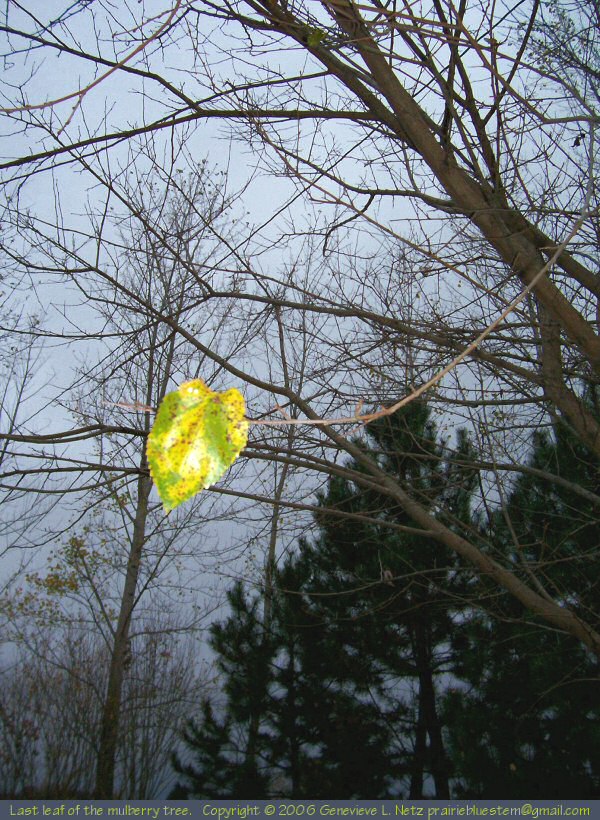
The Last LeafLast leaf on the mulberry tree

When I think of "The Last Leaf", I think of O. Henry's story about the sick girl who clung to life only because she could still see the last ivy leaf.

When I was searching for that story so I could link to it, I found a poem by Oliver Wendell Holmes titled "The Last Leaf" about an old man who has lived beyond his time.

I also found a post in a blog by a lady from the Netherlands, an e-book by James Kendall Hosmer about American and European history, a poem by Joanna Baillie , and many photos -- all titled "The Last Leaf".

It's an interesting thought and image -- see for yourself the many interesting links related to that theme.

Technorati tags:


Wednesday, November 08, 2006

Moss and Lichens


Life in Christian County, Kentucky... More About Trees and Plants...


Moss and lichens

The moss and lichens enjoy this cool damp weather, even if I don't. Yesterday, some of the lichens were looking positively aqua in color. Frost has not yet nipped the little fern that's peeking out behind a fallen leaf.

Technorati tags:


Wednesday, November 01, 2006

Three Sisters

Life in Christian County, Kentucky... More About Trees and Plants...


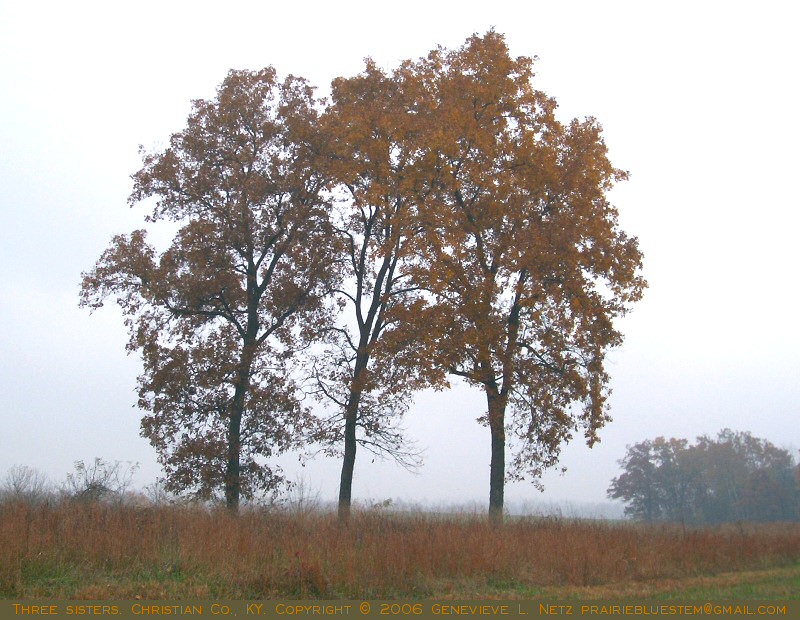
Sister treesThree sisters

These three trees have been growing side by side for a while. Perhaps they've been together fifty or a hundred years already. At first they existed separately, but now their height and breadth have increased and their branches and roots are intertwined. The trees have not grown as large or as evenly as they might have in isolation. The one in the middle has been most affected.

Human history has not touched these trees as they stand on their hill by the road. In their slow, simple lives, their sap ebbs and flows; the sun, rain, and soil feed them. Their leaves mature and and fall. Winter comes and spring follows. In some years they flourish, and in others they simply endure.

They have grown side by side long enough that they've become dependent upon their combined structure. While they are three, they are strong against the wind and weather, but if one falls, the others will be more vulnerable.

This phenomenon is seen when forested areas are cleared to build houses. When a few "lawn specimens" are left standing, those suddenly isolated trees are prone to weather damage. Their roots were torn and trampled when their mates were ripped away, and the branches and trunks that were strong in the group are not robust enough to stand alone.

"God has cared for these trees, saved them from drought, disease, avalanches, and a thousand tempests and floods. But he cannot save them from fools." ~John Muir

Technorati tags:


Monday, October 30, 2006

Autumn on a Backroad

Life in Christian County, Kentucky... More About Trees and Plants...


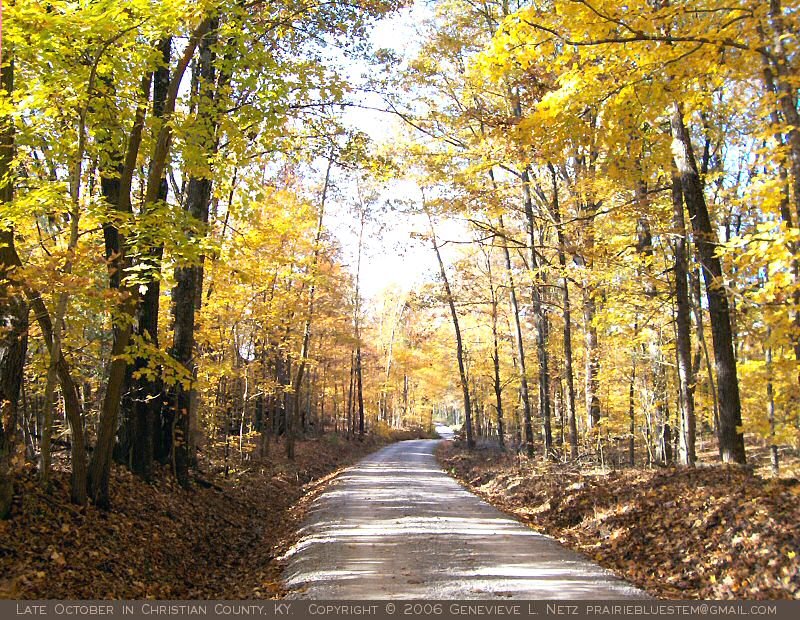
Fall foliage
Fall foliage, mostly maples.
Related Posts Plugin for WordPress, Blogger...

CONTENTMENT: Keep your heart free from hate, your mind from worry, live simply, expect little, give much, sing often, pray always, forget self, think of others and their feelings, fill your heart with love, scatter sunshine. These are the tried links in the golden chain of contentment.
(Author unknown)

IT IS STILL BEST to be honest and truthful; to make the most of what we have; to be happy with simple pleasure; and to be cheerful and have courage when things go wrong.
(Laura Ingalls Wilder, 1867-1957)

Thanks for reading.