Friday, July 18, 2008

Seen in Smiths Grove, KY

Old Farmer's Bank building


Another chapter in what Keely calls "Mom's 'American Main Street' series":

What a surprise for the eyes to see this little limestone bank in Smiths Grove, KY.  (Smiths Grove is a small town in Warren County, about 20 miles east of Bowling Green.)

The Farmer's Bank building is currently unoccupied. I found the following information about its history:

Erected in 1894, Farmer's Bank is a pretentious limestone structure built for Dave and James R. Kirby by an itinerant stone mason. Closed in 1931, Farmer's Bank never reopened and was later used as a post office.

Source: Architecture of Warren County, KY 1790-1940, copyright 1984 by the Landmark Association of Bowling Green and Warren County, Inc., Bowling Green, KY.

A "pretentious limestone structure"? The adjective "pretentious" seems opinionated -- and thus, out-of-place.  This book is supposed to be reporting noteworthy facts about Warren County's best old architecture.

Were the writers insinuating that Smiths Grove was not a fancy enough town to deserve an attractive stone bank?  Or are they suggesting that a small building should not have so many details?  There's no way to know what they really meant, but I'm pretty sure they were expressing an opinion, not giving a fact.

According to WordNet (r) 2.0:

pretentious adj

1: making claim to or creating an appearance of (often undeserved) importance or distinction; "a pretentious country house"; "a pretentious fraud"; "a pretentious scholarly edition" [ant: unpretentious]

2: intended to attract notice and impress others; "an ostentatious sable coat" [syn: ostentatious] [ant: unostentatious]

3: of a display that is tawdry or vulgar [syn: ostentatious, kitsch]

Wednesday, July 16, 2008

Stone Church in Auburn, KY

Pearce Memorial United Methodist Church


Stone church, Auburn, KYI was so busy photographing this interesting stone church in the little town of Auburn, KY, that I forgot to read the name on its sign! The letters are almost too faded to read in my photograph, but I verified its name on the internet. This is the Pearce Memorial United Methodist Church.

After I had the name, I found a church history that was written in 1974 by Nancy R. Wright. It says that the church was named for John Pearce, a lifelong member of the congregation, whose last will and testament designated $20,000 for the construction of the building.

Dedicated on March 26, 1939, this structure replaced an 1882 building and became the third meeting house of the congregation. A stone parsonage (barely visible at left in the photo below) was built behind the church in 1950-1951.

According to Wright's history, this is Bedford stone (a type of limestone) from the Halls Knob Quarry near Auburn. Her history also includes a description of the interior of the building.

The architect of the church was Mr. A. B. Gardner of Nashville. I have not located any additional information about him. I can only say that Mr. A.B. Gardner was not affiliated with the Nashville architectural firm, Dougherty and Gardner, which operated throughout the 1920s. (That was Thomas W. Gardner.) It seems that this fanciful little stone church in Auburn may have been Mr. A. B. Gardner's greatest work.

Stone church, Auburn, KY
(The walls of the church don't really slant in.
The distortion was caused by the wide-angle lens.)

Seen at Kirkmansville, KY

A light unto the Gentiles


Driving home from Greenville a few weeks ago, I paused in Kirkmansville and photographed the United Methodist Church, It is a simple structure with little adornment. Its fanciest parts are its arched windows and its steeple. The steeple (or bell tower) reminds me a little of a sturdy lighthouse.

The church sits along Highway 171, and as you can see from the shadows on the building, it is well-shaded in the late afternoon.

I read that the Methodist-Episcopal Church in Kirkmansville was established in 1876. Its 29 charter members were probably the forefathers of the Methodist congregation in Kirkmansville today.

Monday, July 14, 2008

Horse Drawn Hay Sweep-Rake

Making hay with horses


In the hayfield, the hay sweep (or sweep-rake) moved hay. The driver lowered the sweep's teeth (the long wooden tines) to ground level and took the sweep down a windrow of raked hay. As the sweep moved forward, the hay piled onto the buck (the platform of wooden teeth.)

When the buck was full of hay, the load was taken to the haystack. A good man on the sweep planned his route so he was close to the haystack when the buck was full and heavy.

Mowing machines and dump rake were pulled from the front. However, horses could not walk in front of the sweep-rake -- they would have been wallowing through the hay windrows that the sweep was supposed to gather. This problem was solved by having the horses pull the sweep from the sides.

In the image below, the load of hay has been deposited on the haystacker buck (another platform of wooden tines.) The sweep driver has backed the horses away from the load. Now he is approaching the hay again to push it farther onto the stacker buck. The driver is physically lifting the sweep teeth. Men and horses worked hard in the hayfield.

Out of the camera's range, the stacker team waits. The horses are harnessed to the pulleys that take the stacker buck to the top of the triangular frame and throw the hay onto the haystack. The man who is standing by the stacker buck is probably the driver of the stacker team. This was a fairly easy job, perhaps one that a grandfather might be assigned to do.

By the time I was a child, the hay sweep was a tractor, with its transmission reversed and its seat turned around. Its big wheels were in front and its small wheels were in back. The sweep buck was mounted in front of the big wheels, and it was raised and lowered with hydraulic power. It could carry much larger loads of hay than a horse-powered sweep, and it went much faster.

A tractor pulled the load of hay to the top of the haystack. However, the tractor driver was still said to be "driving the stacker team." Maybe "stacker team" was easier to say than "stacker tractor."

Photographs in this post were taken between 1935 and 1945 by John Vachon (top-left image) and Russell Lee (the other three images) for the Farm Security Agency.

Related posts:
The Hayfield
Horse-drawn Hay Rake
Winter Memories

More images
Solomon Butcher's Nebraska images of hay equipment (stacking)

Arthur Rothstein Comments on a Famous Photo

The photographer explains his art.


UPDATE: I've redone the Library of Congress links in this post, and I hope they'll work now. If they don't, please let me know.

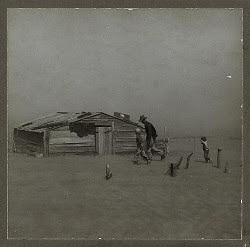
FSA photo by Arthur Rothstein
Cimarron County, Oklahoma, April 1936.

Arthur Rothstein worked as a photographer during the Great Depression for the Resettlement Agency, later known as the Farm Security Agency (FSA).  One of Rothstein's most famous FSA photographs appears above. (Click the image for a larger view.)

Rothstein commented on the photograph in a 1964 interview at the Smithsonian:

You may remember the stories in those days about the black blizzards that swept across the plains and even darkened the sky in New York City...

Well, it was a dramatic catastrophe in American agriculture. Strangely enough, it was a very difficult thing to show in pictures, but I lived in the Dust Bowl for several months and went out every day and took pictures.

In the process, one day, wandering around through Cimarron County in Oklahoma, which is in the panhandle of Oklahoma, I photographed this farm and the people who lived on the farm. The farmer and his two children, two little boys, were walking past a shed on their property and I took this photograph with the dust swirling all around them.

I had no idea at the time that it was going to become a famous photograph, but it looked like a good picture to me and I took it. And I took a number of other pictures on the same property. And then I went on to some other farms and took those pictures. This particular picture turned out to be the picture that was quite famous.

It was a picture that had a very simple kind of composition, but there was something about the swirling dust and the shed behind the farmer. What it did was the kind of thing Roy [Stryker, his FSA supervisor] always talked about-it showed an individual in relation to his environment.

Of course this is the sort of thing that painters from time immemorial have been trying to do-to show man in relation to his environment. You know the old axiom that " Art is the expression of man," so here, if this has any art, it's because it's an expression of man.

Source: Arthur Rothstein Oral History

In the same document, Rothstein also explains a controversial photo of a skull lying on the sunbaked soil of the South Dakota badlands.

One of my favorite Rothstein FSA photos is "Car on the plain", taken in October 1939 in Washington County, Colorado.

A short biography of Rothstein
Links to online archives of Rothstein images
Related Posts Plugin for WordPress, Blogger...

CONTENTMENT: Keep your heart free from hate, your mind from worry, live simply, expect little, give much, sing often, pray always, forget self, think of others and their feelings, fill your heart with love, scatter sunshine. These are the tried links in the golden chain of contentment.
(Author unknown)

IT IS STILL BEST to be honest and truthful; to make the most of what we have; to be happy with simple pleasure; and to be cheerful and have courage when things go wrong.
(Laura Ingalls Wilder, 1867-1957)

Thanks for reading.