Saturday, September 20, 2008

Wise Words about the Banking Crisis

Wisdom from an Irish poet and patriot


Capitalism is not the free world.
Capitalism is a term devised by Marxists to describe what they thought were the worst aspects of our freedom.
We should never let any corporation or bank or computer company pose as the embodiment of our freedom.
Crises for large corporations are not crises for the free world.
Our freedom will endure and grow as long as we continue to elect our governments, to uphold Christian values, to promote small businesses, to permit citizens to own their own property and their own lives, to raise our children with dignity, to be polite to each other in the streets, to contribute directly to each other with charitable hearts, and to care about each other as a community.
As long as these fundamentals are a part of our culture, the fate of soulless corporatist entities is not going to matter...

   -- From "what me worry?" by James Healy, The Heelers Diaries, Wednesday, Sept. 17, 2008.

Wednesday, September 17, 2008

Dumpster Diving

Salvage operation


A young woman was parked at the dumpster behind the mall in Hopkinsville a few days ago. She was reaching through the open doors of the bin and digging industriously. I didn't see her take anything out, but obviously she thought there was a good chance of finding something useful.

If I were ever to try dumpster diving, I guess I'd look for a dumpster like this one. I'm sure the mall stores sometimes discard salvagable items, and most of the trash would be dry so it shouldn't smell too bad.

Some people check the dumpsters at grocery stores for food. I consider that to be hard-core dumpster diving. I prefer that my food come from inside the store. On occasion, I might buy a package of marked-down beef if it still looks good. I don't really want to get any closer than that to salvaged food.

My own trash salvaging has been limited to picking up lumber piled on the curb for the garbage truck. This was very humiliating to my children. They were afraid that their friends would drive by and see their nutty mother throwing plywood scraps into the back of the truck. In deference to their sensitivities, I passed up a lot of perfectly good lumber.

Nowadays, I don't have the kids along to restrain me, but I drive a little car instead of a little truck. It doesn't work very well for hauling, so I'm still passing up lots of useful pieces of lumber. I wouldn't have time to make anything with it, anyway, but it always pains me to see it headed for the landfill.

Monday, September 15, 2008

Hurricane Ike in Christian County, KY

Edge of a hurricane at Hopkinsville, KY


At Hopkinsville, KY, we were supposed to be a bit outside of Ike's path, according to a weather map I saw on Saturday night. That map underestimated the situation. Satellite photos, taken as Ike passed over the region Sunday morning, show a wide band of hurricane-influenced weather.

We had some very strong wind here. The Kentucky New Era reports wind gusts up to 64 mph.

I slept late rather than going to church Sunday morning, because I had to work until midnight on Sunday night. It wasn't very restful sleep. I woke again and again to the wind's howl as it ripped through the trees. About 10:00 a.m., every other sound in the house halted abruptly, signaling a power failure. I was sorry that I hadn't at least made a pot of coffee.

When Dennis got home from church, he said that the streets in Hopkinsville and the roads on the way home were full of tree limbs, small and large. He wasn't surprised about the power outage because he had stopped to talk to our neighbor down the road, who had a large tree lying across electric lines in his front yard.

When I left for work, the electricity was still out, but the worst of the wind had passed. Several other employees had stories of trees down and power out. One lady said that Madisonville, a town about 35 miles north of Hopkinsville, looked like a tornado had gone through it.

The electricity was back on when I got home late that night. A lot of branches, most of them already dead, are scattered around the yard. None of them fell on anything important. All of our trees managed to hang on and stay in the ground. The wind ripped out the hinges of one door on the old bathroom vanity which is still sitting on the carport. Now I'll have to fix it before anyone will want it from Freecycle.

We were fortunate that we didn't suffer any severe damage. Our worst complaint is that, with all that wind, we didn't get one drop of rain!

Kentucky New Era report of the wind storm
National Weather Service report from Paducah

Alhambra Theater in Hopkinsville, Ky

Historic theater, then and now


Hopkinsville's historic Alhambra Theater has recently been renovated. Most of the changes were made in the lobby, as I understand it. The restrooms were enlarged, so the ticket window had to be eliminated. It was a case of modern needs overruling perfect preservation.

In the Christian County Courthouse, I photographed an old photograph (image below) that shows the Alhambra about 50 years ago. I would guess that this photo is from about 1960. (Note the air conditioner in the second story window.)

The Christian County courthouse stands next door to the Alhambra. It's the building that is visible to the left of the theater in the image at the top of this post.

In the old photo, a crowd of people are waiting to enter the courthouse for some reason. The Alhambra theater, as it was then, is shown in the background. The man in military uniform was probably a soldier from Fort Campbell.

Friday, September 12, 2008

Radio Days

A revolutionary invention


Imagine America at the end of World War I. Brief notices of important events were still sent by telegraph, the fastest communication that existed.

People read newspapers and magazines to learn details about happenings in the world beyond their hometowns. In small towns, the news was often out-of-date before the publications arrived. For that matter, much of the news was old even when it was written.

A decade later, a surge of interest, development, and investment in commercial radio had transformed the nation.

Election results were broadcast by radio for the first time ever in 1920 (by KDKA in Pittsburg.) Owners of radio sets heard the news first. They didn't have to wait for printing presses to grind out an extra and newsboys to run it through the streets.
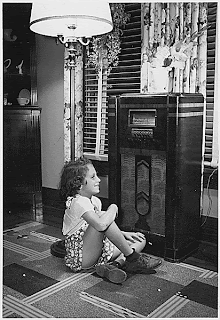
With that broadcast, radio gained a new measure of respectability. Its potential was examined and found promising; it was recognized as more than a curious hobby.

By 1927, radio frequencies were so crowded that Congress set up a regulatory agency, the Federal Radio Commission, to issue broadcast licenses.

The 1930 census inquired whether the household owned a radio set. Many people did. The wealthy purchased a commercial model, and the poor built their own crystal sets or vacuum tube radios using the plans published in hobby magazines.

Americans tuned in regularly for the news, farm reports, and weather reports, and for other favorite programs -- music, drama, quiz shows, humor, and more. The radio often became the family gathering place, assuming a role that the piano or the phonograph had previously enjoyed.

Franklin D. Roosevelt used radio to bring his "Fireside Chats" into American living rooms, starting in 1933. He employed the cutting edge of technology to speak directly to the people in an unprecedented way.

From that era, here are two interesting quotes:

I live in a strictly rural community, and people here speak of “The Radio” in the large sense, with an over-meaning. When they say “The Radio” they don’t mean a cabinet, an electrical phenomenon, or a man in a studio, they refer to a pervading and somewhat godlike presence which has come into their lives and homes.

—E. B. White, 1933

God Hears Prayer

If radio's slim fingers can pluck a melody
From night -- and toss it over a continent or sea;
If the petalled white notes of a violin
Are blown across the mountains or the city's din;
If songs, like crimson roses, are culled from thin blue air --
Why should mortals wonder if God hears prayer?

-Ethel Romig Fuller (from the 1937 anthology, 1000 Quotable Poems)

Related post: I Grew Up in Radio Land
Related Posts Plugin for WordPress, Blogger...

CONTENTMENT: Keep your heart free from hate, your mind from worry, live simply, expect little, give much, sing often, pray always, forget self, think of others and their feelings, fill your heart with love, scatter sunshine. These are the tried links in the golden chain of contentment.
(Author unknown)

IT IS STILL BEST to be honest and truthful; to make the most of what we have; to be happy with simple pleasure; and to be cheerful and have courage when things go wrong.
(Laura Ingalls Wilder, 1867-1957)

Thanks for reading.