Showing posts with label citizenship. Show all posts

Monday, October 07, 2013

Two Ordinary Patriots

Samuel Mapes (1735-1820) and Smith Mapes (1756-1830)


In 1775, just a few weeks after the Battle of Lexington and Concord,  Samuel Mapes and his 19-year-old son Smith Mapes signed the Revolutionary Pledge* in Ulster County, New York. Shortly thereafter, Smith and Samuel and dozens of their neighbors joined McClaughry's Regiment (the Second or "South-end" Regiment of the Ulster County militia.) As their signing of the Pledge expressed, they were "greatly alarmed at the avowed design of the Ministry to raise a revenue in America, and shocked by the bloody scene now acting in Massachusetts Bay..."

Militia Men


Ulster County, today. Photo by Doug Kerr.
Samuel Mapes was a farmer, and it is likely that Smith, his oldest son assisted in the farm work. Joining the local militia probably seemed more practical than joining the newly-formed Continental Army. Samuel had a large family to provide for.

But even militia men were called into the army as needed. "The militia was virtually State troops. They could be called upon for service in the army by the proper authorities at any time, and in such cases the colonel of a regiment was ordered to furnish a certain number of troops for a certain purpose, and the men were drafted from the whole number, and they in fact became as regular troops or the line of the army, after they were so drafted, for the time being." (History of the Town of Marlborough, Ulster County, New York, by C. M. Woolsey, page 107. Published 1908) And so various elements of the Ulster County Militia fought at Long Island, Saratoga, and other battles outside their home county.

Defending the County


The defense of the small frontier settlements in the western part of Ulster county was a huge problem. "The mountains in the west of Ulster pierced by the two branches of the Delaware, the Esopus and the Rondout, were peculiarly open to attack by such a foe as an Indian with the knowledge of a woodman and the cunning of a savage." (Olde Ulster : an historical and genealogical magazine. Vol 3, No.1, page 18, published 1907.) The Indian attacks were orchestrated by Torries and British, who sometimes disguised themselves as Indians and joined in the destruction.

In early 1777, a detachment from the Ulster County militia marched "under alarm" with Lt. Col. Newkirk to the frontier settlement of Peanpack in western Ulster County to combat an attack of this sort. Samuel Mapes was in the group of men. Another detachment, also in 1777 and also under alarm, was led by Major Phillips. Smith Mapes was in that group. (Revolutionary War Rolls of New York, viewed at Fold3.com.)

Meanwhile, the Patriots struggled with the British for control of rivers. Ulster County, a large region with the Hudson River forming its entire eastern border, saw a great deal of military action during the Revolution. Many militia men enlisted multiple times, serving when called, going to battle in their everyday work clothes, carrying whatever provisions, ammunition, and weaponry they possessed.

Kingston in Ulster County, at that time the state capital, was burned by the British during the war. And a British general justified his burning of Esopus, an Ulster County town along the Hudson's west banks, as entirely necessary because of the rebellious rascals who lived there.
On the 17th of October, 1777, General John Vaughan of the British Army, thus reported to his commanding officer upon his vandal deed of the preceding day: "I have the honor to inform you that on the Evening of the 15th instant I arrived off Esopus: finding that the Rebels had thrown up Works and had made every Disposition to annoy us, and cut off our Communication, I judged it necessary to attack them, the Wind being at that Time so much against us that we could make no Way. I accordingly landed the Troops, attacked their Batteries, drove them from their Works, spiked and destroyed their Guns. Esopus being a Nursery for almost every Villain in the Country, I judged it necessary to proceed to that Town. On our approach they were drawn up with Cannon which we took and drove them out of the Place. On our entering the Town they fired from their Houses, which induced me to reduce the Place to Ashes, which I accordingly did, not leaving a House. We found a considerable Quanity of Stores of all kinds, which shared the same Fate. (Olde Ulster: an historical and genealogical magazine, Vol. 1, No. 2, page 33, published in 1905)

These are just a few examples of the sort of fighting that took place in Ulster County. A third of all battles of the Revolution were fought in New York (New York Military Records at FamilySearch.) The regiments of the Ulster County militia did their part at home and away. I am confident that those militia men fought with a keen sense of vengeance for the outrages committed in their homeland and the losses suffered by their families and friends.

British cannon above the Hudson River.
Photo by Michael Francis Studios

After the War


Sources do not agree about the date that Samuel and his family moved to Blooming Grove (then in Ulster County, but now in Orange), but it seems clear that around the time that the Revolution ended, he moved to Howell's Depot.
He had more sons than land, and in order to provide a farm for as many of them as were content to remain in Orange County, he removed from Blooming Grove to the locality now known as Howell's Depot, then chiefly an unbroken wilderness, and purchased a mile square, or 640 acres of land, upon which he settled, and with the aid of his sons brought under cultivation.

He was a man of vigorous constitution, untiring industry, and a cheerful and jovial temperament. His land was rough and hard to cultivate, but he made the best of it, and it is related of him that when one of his old Blooming Grove neighbors once asked him what on earth he did with some of his roughest land, he replied that that which was too stony for the sheep and cattle to pasture in, he mowed to furnish hay for their winter keeping. (The Family Record: Devoted for 1897 to the SACKETT, the WEYGANT and the MAPES Families by C. H. Weygant, published by C. H. Weygant, 1897, page 46.
Samuel Mapes set aside a plot of land on his farm for a family burying ground, and he was laid to rest there in 1820, having completed a life of nearly 85 years. His wife Mary and many other Mapes descendants are buried there as well.

Smith and Rachel


New York's Revolutionary War Rolls show that Smith Mapes became a corporal, but nonetheless, he found enough time to court Rachel McKnight. They were married on February 10, 1779.

Smith and Rachel made the move to Howells with the Samuel Mapes family. By 1792, five of their children had been baptized at the Old School Baptist Church in Howell's, New York. One of the children baptized there was William Warren Mapes (William Warrington Mapes), my 3rd-great grandfather.

Sometime in the next few years, Smith and Rachel Mapes left Howells and moved about 200 miles west to the Finger Lakes area of New York where they were admitted by baptism to the First Baptist Church at Benton Center, Yates County in 1800. (Early Settlers of New York State: Their Ancestors and Descendants, Volumes I-VI, by Janet Wethy Foley. Pages 6 and 148. Originally published in 1934-1940 by Thomas J. Foley, Akron, NY.)  

Smith and Rachel spent the rest of their lives in western New York. Smith died  in 1830 at the age of 72, and Rachel died five years later. I do not know the location of their graves.
- - - - - - - - - -
* The Revolutionary Pledge: "Persuaded that the salvation of the rights and liberties of America depend, under God, on the firm union of its inhabitants in a vigorous prosecution of the measures necessary for its safety, and convinced of the necessity of preventing anarchy and confusion which attend a dissolution of the powers of government, We, the Freeman, Freeholders, and Inhabitants of ---, being greatly alarmed at the avowed design of the Ministry to raise a revenue in America, and shocked by the bloody scene now acting in Massachusetts Bay, do in the most solemn manner resolve never to become slaves, and do associate, under all the ties of religion, honor, and love to our country, to adopt and endeavor to carry into execution whatsoever measures may be recommended by the Continental Congress, or resolved upon by our Provincial Convention, for the purpose of preserving our constitution and of opposing the several arbitrary acts of the British Parliament, until a reconciliation beween Great Britain and America, on constitutional principles (which we most ardently desire) can be obtained, and that we will in all things follow the advice of our General Committee respecting the purposes aforesaid, the preservation of peace and good order and the safety of individuals and property."  (The History of Dutchess County, New York by S. A. Matthieu. Published in Poughkeepsie, NY, 1909. Page 95.)
- - - - - - - - - -
This article was written by Genevieve L. Netz and originally published as a blog post at http://prairiebluestem.blogspot.com/2013/10/two-ordinary-patriots.html . Copyright 2013 Genevieve L. Netz. All rights reserved. Permission is granted for attaching this article to Mapes family trees as long as this entire notice is included. Any other use requires written permission. gnetz51@gmail.com

Download a copy of this article for your family tree.


Wednesday, February 06, 2013

A Citizen's Visit to the Smithsonian

Country folk in the nation's capital


Dennis and me. If this were a video, you'd see
us shivering and hear our teeth chattering!

I've been looking through some photos tonight of a trip we really enjoyed. In 2007, Dennis, Isaac, and I went to Washington D.C. during Isaac's Easter break from school. Via the internet, I found a reasonably-priced hotel located just a block from the Iwo Jima monument in Arlington National Cemetery and just across the river from many famous monuments and buildings.

The Iwo Jima Memorial in Arlington National Cemetery

The Virginia Suites worked out great for us. Our studio apartment was spacious and clean. It had a small, completely furnished kitchen and dining area, so I brought a few easy-to-cook things with us, and we ate in the room at night.  We enjoyed the generous continental breakfast that was served downstairs each morning, and then we walked a few blocks to the subway and rode a short distance to the Mall area. We carried snacks to eat at lunchtime. ("Poor folks have poor ways," my mother-in-law often said, in praise of frugality.)

Early April gave us a little surprise. Snow fell during our first night in DC. The next morning, the grass and all the parked cars had a crusty, white coat.

And speaking of coats -- we wished we had brought heavier ones! The wind blew hard, and the temperatures were in the 40s most of the time we were there. We wore extra layers of clothing but we still shivered in the wind chill. The cherry trees were blooming, but the combination of the late freeze, the snow, and the gusty winds frazzled them a little. The tourists looked frazzled too, huddled inside their coats as the wind hurried them along. I'm sure we looked much the same.

Wednesday, May 18, 2011

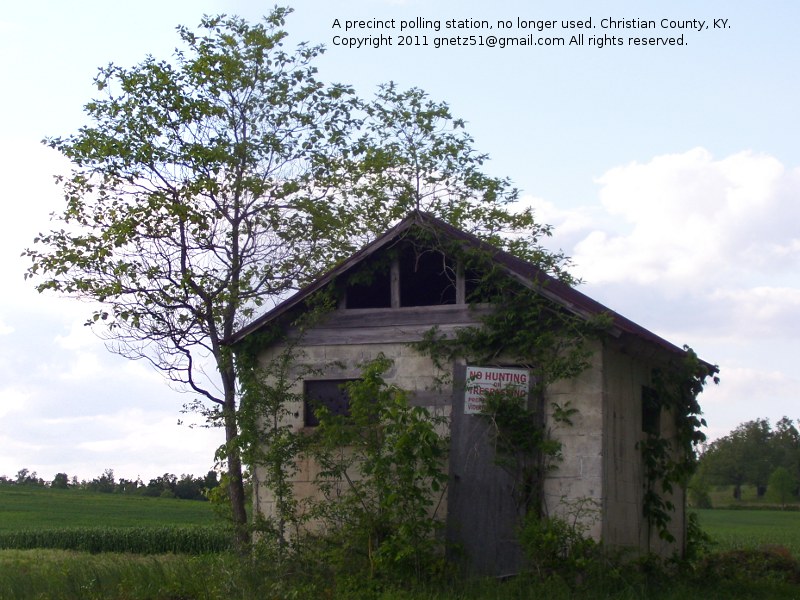
Polling Place of the Past

An old precinct building in Christian County, KY


This little concrete-block building stands at the intersection of Pilot Rock Road and Laytonville Road in Christian County, KY. It was once the voting place for citizens of the surrounding rural area. Several local residents have told me that they remember voting in this building, years ago.

I believe this little block voting building served the Pilot Rock precinct. If I'm correct about that, then this is the building reported vandalized in the following news report from November 1976:

[Christian County Court Clerk Thomas E. Morris] explained that the only irregularities occurred at Precinct 27 at Consolation and at Precinct 30 at Pilot Rock where vandals launched an overnight attack on voting machines and buildings.

Damage to fuses and fuse boxes were reported at both locations, forcing officials to do emergency electrical repair work so that automatic machines would operate. There also was profanity scribbled on the walls [of] at least one of the voting sites.

Source: "Area Vote Total Said To Be Light" by Mike Herndon, Kentucky New Era, May 25, 1976, page 1

The Consolation precinct building, mentioned in the quoted report above, was located somewhere near the junction of Dawson Springs Road and Highway 800 in northwestern Christian County. A proposal for its construction was heard by the Christian Fiscal Court in 1973, so it was still quite new when the above incident occurred. I don't know if it is still in use or not.

Sunday, December 12, 2010

Justice Center and Jail, Hopkinsville, KY

Law and order on the West Bank


Christian County Justice Center, as seen
from the east bank of Little River


Main entrance, Christian County Justice Center
The Christian County Justice Center sits on the west side of Little River in Hopkinsville (KY). This handsome public building was designed by local architect Keith Sharp and put into service in 2002. It includes 73,000 square feet of space and houses five courts.

In a May 24, 2002, Kentucky New Era article, Sharp commented on the underlying philosophy of the building's design:

We live in a land of freedom and justice. You are entering into a place that should evoke you to think about that. Public buildings have a duty to the community to establish a sense of permanence. That sense of establishment is present in this courthouse...
(Source)

Frankly, the Justice Center has so much gravitas that I feel a little awed every time I drive by it.

The Justice Center is connected by tunnel to the Christian County Jail (located on the opposite side of West 7th Street). The jail was also designed by Keith Sharp, and it was completed in 1994. Like the Justice Center, it has an attractive, dignified facade. The City of Hopkinsville website has a good photo of the jail, contributed by Jim Creighton.

I don't often have a reason to visit the Justice Center. Unless I am called again for jury duty, I probably won't go there again until I need my driver's license renewed. I have never yet been inside the jail.

These two "law and order" buildings, the public library, and the public park along Little River form a civic campus that enhances the west side of downtown Hopkinsville. I wish all the approaches to our historic downtown area were as attractive!

West 7th Street, looking toward
Little River and the historic downtown

Monday, August 09, 2010

LST Ship Memorial at Evansville, IN

The ship that won WWII for the Allies


Isaac and I visited the LST Ship Memorial at Evansville (IN) about two years ago. We've been planning to take Dennis to it ever since, and this past Sunday, we finally made that trip. I enjoyed going through the ship again and hearing the spiel of a different tour guide. Dennis enjoyed the tour from his own unique perspective. He is a Navy veteran as well as a history-lover, and also, his father was a machinist in the Navy during World War II.

The LST (Landing Ship, Tank) was a World War II invention.  It was a flat-bottomed, high-riding ship that could be driven right onto most beaches. The big doors at the end of the LST opened and a gangplank flopped out, so tanks and other vehicles could drive off, ready to do battle. If  the ship couldn't plow up onto the beach, the tanks and other vehicles drove off via pontoon bridges. According to our tour guide, the LST was first imagined by Winston Churchhill, who knew that tanks would greatly the chance of every invasion's success.

Evansville, Indiana, was one of several places where the LST was manufactured in the U.S. Although Evansville had not previously had a shipyards, 167 LSTs and 35 other vessels were built there by the Missouri Valley Bridge and Iron Company. At the peak of production, Evansville was building 2 LSTs per week, and over 19,000 people were employed at the shipyards. After manufacture and christening, the LSTs were outfitted, sailed to New Orleans, and from there, put into military service. 

Wednesday, April 07, 2010

Hopkinsville Tax Day Tea Party

A non-partisan public assembly on April 15, 2010


Quoted from the Hopkinsville Tax Day Tea Party website:

Where: Parking lot of Dr. John A. McCubbin MD, Ophthalmology at 216 West 15th Street, Hopkinsville, KY,

Date: April 15, 2010

Time: Around 5:00 PM till done

Bring: A creative sign and a lawn chair

Events: A prayer, the Pledge, and a few short speeches

Map: Click here.

If I do not have to work that evening, I hope to attend.

Friday, August 14, 2009

Jury Duty

Trying to be a good citizen


It started with a letter from the Christian County Circuit Court Clerk. The envelope bore the Kentucky Court of Justice seal and looked ominously official.  "PLEASE OPEN IMMEDIATELY," it said in large red letters across the top.

Inside, I found a summons. "DEAR PROSPECTIVE JUROR: You have been selected to serve as a JUROR in the Christian County Courts. You are summoned to appear at the following place, date, and time. Failure to appear may result in a fine or jail time..." and so on. 

I had to answer some questions on a form and return it within five days. Most of the questions were innocuous. I remember only two of them -- whether I or anyone in my family had ever been convicted of a felony and whether I or anyone in my family had ever filed a personal injury claim.

On July 6, roughly 50 citizens (including me) answered the jury duty summons. Getting through the metal detector and security check at the door of the Justice Center was difficult for me. First, I had to remove my nail clippers from my key chain and take them back to my car. Then I had to take my camera out of my purse and take it back to my car.

I finally got through security, found the courtroom and sat down in an empty seat. In a few minutes, a secretary for the District Court welcomed us to jury duty. After roll call, she told us a bit about the types of cases that are tried in District Court and how a jury would be selected, if needed. Then we watched a video about Kentucky's justice system.

Before we left, each of us received a card with a telephone number on it. We were instructed to call that number each day after 4:30 p.m. to hear whether we had jury duty the next day. The card also had a telephone number to call in case of an emergency that would prevent us being available for jury duty.

I didn't anticipate that I would have any emergencies, but I did. When my Aunt Cleona passed away, I was gone for about five days, so I called the emergency number. The clerk's office told me that there was a case that required a jury on one of the days I was going to be absent. However, I was excused.

When I got back home (on a Thursday night), I was busy with catching up on my life and going back to work. For several days, I totally forgot that I had jury duty. On Monday night, I was taking a shower, when it hit me like a bolt of lightning -- oh-my-gosh, I'd forgotten to call, and what if I had missed a time when I was supposed to appear?

I called the number as soon as I got out of the shower. The message said that jurors were needed the next morning. I still don't know if the jurors were needed on the Friday and Monday that I forgot about jury duty, but I doubt it.

The next morning, the session in the courtroom began with a roll call of the jurors. I was thankful I was there to answer when my name was read. Then the lawyers and the judge had a quiet discussion at the bench. I heard the words "car accident". Soon, the judge announced that a key witness was unable to be in court that day so the trial was postponed.

I've only had jury duty one more time since then. We all met in the same courtroom again. After the roll call, the judge explained that the court would be considering half a dozen cases of adults who might be unable to handle their own affairs. The jury would hear the evidence in each case and decide whether the person was incompetent. If necessary, the judge would then appoint someone as a guardian.

A clerk turned a handle to spin a little wire cage of numbered balls. After a few revolutions she pulled out a ball and called a name. One of the jurors in the audience rose and took a seat in the jury section at the front of the courtroom. The judge questioned him about his acquaintance with the families and the witnesses. (The juror would have been disqualified if he felt unable to be impartial.)

The process was repeated until twelve jurors were seated. Then the balls were spun again, and 6 of the 12 jurors were chosen. The other 6 were dismissed, along with all the rest of us in the jury pool. I could have stayed and observed the trial, but I left. I was making a quick trip with Isaac to Murray that day to try to iron out some college enrollment complications before I had to be at work in the afternoon.

My session of jury duty ends in a little over two weeks. It has been interesting, but I'm thankful that so far, I haven't had to sit on a jury. If I do have to be a juror, I will do my best to give an honest and fair vote based on careful consideration of the evidence. However, if that grave responsibility does not come to me, I won't be disappointed.

(I took the photo of the statue of Lady Justice a couple of years ago when I attended a trial at the Justice Center. No one said a word about me having a camera, then.)

Wednesday, April 15, 2009

Tax Day 2009

Taxes and Tea Parties


Today was April 15, so I completed and e-filed our taxes. When I figured them roughly several months ago, I saw that we had to make an additional payment. I wasn't anxious to relinquish the money until the last minute.

I had a Tax Day conversation with the man who's doing roofing repairs for us. He told me that he had to pay an extra "five" when he filed a few days ago. "Five hundred?" I asked. "No, five thousand," he replied. (He probably needs to increase his quarterly payments!)

If I hadn't been busy with our taxes today, I could have gone to a Tax Day Tea Party. As you may know, rallies against higher taxes were held across the nation. Many people are very concerned about a huge increase in Federal spending that ultimately must be funded with a huge increase in taxes.

Several Tea Parties were held in this area today -- Bowling Green (KY), Clarksville (TN), and Madisonville (KY). The Hoptown Hall forum has some accounts from people who attended these events, and the forum's moderator has posted some photos from the Bowling Green Tea Party.

When I was in Wal-Mart late this evening, I noticed that the edition of TurboTax I used was sold out completely. It's a good thing I didn't wait until the last minute to buy the software, or I might have been downloading desperately. (Figure the taxes on paper with brain and calculator power? Perish the thought!)

Wal-Mart's in-house tax service, Jackson Hewitt, was closing up shop and moving out. A crew was taking the booths, desks, and computers to a truck and trailer waiting outside. Tax season is over for this year, but it's a sure bet that the debate about taxes will continue.

Friday, January 09, 2009

1870s Fourth of July

Twisting the tail of the English lion


On the Library of Congress website, I found a 1938 interview with Miss Nettie Spencer of Portland, Oregon, in which she remembered her childhood during the 1870s. The interviewer and writer was Walker Winchell of the Federal Writers Project.

Miss Spencer talked about the annual Fourth of July celebration held in her rural community. It was the one event of the year that everyone in the entire area attended.

Early in the morning, the family and great quantities of food were loaded into the wagon for the trip to town. When everyone had gathered, the celebration began with a parade.

The first float always carried that year's "Goddess of Liberty," a pretty local girl who had won the contest. She was surrounded by little girls who represented the states of the Union. Cadets from the local agricultural college and a band followed, and there might be floats with political effigies behind them.

Now for the interesting part:

Just before lunch - and we'd always hold lunch up for an hour - some Senator or lawyer would speak. These speeches always had one pattern. First the speaker would challenge England to a fight and berate the King and say that he was a skunk. This was known as twisting the lion's tail.

Then the next theme was that any one could find freedom and liberty on our shores. The speaker would invite those who were heavy laden in other lands to come to us and find peace. The speeches were pretty fiery and by that time the men who drank got into fights and called each other Englishmen.

In the afternoon we had what we called the 'plug uglies' -- funny floats and clowns who took off on the political subjects of the day. There would be some music and then the families would start gathering together to go home. There were cows waiting to be milked and the stock to be fed and so there was no night life.

The Fourth was the day of the year that really counted then. Christmas wasn't much; a Church tree or something, but no one twisted the lion's tail.

Source: Life History of Miss Nettie Spencer, Portland, Oregon


Fathers, grandfathers, and great-grandfathers of many Americans of the 1870s had fought in the American Revolution and the War of 1812. This community's formal "twisting of the lion's tail" each year honored the sacrifices made for independence and took pride in winning a hard fight.

(Right: UK coat of arms, 1837-present. Image from Wikipedia)

Friday, November 07, 2008

Poll Worker Report

Working the election


Dennis and I were poll workers in the November 4, 2008, election. He was the Democrat judge and I was the Republican judge. (Yes, we really are registered that way.)

We arrived at the polling place at 5:15 a.m., the appointed time, and found the other poll workers already setting up the signs. Dennis and I hurried to set up the voting machines. We have a good system -- I read the directions and he does the setting up. It went smoothly, and we were ready about 15 minutes ahead of time.

At 6:00 a.m., we opened for voting. A line had already formed outside the door. With our new E-Scan system, the voters moved through at a steady pace. Each voter received a paper ballot and went to one of five privacy booths to mark it. Then the voter brought the completed ballot to the E-Scan machine to electronically record his/her vote. Many expressed appreciation for the quick and easy voting procedure.

Just one complaint

We had only one disgruntled voter. He arrived at the polls mid-morning, feeling cranky and hoping for a problem. He let us all know that he'd been listening to news reports about malfunctioning machines. We assured him that we had a very good and totally up-to-date system, but he was clearly dubious.

After he marked his ballot, he fed it into the eScan and read the message: "Your vote has been recorded. Thank you for voting!" Then he told us that was not satisfactory. He wanted the machine to also display a summary of what it had read from his paper ballot -- that is, to tell him who or what he had chosen on the ballot. (Can you imagine the bottleneck this could potentially create?!)

We told him that it was the voter's responsibility to ensure that the ballot was correctly marked before feeding it into the machine, but we would write his suggestion on the Sheriff's Report. (And we did.)

Our oldest voter was 101. He voted by the eScan with assistance from his son. We had quite a few voters who were in their 80s and 90s. They had all voted by eScan during the spring primaries, and they had no problem at all with it in this election.

We had to turn one lady away who wanted to vote. Her name was not in the voter roster, and when we called the county clerk's office, they couldn't find her name in their list of registered voters. She said she hadn't voted for over twenty years. Apparently her name had been inactive for so long that it was removed. She didn't seem surprised. It's a shame that she didn't check on her registration before Election Day.

Our son Isaac voted for the first time, and we, as election judges, helped him cast his ballot. That was a moment of pride and joy for us. I think he will be an informed citizen and a faithful voter. He is interested in history and current events.

By our unofficial estimate, based on the number of ballots used and the number of registered voters in the book, over 2/3 of the registered voters in our precinct came to the polls. It's possible that some also voted by absentee ballot. We didn't have any statistics for that.


Long Day

The polls closed at 6 p.m. Dennis and I closed down and locked up the machines, following the instructions step by step. Three tapes were printed from each machine, and all of the election workers signed each tape. One tape from each machine was hung on the door and the other tapes were for the county clerk's office.

As election judges, Dennis and I had the responsibility of carrying the briefcase with our election materials and results to the county clerk's office. We got there ahead of the rush and didn't have to wait in line at all. The girls went through the bag quickly and checked to see that nothing was missing. I am always relieved when we successfully complete that checkup!

It was about 7:30 p.m. when we got home. We attended two classes before the election and worked about 14 hours on election day. In this county for this election, workers will be paid $150 each for working. Judges who drove the results to the courthouse will also receive a small milage payment. At our house, these payments will go to Isaac's college fund.


eScan Success

In my opinion, the eScan performed flawlessly at our precinct. I like the E-Scan system because the paper ballot, marked with ink, is retained when the ballot is scanned. A numbered stub from each ballot is also collected separately. The number of ballots, ballot-stubs, unused ballots, and signatures in the voter roster all must agree, so it seems to me that the system would be hard to cheat.

If there was a question about the results, the ballots could be scanned again. No "hanging chads" will create uncertainty or confusion. In fact, if there is any problem with the ballot (such as too many votes or no votes at all or stray marks on the ballot, it's immediately apparent. The machine rejects the ballot, and the voter can correct the problem on the spot.

Christian County also provides an eSlate machine for voters with disabilities. It has a dial that the voter turns to select names on a lighted screen. Than a button is pushed to cast the ballot. It is more confusing to use and it does not provide a paper record of the votes cast, so we encouraged all our able-bodied voters to use the eScan instead.

I was quite surprised to read on the Hoptown Hall that someone was unhappy with the eScan's system of paper ballots. The voter seemed to feel it was a step backwards rather than an advance. I suspect that he was disappointed that it was so easy to vote.


Results

About 75% of our voters chose the John McCain/Sarah Palin team in the presidential race. In combined results for the entire county, the election was a little closer, but McCain still won: 13,669 to 8880. McCain carried the entire state, and in fact, Kentucky was the first state announced for McCain in the election results.

On the national level, voters in our county preferred Mitch McConnell (Rep.) for U.S. senator over Bruce Lunsford (Dem.) and Ed Whitfield (Rep.) for U.S. representative over Heather Ryan (Dem.) The electorate in other western Kentucky counties agreed, and both of these men are being sent back to Washington.

In state races, we returned Myron Dossett (Rep.) to Frankfurt as a state representative and Joey Pendleton (Dem.) as a state senator. Both of these men were incumbents.

For more results in Christian, Todd, and Trigg counties, see the Kentucky New Era's election page

Saturday, May 24, 2008

Play a Word Game To Donate Rice

Help the UN World Food Program


http://www.freerice.com/index.php

Visit the above link to increase your word power and help feed the world's hungry. For each correct answer you give, 20 grains of rice are donated to the UN World Food Program by a sponsor. Visit the options page to customize the game to your liking.

I have a hard time quitting this little word game, once I start to play. I hope you'll give it a try.

Wednesday, May 21, 2008

Poll Worker's Day

Working the election


Vote
Dennis and I were poll workers in Kentucky's primary election on Tuesday.

As judges, one of our responsibilities was to provide the voters with the correct ballots and to tell them how to record the ballots on the machines. It was a primary election, so the Republicans had a different ballot than the Democrats.

One of our machines the E-Slate, has been used for several elections now. It is designed to make voting easier for disabled people. A wheelchair can roll right up to the screen and controls. The buttons and dials are large, and there are earphones. The words on the screen are in a large font.

The other machine, the E-Scan, is a new machine that we used for the first time. Many of the voters were apprehensive when told they'd be using a new machine. However, many remarked afterward that voting had been quick and easy.

We gave each E-Scan voter a paper ballot and explained how to mark it. The voter took the ballot to a privacy booth, marked it, and signed his name on a stub at the bottom of the ballot. Next, the voter brought the ballot to the E-Scan machine. He tore off the stub with his signature and put it into a slot in the side of the E-Scan. Then he fed the ballot into the scanner.

The E-Scan refused to accept a couple of ballots. In both cases, there were marks in too many boxes. One man had made a mistake and partially blackened an extra box. The other fellow told us that he did not realize he could only vote for one in each race. He had voted for several.

We couldn't look at their ballots to figure out the problem -- that would have been illegal. Rather, we made suggestions, based on the error message. The spoiled ballots were put into the slot in the side of the machine, and the voters received fresh ballots to try again.

Our precinct's voting place is a country church basement. The church members are having supper and a revival meeting every night this week. There were lots of leftovers in the refrigerators, and they urged us to help ourselves. We did try their banana pudding and Strawberry Delight. The Strawberry Delight was wonderful -- I must get that recipe! (This sounds like it.)

Election results returned to the courthouseAfter we locked the doors at 6 p.m., we closed the machines and printed the tallies. Then the machines were taken down and secured. That completed the day for the other election workers, but the judges (Dennis and I) had to take the election returns to the courthouse.

At the courthouse, we waited in line to have our suitcase checked. The girls from the county clerk office checked each ease for the control unit for the E-Slate, the voter register, the clerk's and sheriff's records, leftover ballots, and the envelopes that contained the vote tallies. It was a rather nervous moment when they opened our suitcase, and we were relieved when we had checked out OK.

It was a long day (5:15 a.m. when we left the house and 7:45 p.m. when we got home.) We got to see a lot of our neighbors though, and we helped them vote, so it was a day well-spent.

Wednesday, November 07, 2007

An Election Worker's Day

Providing a fair and honest election to my precinct


I Voted stickerYesterday, I was an election worker in Kentucky's General Election. My day began when the alarm rang at 4:15 AM. I left the house at 5:15 AM and drove a couple of miles to the local church that is the polling place for our precinct. Other workers arrived at about the same time, and we got the voting machines ready to go, tables arranged, sample ballots posted, and "Vote Here" signs installed outside.

At 6:00 a.m., we had our first voters. The next 12 hours went by fairly quickly, with a steady stream of people passing through. Usually, we had only one or two voters at a time, but at times, we had up to a dozen people waiting to vote. In all, about 1/3 of the registered voters in our precinct cast a ballot.

Due to a shortage of election workers, we had a three-person crew. We are supposed to have four workers -- clerk, Republican judge, Democrat judge, and sheriff. Since we didn't have a sheriff, we had to share that job between us.


Voter registration irregularities


We did have a few registration irregularities. We had several people who had moved from the precinct but had not changed their registration to their new precinct. It's illegal for them to vote in a precinct where they don't live, so we had to fill out paperwork for them and send them to their proper polling place.

In another case, a wife was listed as a legal voter in the book, but the husband was not listed, even though he had voted and resided in the precinct for years, just as his wife has. The county clerk allowed him to vote, but it required some phone calls and paperwork. The man was irritated and I understand why, but it certainly wasn't our fault.

In another case, a voter was incorrectly listed so we couldn't find his name. After a phone call to the County Clerk's office, we learned that he was listed with his middle name as his last name and his last name as his first name. He was able to vote under his incorrectly-listed name, and he filled out a new voter registration card to change his name so it will be correct next time (we hope.)

Problems with voting


An elderly gentleman requested the old voting machine. He couldn't hear very well. When he came out of the booth, we election workers didn't think that we had heard the bell on his machine ring (indicating that his vote was cast.) He asserted that he wouldn't have heard the bell if it did ring, but he had certainly pushed the "Vote" button. We commented that the lights next to the names on the screen were still flashing which indicated his vote was not complete. He insisted again that he had voted (!) so we didn't press the issue further. However, we don't think that his vote was recorded.

Workers aren't allowed to enter the booth with the voter, so it's hard to determine exactly what the problem is in some cases. O
ne of the last voters of the day used the new voting machine and somehow managed to press buttons in a sequence that looped him back through the ballot several times. We tried to talk him through it from outside the booth. When the ballot has been successfully cast and the votes recorded, a success message and the American flag are displayed on the screen. He finally got that screen, but he was not satisfied that his vote had been counted.

Each of these incidents had to be recorded on the Sheriff's report, and some of them happened while we were pretty busy with voters, so it would have been good to have that fourth worker. Our precinct was one of several that did not have a full crew. I don't know why they can't find enough election workers. Is it the long day?

Following correct election procedures


Some voters seemed a bit miffed that they had to show an ID, but that's the rule unless an election worker will sign that he/she personally knows the person's identity.

I felt that all the election workers at our precinct were following regulations and procedures as best we could. We were going by the book. No one was trying to stretch or bend the rules or influence the voters. We were doing our best to provide a fair and honest election to the residents of our precinct.

After the polls were closed at 6:00 p.m., it took us about half an hour to print out the tapes on the machines, close them and shut them down, and pack up all the election materials. Then the other judge and I had to take the tapes, the memory units from the machines, and the voter books and other papers to the County Clerk's office.

One thing I learned is that it might be a good idea to check your voter registration at the courthouse once in a while, even if you've been voting regularly and haven't made any changes of address.

It was a long and tiring day, but it was good to participate in the exercise of democracy. I enjoyed it.

Related:
KY Poll Worker Charged With Assault -- Wow!
Fun, Civic Duty Cited as Reasons to Work the Polls -- Local election worker has served for 25 years.
Sheriff Called In to Solve Oak Grove Poll Problem -- Election workers coped with an inhospitable polling place elsewhere in my county. Check out the mayor's statement in the last paragraph. What an idiot. I hope the voters realize that he's messing with their voting rights, not just with the election workers who happened to be assigned there.

Sunday, September 16, 2007

The Messy Side of Second Amendment Rights

A citizen who wasn't ready for gun ownership...


Most Kentuckians are strong supporters of Second Amendment rights, and I agree that citizens should have the right to own weapons. We have a few guns ourselves. I've always thought that an occupying force would have a terrible time subduing Kentucky, given the armed populace, the love of freedom, and the challenging terrain.

Unfortunately, a very sloppy exercise of Second Amendment rights happened in Hopkinsville last Friday. It was chilling to read about it, but on the other hand, the story has some almost-comical elements.

According to Hopkinsville's newspaper, the Kentucky New Era, Matthew Ashley Hicks went to WalMart and bought some ammunition for his brand-new Jennings 9mm handgun. Then he walked out of WalMart with his purchase and got into his vehicle,

Sitting in the driver's seat of his Mercury Mountaineer in front of the WalMart garden center, Hicks began loading the gun. In the process, he fired it three times.

The first bullet went into the steering wheel. The second bullet went through the driver's side window and the front tire of a nearby car. Glass from the shattered window sprayed onto the hood of another vehicle parked nearby. Police hadn't located the third bullet at the time the report was prepared for the newspaper. The story includes a photo of a policeman on his hands and knees, inspecting the bullet hole in the flat tire.

Luckily, no one was injured. I'm surprised that Hopkinsville police can't think of anything to charge Hicks with, but the newspaper reports that no charges will be filed. Hicks' age and address were not available at the time the story was written.

Dennis and I were leaving WalMart at about the time all this was happening -- 2:30 p.m. on Friday . We were getting groceries for a Boy Scout campout. We didn't hear the gunshots. Fortunately we had parked on the other end of the parking lot!

I don't want you to think that incidents like this happen often in Hopkinsville's parking lots. The majority of our gun-owning citizens are careful, steady, responsible folks who, I'm sure, could hardly believe this story!

(Source: "Accidental gunfire damages 3 vehicles in Wal-Mart parking lot," from staff reports, Kentucky New Era, published in Hopkinsville, KY on Saturday, September 15, 2007.)

Technorati tags: , , ,

Related Posts Plugin for WordPress, Blogger...

CONTENTMENT: Keep your heart free from hate, your mind from worry, live simply, expect little, give much, sing often, pray always, forget self, think of others and their feelings, fill your heart with love, scatter sunshine. These are the tried links in the golden chain of contentment.
(Author unknown)

IT IS STILL BEST to be honest and truthful; to make the most of what we have; to be happy with simple pleasure; and to be cheerful and have courage when things go wrong.
(Laura Ingalls Wilder, 1867-1957)

Thanks for reading.