Showing posts with label homesteaders. Show all posts

Thursday, February 21, 2013

Memories of a Homesteader's Dugout

One underground room, a dirt floor and roof, and fleas


An Oklahoma dugout photographed c. 1909.
The family is probably sitting in the only available shade.
Source:http://www.loc.gov/pictures/item/2004665280/
From a picture postcard series by J. V. Dedrick
James Barton came to Republic County, Kansas, in 1871, from Marshall County, Iowa, as a young child. His parents homesteaded near modern-day Cuba, Kansas. Looking back on the family's trip by covered wagon, Mr. Barton remembered that it "was a mighty long and hard walk from Iowa to Kansas for a seven year old, barefoot boy!"

The following paragraphs are excerpted from an account of homestead days that Mr. Barton wrote in 1936.

In the spring [of 1872] father built our dug-out. Now you young folks, who think your pretty homes are not comfortable enough, you should have seen our first Kansas home -- one underground room, dirt floor, dirt roof, and fleas and snakes for company. You never saw so many fleas-- we always blamed the buffalo and buffalo grass for these fleas, for all sod-house and dug-out families had them.

Our first crop was cut by father and a Mr. Zavodsky with a "cradle" scythe, -- a hard beginning for our parents, but how we children enjoyed the pretty country-- miles and miles of "Blue-Stem" in places three and four feet high, and just a lot of fun to play and hide in! There were no roads -- no towns -- no churches -- no schools -- no doctors -- and no railroads... When father went for provisions, it took him about a week to drive it with oxen, where you young folks now could motor it in an hour and a half...

While herding cattle we would see lots of buffalo heads and bones, undoubtedly left behind by Indians. Wild game was plentiful, including countless prairie chickens and quail everywhere. That first fall, we saw several deer and antelope grazing on our rye, but our nearest buffaloes were west of the Republican River. However, we often had buffalo steak brought back by other pioneer hunters. My father never owned a gun. I don't know what we would have done, had some of our Indian scares developed into reality.

Source: James Barton's pioneer memories of Republic County, Kansas.

My great-great-grandparents Ashbel and Martha Mapes were among the earliest settlers of Republic County, arriving in 1869, so this account is very interesting to me.

I have heard people say that in the Nebraska Sandhills, a quick "dugout" was sometimes made by simply laying a board roof across a wind-eroded "blowout" in a hill.

Here are three more photographs of dugouts from the Library of Congress. I think all of these are more elaborate in construction than most of the initial underground shelters that pioneer familes dug. If you have time, you might enjoy visiting the links in the picture captions -- they contain additional photos and more information.

This dugout in Humboldt, Nevada, appears to have a rock front.
Source: http://www.loc.gov/pictures/item/wy0223/
Photographed by Larry Kingsbury, October 1994


A thatched dugout in Minnesota, about 1900-1910.
Source:  http://www.loc.gov/pictures/item/det1994020491/PP/
Photograph by the Detroit Publishing Company 
A homesteader's stone dugout in Campbell County, Wyoming.
Probably constructed between 1917 and 1936. "Unusually well crafted."
Source:  http://www.loc.gov/pictures/item/wy0223/
The associated data pages at this link are full of info about dugouts. 

Monday, September 24, 2012

Willoughby Cemetery: Homesteader's Rest

An old settlers graveyard in Republic County, Kansas


Willoughby Cemetery, near Agenda, Kansas

One hot day last July, my brother, my sister, and I drove up to Republic County, Kansas, and found Willoughby Cemetery. It's named for W. H. Willoughby, the man who donated one corner of his homestead to be a community burying ground.

W. H. Willoughby (my great-great-granduncle-by-marriage) was a preacher and one of the first settlers of Elk Creek Township in Republic County.  He homesteaded on Elk Creek in the late 1860s, along with a small group of brothers, cousins, and  "in-laws." This group of original settlers included  my great-great-grandfather Ashbel Mapes. Ashbel and W. H. Willoughby were brother-in-laws: Ashbel was a brother of  W. H.'s wife Rachel Mapes Willoughby.

My gr-grandfather's Charles Leslie Hill's original gravestone.
There's also a new stone for Charles and Lilly Hill  (at right.)
My family has several graves in Willoughby Cemetery. Great-great-grandmother, Martha Vining Mapes (wife of Ashbel Mapes), is said to be there, but we didn't see her grave.  I don't know if it is unmarked, or marked with a uninscribed stone, or the words on her tombstone have weathered away. Or maybe her stone is hidden by a clump of bushes or flowers.

Great-grandfather Charles Leslie Hill is buried there, beside his first wife, Lillie Mapes, who was a daughter of Ashbel and Martha Mapes. When Lillie died of "catarrhal fever" leaving three little children without a mother, Charles married her younger sister Lana Mapes, my great grandmother.

My gr -gr -grandaunt, Rachel Ann Mapes,
She was W. H. Willoughby's wife.

Several other Mapes family members are buried in Willoughby Cemetery, including  Rachel Mapes Willoughby,  and several of Ashbel and Martha Vining Mapes's ten children: James Mapes, Nellie Mapes Boyer, Lillie Mapes Hill (as already mentioned), and probably Lucy Artimus Mapes Wharton (very likely, but not yet proven.)

Also, little Clarence Hill, a great-uncle who died at the age of 3 years and a few days, is buried there. His grave is probably at the foot of his mother's Lillie Mapes Hill's grave, where a small, uninscribed stone stands.

 While we were there, I tried to photograph all of the gravestones in the cemetery that were legible or at least partly so. I planned to post them to Find-A-Grave when I got back home.

When I began editing the photos and researching the names in Willoughby cemetery, I learned that a surprising number of people there were related to my relatives in one way or another.

All of them, related or not, were from neighbor families and many were homesteaders. Some came to Kansas from New York, Ohio, Indiana, and other states, and others were immigrants from foreign countries.Their life stories were just as interesting as my own family's. (And I don't mean that they were all saints! One of them even served time for stealing chickens.)

Intrigued by their histories, I decided that I would include at least a few sentences about the life of each person in Willoughby Cemetery in his or her Find A Grave memorial. Achieving that goal has been an interesting, engrossing project. I've found obituaries for many of them in the old Republic County newspapers. For others, I've constructed a short biography from census data and other sources.

While searching the old newspapers for the names on the stones, I've found about twenty obituaries for people who were buried in Willoughby, but do not seem to have grave markers (or their grave markers are illegible.) So, I created Find-A-Grave memorials for them with their obituaries, so their stories can be retold and remembered, too.

Willoughby Cemetery in Republic County
near Agenda, Kansas
I have done about 40 memorials so far, and I still have about 25 more photographs and a few more obituaries to work through. Some of the stones in the remaining photos are badly weathered, but maybe I can figure them out with the help of Ancestry.com, Family Search, and the old Republic County newspapers.

A shopkeeper in Agenda, a little village a few miles away, told us that W. H. Willoughby gave the cemetery land with one condition -- that no one would ever have to pay to be buried there. No burial plots in Willoughby Cemetery were ever to be sold. The community still honors that promise, she added.

The first burial in Willoughby Cemetery (that I know of)
was little Margaret Miller who died in 1871.

These Willoughby children were a nephew and a niece of
W.H. Willoughby, who founded Willoughby cemetery to
serve the needs of the Elk Creek homesteader community.
Rest in peace, little ones.

Friday, April 06, 2012

The Easter Blizzard of 1873

Deadly April snowstorm on the prairie


I found this account of the terrible Easter Blizzard of 1873 in a history of Seward County, Nebraska that was published in 1920. This account is part of a longer passage that was reprinted from W. W. Cox's earlier history of Seward County.


Seward County in Nebraska

I have edited Mr. Cox's prose a little, breaking the very long paragraphs-- and in some cases, the very long sentences-- to make them easier to read. In doing this, I changed some words and punctuation. Please see the original if you want to quote something from this account.

Nebraska in the United States

The spring of 1873 was very pleasant, and people had made gardens. Prospects were so fair for an early summer that the ordinary straw stables for stock had been neglected and permitted to become open, the sides having been blown away. In fact, all precatution and care for the protection of man and beast from the cold blasts of a winter storm had been forgotten.

On the tenth of April, a rain commenced to fall, the wind blowing mildly from the south-east, both continuing until the night of the twelfth. The clouds, thickening at times, were accompanied by lightning and thunder.

We were living in our twelve foot pioneer residence with two windows. On that memorable night of the twelfth of April, we were awakened by an unusual roaring of the wind. Glancing at the windows, we thought the moon was shining, but soon recalled the fact that there was no moon.

We got up and opened the door, and were almost instantly made aware of the source from which the disturbance and the light in the windows came. The wind had veered to the north-west and seemed to have the force of a cyclone, and the air was so full of snow as to produce a moonlight appearance.

In fact, the most terrifying blizzard we had ever witnessed was before our drowsey eyes in all the horrors that could be depicted. We did not tarry long to enjoy the panarama as the ruling elements seemed to suggest that we retire and shut the door.

This blizzard continued three days and nights without abatement for an instant. The doleful tones, ever present in our ears during that time, scarcely left us even when in the refreshing embrace of slumber.

And there was scarcely a minute during the seventy-two hours that an object of any dimension could be discerned ten steps distant. Two minutes exposure to the full force of the storm would cause the vacant places in a person's clothing to fill full of the celebrated (but not appreciated) "beautiful snow."

Several of our neighbors saved their cows, horses, and mules by taking them into their houses. We saved three out of four small hogs and about thirty hens by dividing our twelve-foot space with them. We did not bring these animals in until the second day, and one of the hogs died in fifteen minutes, after being brought in.

Charles Emerson, living is a sod house on a hill in L precinct, kept his horses in a dugout stable at the foot of the hill, perhaps six or eight rods from his house. The storm was so blinding and severe that he did not venture to go and attend to them during the three days.

After the storm abated, his heart almost failed him when he went to his stable and opened the door that he had carelessly left only half-closed. He found the interior packed full of snow and not the least sign that his faithful horses were alive.

He secured a shovel, and after digging a while, came upon the horses, both standing up. The snow had filled in so close around them that they could not lay down. The warmth of their bodies melted the snow sufficiently to give them breathing room, and both were alive.

This terrible storm raged during the 13th, 14th, and 15th of April, the latter being Easter Sunday, and would justly pass to history as the greatest Easter storm on record.

Source: Pages 24-26, General History of Seward County, Nebraska, by John Henry Waterman. Published in 1920 in Beaver Crossing, Seward County, Nebraska.

Other histories tell of blizzard winds that tore the roofs off flimsy homesteader shacks, exposing the occupants to the elements. Other settlers froze to death because they didn't have enough firewood on hand. Some lost their way between house and barn and wandered off into the blizzard. Others were caught traveling or hunting on the prairies and either froze to death or smothered under the snow. Thousands of livestock died, and a great deal of wildlife perished as well. 

After the storm, snowdrifts were fifteen and twenty feet tall.  Some settlers who lived in dugouts had to burrow through deep snowdrifts.  Hilltops were swept bare, but the draws were full of deep, hard-packed snow. The best of the spring grass, which the surviving livestock really needed, was buried under the snow for a long time afterward. Many bodies of both man and beast were not found until the snowdrifts finally melted.

Read more:
Text of a Nebraska historical marker for the Easter Blizzard of 1873
Out of Old Nebraska: April Blizzard of 1873
The Easter Storm of 1873
Google Books search for "Easter Storm of 1873"

Wednesday, March 21, 2012

A 1919 Session of Naturalization Court

American citizenship, granted and denied


We know that our immigrant ancestors became U.S. citizens, but what was the process? I found a report of a session of Naturalization Court held in 1919 in rural northern Kansas, while I was looking through old newspapers for information about my relatives who lived in the area. My German great-grandparents, immigrants to America in the 1880s, probably went through similar court appearances during their efforts to become citizens.

I was afraid it might be a copyright violation to reprint the entire article, so I wrote a summary of the facts in it.

----- ----- ----- -----

On November 10, 1919, a Naturalization Court was held in Republic County, Kansas. District Judge Hogin was assisted by Examiner C. A. Ramsey of Kansas City. Fourteen applicants for American citizenship attended the court, but only three were successful in acquiring citizenship: Henry Skucius of Belleville, Kansas, and James Nordquist and Axel Johansson, both of Agenda, Kansas.

There is no mention of any women among the citizenship applicants; apparently all fourteen were men.

Of the three successful applicants, two of them got new names along with their citizenship papers.
Mr. Nordquist's old country name was Jons Nordqvist and the court at his request, on his petitioning for the second time under his true old country name, changed it to James Nordquist as he wished.

This was also Mr. Johansson's second trial at citizenship and the court changed his name to Axel J. Smith, by which name he has been known for many years. So many men in his home community by the name of Johansson caused confusion in getting mail and the like was the reason he preferred to be known by the name of Smith.

Some cases were continued because the applicants had not yet mastered the English language. Other cases were continued because the U.S. had recently been at war with the native countries of the applicants, and thus, special releases were needed (and not yet received) from the War Department. One case was dismissed at the request of the applicant, a pastor who had moved to another state.

1920s: A Turkish immigrant celebrates his
newly-acquired American citizenship.
Image from Wikimedia.
One applicant for citizenship, Andrew Nelson, of Wayne, Kansas, did not appear in court, although he was notified. His case was continued because he was serving in the Army.

The judge and the examiner dismissed the application of another immigrant, Frank Hostinsky, because one of his witnesses had been in the Army in France for the last five years. Mr. Hostinsky was instructed to reapply with new witnesses at the next court (May 17, 1920.)

Examiner Ramsey and Judge Hogin urged the unsuccessful applicants to attend the Naturalization Schools offered twice a week in two locations in Republic County. At these schools provided by the Naturalization Department, the applicants could receive instruction, free of charge, in the English language and in principles of American government.

Source: Cuba Daylight of Cuba, Kansas (which was published in Belleville, Kansas, "in the interests of Cuba and vicinity"), December 5, 1919. Page 1, column 3. Located via the Digital Archives of the Belleville Public Library.

Victor Serrao, American citizen, June 24th, 1929.
Image courtesy of staypuftman on Flikr

Immigrants taking the U.S. citizenship oath, 1925
Image courtesy of the Minnesota Historical Society on Flikr

Friday, March 09, 2012

Sunshine and Shadow

At the VA Medical Center in Nashville


I spent a day at the VA Medical Center in Nashville with Dennis, earlier this week. In the late 1960s, he injured his hand while working on a Navy aircraft carrier flight deck. Now the injury is affecting his ability to grip with that hand, so he had a morning appointment related to that. Then he had a 3-hour wait for an unrelated appointment in the afternoon.

While Dennis was at his first appointment, I waited for him in a lobby on the third floor that overlooks a courtyard. The last time I spent time looking through that window, workers were laying the walkway. It was interesting to see the finished project. One thing bothered me, though -- a red piece of garbage on the rocks.

The courtyard, seen through a third floor window

When we went back to the first floor, I walked outside, crunched my way across the rocks, picked up that piece of trash, and put it in a garbage can. It was a jagged piece of red plastic with a few small white words on one side. I decided it was part of a broken sign. Maybe it blew off one of the surrounding rooftops.

In the background, the window where I took the first picture.

Every plant in the courtyard makes a statement. The flower planters had not seen any attention this spring. A scraggly pansy was growing in the corner of one planter. In another, a single tulip was almost ready to bloom. Why not plant ivy in the flower boxes if they aren't going to be kept full of flowers?

Unexpected visual treat
The designer planned for people to experience the courtyard by seeing it from windows, as well as by visiting it. From all levels, the simple structure of the courtyard and the contrasts of light within it are interesting, but soothing.

I didn't spent my entire day analyzing this courtyard, even though it may sound like it. After I got that piece of red plastic trash picked up, I spent the rest of the afternoon in 19th century South Dakota with Norwegian settlers -- Giants in the Earth by O. E. Rölvaag. After we finally got home, I sat down and finished the book.

In Giants in the Earth, there are great dreams, mighty labors, well-earned victories, crippling fears, terrible loneliness, and heartbreaking losses. Several days later, I am still mulling over what I read.

Thursday, October 29, 2009

Sod House at the 1901 Pan American Exposition

Sod houses, Nebraska cooking, and the indomitable Mrs. Bowser


In 1901, the Pan American Exhibition opened in Buffalo, New York. The fair was a huge and wonderful event celebrating the achievements and industries of America, the scientific frontiers of the new century, and the treasures of the world.

A sod house from Nebraska was among the hundreds of exhibits at the fair. It was located in the southeast quadrant of the fairgrounds, tucked between the Forestry building and the Indian stockade, (about halfway down the right side of this map.)

The Nebraska Sod House was a popular restaurant of the fair, and Mrs. L. Bowser, the restaurant's manager, was a former homesteader of the Newport, Nebraska, area. It was there that she lived in her first sod house. This bit of trivia is interesting to me because Newport is located in Rock County, Nebraska, where I grew up.

Wednesday, June 11, 2008

Long Valley Cemetery in Loup County, Nebraska

Remote hill country of northwestern Loup County


While I was poking around Abebooks tonight, I happened upon several copies of the Holt County, Nebraska, centennial book and a copy of the Loup County, Nebraska, centennial book. These counties border on Rock County, Nebraska, where I grew up.

I probably won't buy either book. All my bookcases are stuffed already, and besides that, I don't casually buy $50+ books. Also, the Loup County GenWeb page says that the Loup County Historical Society still has new copies of the centennial book for sale.

I'm a little more interested in Loup County history than Holt County history, because my family had pasture land in northwestern Loup County. Much of the county is Sandhill rangeland -- big, sandy hills -- and there aren't many real roads off the highways. Two-track trails wind through miles of pastures from one windmill to the next. They are used by ranchers checking their cattle. No one else has any reason to be out there in the hills off the main roads.

At one time, every square mile of those hills was homesteaded. One by one, most of  the homesteaders eventually went broke or gave up, and their land was bought up by the cattle ranchers. In some places, the land is still scarred a century later from wind erosion of the homesteaders' plowed fields.

Long Valley Cemetery is another reminder of the homesteaders who once inhabited the hills. It's south of the land we owned, and west or southwest of the Upstream Ranch (a landmark along the 60-mile stretch of Highway 183 between Taylor and Bassett.)

The Taylor, Nebraska, website states,

Located in the yard of the old Long Valley Methodist Episopal Sod Church, with seven interments, this cemetery is accessible only via guide and 4-wheel drive pickup. Contact Loup County High School if interested. There are NO roads near this cemetery. (Source)

In other words, they don't want people to drive out into the hills and get their cars stuck in the sand trying to find the cemetery, and then maybe get lost trying to walk back.

A history of Loup County provides a little information about the Long Valley Church:

A Methodist Episcopal Church was organized and incorporated at Long Valley in western Loup County Sept. 12, 1909. Rev. Mr. Brink of Burwell was the organizer and later Rev. Albert Elliott became regular pastor. The church building was a large sod structure, which was not uncommon in the early days in the sandhills. (Source)

I would probably find lots of interesting, obscure, historic trivia of this sort in the Loup County centennial book, and that's why I'm tempted to buy it, despite my better judgment.

Above: A sod church somewhere in
Nebraska (not the Long Valley church)
Also see this photo of a

Tuesday, February 26, 2008

1880s Settlers in Northern Nebraska

Old book about a Pennsylvania colony in Brown County, NE


Tonight I've been browsing through the digitized edition of To and Through Nebraska by Frances I. Sims Fulton. It tells a bit of the story of some Pennsylvanians who homesteaded as a colony in Brown County, Nebraska, in the early 1880s.

It seems that in the early 1880s, around Bradford, Pennsylvania, there was an oilfield boom and bust. Many people who had speculated with their life savings lost everything.

Seeking a new start in life, the author's brother and other westward-leaning men organized "The Nebraska Mutual Aid Colony." When they had enlisted enough investor-homesteaders, they purchased 640 acres in northern Brown County, Nebraska, as a townsite. Each member was guaranteed two lots in the town plus a share in the sale of future lots. Members who wanted land were supposed to buy or homestead within ten miles of the town.

The author, a young single lady, traveled from Pennsylvania to Brown County, Nebraska, with the first group of colonists. They came by train to Stuart, Nebraska, and then went overland to the settlement area. Her intent was to give an eyewitness report about the situation to her family at home. Her father had invested, but he was worried about the settlement's distance from the railroad.

When the colonists arrived at their selected settlement area, things didn't go quite as they had planned. Some land around the townsite had already been homesteaded by strangers, and some of the colonists weren't able to get land nearby as they had planned.

The author's father wrote to her, saying that he couldn't bear to relocate at his age, so Miss Francis Fulton gave up the idea of being a homesteader. But before she went back to Pennsylvania, she spent several months in Brown County with the colonists, recording her experiences for the benefit of others who might want to emigrate to the area.

When she left Brown County, she traveled to Long Pine, Valentine, and Fort Niobrara to see the scenery. (These are still scenic areas today) She had heard stories about the wild cowboys at Valentine, so she traveled with a middle-aged married lady. They had no problems, and she observed that some of the cowboys were truly just boys. She also visited the Platte, Big Blue, and Republican River valleys in Nebraska before returning to Pennsylvania.

The book is an interesting account of a young Victorian lady's great adventure on the Nebraska prairie, one of the last American frontiers. If you like Nebraska history, I think you'll enjoy browsing through the book. And the price is right -- free.

Note:
Holt Creek and the Keya Paha River are mentioned, so I think the settlement was near the Nebraska / South Dakota state line in present-day Keya Paha County, NE. To be specific, I think it was northeast of Springview in the Burton area. A letter from one of the colonists is quoted in the book; the heading is "Brewer P.O., Brown Co. Neb." A history of Keya Paha County lists Brewer as a post office in 1884; however, Brewer is not shown on an 1895 map of Keya Paha County.

Keya Paha County isn't actually in the Nebraska Sandhills, but for simplicity's sake, I'll give this post a "Nebraska Sandhills" tag. The Sandhills are certainly not far away.

Wednesday, November 14, 2007

Mennonite Immigration from Russia to America

Russian Mennonites on the North American prairies


If you are interested in the Mennonites, I've found an old article that you may enjoy reading. It appears in an 1878 encyclopedia that has been digitized by Google. You can read the first paragraph at the bottom of this post, and then go to the link to read the remainder of the article (about two pages in all.)

The article explains some of the circumstances that led Mennonites to immigrate in large numbers from Russia in the 1870s and settle on the North American prairies.

Brief history of the Russian Mennonites


Thousands of Moravian and Prussian Mennonites went to Russia during the 1600s and 1700s to escape cruel persecution in their homelands. However, in the 1870s, they were threatened with conscription into Russian armies, which was against their religious beliefs.

Because of their reputation as an industrious, law-abiding, productive people, the government of Canada sent a special messenger in 1874 to invite Russian Mennonites to settle in Manitoba. Canada even lent them money to help them resettle.

Settlements were also established in Kansas, Dakota, Nebraska, and Minnesota. In some cases, whole villages of Mennonites left Russia and resettled on the prairies of North America.

The author (name not given), writing in 1878 during the surge of Russian Mennonite immigration, comments that they are hardworking and thrifty farmers, but reluctant to associate with outsiders and fond of their own language. The women are good housekeepers and the men are good farmers. He is impressed with their ability to establish attractive, well-equipped, productive farms despite limited funds and adverse weather conditions.

The historic marker in the photo below tells a little about the hard red wheat ("Red Turkey Wheat") that the Russian Mennonites brought with them to Kansas. This wheat made Kansas the "bread basket of the nation." I took this photo along Highway 50 in Harvey County, east of Walton, Kansas.

Russian Mennonites brought red wheat to KansasRed Turkey Wheat: Mennonite gift to agriculture.
Text on this historic marker is also available here.


Mennonite immigration to America began in the 1600s.


It is curious that the encyclopedia author writes as if the Mennonites from Russia were the first Mennonites to come to the New World. That's not correct at all.

In 1683, William Penn extended an invitation to the Mennonites to settle in Pennsylvania, and that was the beginning of a large settlement of Mennonites in Pennsylvania. Penn was a Quaker, and he viewed the Mennonites as gentle people of similar faith.

By 1735, there were already close to 500 Mennonite families in Pennsylvania. (Source) I suspect that number included families that we would call Amish today. The Amish were Mennonites who followed Jacob Ammen's teaching about church discipline.

1878 encyclopedia article about Russian Mennonites


Here's the first paragraph of the old encyclopedia article about the Russian Mennonites. The link below it, will take you to the full article.


If the small print is difficult to read, there's a text version. Just follow the link above, and when you get to the Google page, look in the upper right hand corner for the "View Plain Text" link.

Thursday, October 18, 2007

Reports of Prairie Fires and Wolves

Turn of the century homesteader adventures


I'm fascinated. I've recently discovered the New York Times (NYT) archives. To travel back in time, just use the search bar (below the masthead) and select the "1851-1980" option.

If you ever want to research U.S. history from 1850-1920, this is an excellent resource. NYT news reports within that time frame can be viewed free of charge in PDF format (Adobe Acrobat reader required.)

I spent a while today reading a few of the many old articles about Hopkinsville, KY. Wow, what an eye-opener regarding local history. To summarize it in just a few words: slavery, its aftermath, and tobacco. I may write a post or two about some of the events, but I need to read more of it first.

I even found a couple of short, but interesting stories, about Rock County, Nebraska, in the NYT archives. (Rock County in northern Nebraska is where I grew up.) Both articles are from the era when northern Nebraska was being homesteaded.

A February 24, 1911, dispatch from Bassett, Nebraska, reports that 1000 men and women conducted an intensive wolf hunt (PDF file) over 175 square miles in northwestern Rock County. Apparently they didn't find as many wolves as they had expected.

The homesteaders probably didn't realize what a large range wolves may have. According to a PBS website, "Wolf packs usually live within a specific territory, which typically ranges in size from 50 square miles to 1,000 square miles, depending on prey." I expect that some substantial livestock losses led the homesteaders to organize the hunt.

The other article is a report from Newport, Nebraska, in November of 1892. It concerns a prairie fire that 200 people from Newport and Bassett went to fight.

No lives were lost, but some families lost their homes, barns, and everything they owned as well as many tons of hay. In other cases, the buildings were saved. At the time of the report, the fire was still burning fiercely in a southeasterly direction.

At that time, a great deal of hay was shipped out of the Newport area via the railroad. It was terrible to lose the year's hay harvest.

Some families had to take refuge in lakes and wells. Water for firefighting would have been brought by horse and wagon from such sources. Probably "gunny sacks" were soaked in water and used to beat back the flames. They might have plowed firebreaks around the buildings that they managed to save.

This prairie fire took place at Clarksville in Clark County. I have no idea where Clark County was, but apparently it was close to Newport, Nebraska. I can only guess that it might be a "ghost county."

Technorati tags: , , , , ,

Sunday, July 15, 2007

Sod House Construction

How sod houses were built


The following description of sod house construction is from a 1916 journal for geography teachers. It includes some interesting details about how sod houses were made.

How is a sod house constructed? Nature furnishes the material at first hand. She also deals kindly with man's handiwork. The house is put together most simply. Sometimes, as in the case of a school house, all the neighborhood families gather and build it in one day.

No framework need be erected before the sod is laid. Any tough sod convenient to the building is used, such as blue-stem grass or hay meadow grass cut from a moist, compact land, a mile or less away. Autumn is the preferred time, when the roots are tougher and thicker.

A dry time is best for laying the sod, as the building settles less. The sod is cut in blocks two feet or more in length, a foot or more wide and two to four inches thick. It is laid block upon block like brick, with the grass side down. The length of the block determines the thickness of the wall.

It can easily be seen that window and door casings will be wide when set in a wall that is several feet thick. The frames for these are of lumber,and are in place when the walls are being built up.

The roof of the early sod house was of sod, where now shingles are often used. It is able to withstand the showers. From the "draws" or "canyons" the homesteader secures the long pine and the saplings...

The ridge-pole for the roof of the "soddy" is usually the long pine. Along the middle of each side of the roof a second long pole extends parallel to the ridge-pole. Rough slabs are laid across the poles. These may be covered with tar paper or straw before the sod is laid for the roof, grass side down.

The sod may be laid double, the second layer covering the openings in the first. The pitch, or slant, of the roof is slight. And invariably the stove pipe extends through the roof. The American homesteader seems not to have made a success of roof thatching...

A well-build sod house may be occupied for ten, twenty or thirty years, with the sod roof renewed occasionally. Cool in summer and warm in winter,it furnishes secure shelter when the winds howl over the plains bearing the blinding blizzard or the grating sand. Flowers bloom in the deep window recesses the year around.

Today many a family lives in the sod house as a matter of preference. In modified form, it is likely to remain in use for some time to come in the western counties of the Great Plains, where timber is scarce and transportation poor and towns are far apart.

Source: The Journal of Geography 1915-1916, Volume XIV, June 1916, pp. 387-388. Edited by Ray Hughes Whitbeck, and published by the Post Publishing Company of Appleton, Wisconsin. Digitized by Google Books.
Related website: How to Build a Sod House
Also on Prairie Bluestem: Sod House Stigma

Technorati tags: , , , ,

Saturday, July 07, 2007

Sod House Stigma

Little sod houses on the prairie


It was hard work to build a sod house. Ripping up an acre or more of sod, cutting it into large building-block chunks, and stacking it to form walls was dirty, back-breaking labor.

Then a ridgepole was laid across the top and a wooden framework was built to support the roof -- a sod roof if the builder couldn't afford lumber.

Sod roofs often leaked, and sod houses tended to be dark and dirty. It's easy to imagine why a frame house was preferred.

Sometimes the walls were plastered or stuccoed, inside and out, if suitable materials could be found. This made the house more durable, brightened the interior, helped keep out insects, and decreased the dustiness. Interior walls were often covered with newspaper, if it wasn't possible to plaster them.

A sod house in the family tree


My father was born in a sod house in Brown County, Nebraska. I didn't learn this until I was in my early 40's.

When Daddy passed away a few years later, I helped write a eulogy. I suggested that we mention his birth in a sod house. To my surprise, my mother said she didn't know if my father would want that included. She relented when I said that descendents of the family would like to know that interesting fact.

I think my parents felt that sod houses were lower-class dwellings. By the time they were born in 1923, I suppose that many of the sod houses the homesteaders built had been replaced with frame buildings. Only poor folks lived in sod houses -- like my father's young parents who were struggling to get a start.

Who knows? Maybe the kids at school teased my dad about being born in a soddy.

I don't know when my grandparents became owners of land adjoining Moon Lake (south of Johnstown, NE), but that was the setting of all the stories I know of my father's childhood. The ranch had a two-story frame house that burned to the ground when my father was 12 or so. Fortunately, they had insurance and they were able to rebuild.

A South Dakota soddy


A few sod houses were still being built when my parents were children (the 1920s and 1930s). In a book of South Dakota homesteader history, the following account is given:

Mr. and Mrs. Jesse Tuttle and family came to Mellette County from Tripp County in 1929. Upon arrival they lived for two years on what was known as the Ivan Nelson ranch, just two miles from where the Tuttles live now. Later they moved onto their own place and lived in a schoolhouse while Mr. Tuttle built a sod house.

He said it was difficult to find good sod in this territory [northwest of Valentine, Nebraska] as it washed so easily one could hardly hold a house together. Mr. Tuttle is rather an expert at building sod houses.

In 1932 the family moved into their new dwelling. It was a comfortable sixteen by thirty-six inside and the walls were two feet thick. Mrs. Tuttle recalls that they kept the house warm the first winter with just a kitchen range.

Source: Mellette County: 1911-1961 published August 15, 1961 by the Mellette County Centennial Committee, White River, South Dakota

I grew up in the 1950s and 1960s. I don't remember any ruins of sod houses, though there surely had been some in that area at one time. I do remember hearing that one of our neighbors (south of Bassett, Nebraska,) had a sod house enclosed within their frame house.

Here in Kentucky, when a log house has been enclosed within a frame house, they call it a "log room." You could say our Nebraska neighbors had a "sod room."

Related websites:
Nebraska Studies: Building a Sod House
Sod House Photograph Collection

Related Prairie Bluestem article:
Sod House Construction

Technorati Technorati tags: , , ,

Monday, March 26, 2007

Rattlesnake Stories from South Dakota Homesteaders

History and Old Stuff...


Prairie RattlesnakePrairie rattlesnake. Photo by Tom Wyant,
Los Alamos National Laboratory.


The following rattlesnake stories are quoted from the book, Mellette County, 1911-1961*. Mellette County lies just north of the Rosebud Indian Reservation in south central South Dakota.

The book tells the stories of pioneers who settled Mellette County, South Dakota, after the state of South Dakota reneged on an 1868 peace treaty that had given the land to the Sioux Indians. The land was thrown open for settlement in 1911, and thousands of people came to enter their names in a drawing to have the privilege to buy the prairie land.

Some common themes run through many of the pioneer stories--the blizzards, the grasshoppers and "Mormon crickets," the fenceless range, the repeated and dangerous well-digging until water was finally found, the diphtheria and influenza--and the rattlesnakes!

During the century since settlement began in Mellette County, prairie dogs (one of the rattlesnakes' main foods) have been reduced to a tiny fraction of their 1911 population. I doubt that the rattlesnakes thrive as they once did on the prairie lands, though I am sure they may still be found.

From the story of Jens J. Norup:
...Rattlesnakes were more than plentiful when we were all breaking sod with walking plows. It seems like I killed a snake nearly every day during the hot summer weather for three years or more. Three young homesteaders in less than three hours killed over 100 snakes in one day...


From the story of Otto Hansen:
...The first year, I borrowed a team from Dan Ryan, a neighbor, to go with a team I'd bought which were not broke to work. One day while breaking sod with them, I heard a rattler buzzing under my feet. The plow share had just skinned his back and pulled him out of his hold. Did I ever get out of that furrow! And I would not get back in the rest of that day. I wore boots after that. I broke 25 acres that year with a walking plow...


From the story of Mrs. Maymie Hutchens:
...Rattlesnakes were plentiful on the prairies and the homesteaders had to be very careful for they would crawl under their shacks and when you walked across the floor they would hiss and rattle...


From the story of Beulah Krieger Towne:
...When Dad had selected our ranch he had picked the most beautiful spot in the whole country, nestled at the north edge of a range of buttes. There were no buildings, so we slept in a tent the first night. The carpenters and hired men bedded down on blankets under the stars, inside a circle of lariat rope to keep the rattlesnakes away...


J. B. Brown and his bride of a few days arrived in October of 1912. They had a long, hard first winter, but they planted a big garden as soon as the snow drifts were gone and the weather had warmed during their first spring. From his story:
...Mrs Brown, armed with a long handled hoe, not only helped to keep the weeds down, but she also killed some 10 or 12 large rattlesnakes that crossed her path between the house and the garden...


From the story of Fay Kaufman:
...I went to see my mother one day. The dog was really up in the air about something. We both went out and there were two very large snakes. Mother sent me to the house for a gun. Of course, I had to pick up an automatic revolver which neither one of us knew how to shoot. A good thing we didn't get the gun off safety for it would have shot a full round before stopping. The rattlesnakes turned out to be the biggest bull snakes [a non-poisonous prairie snake] I have ever seen. Mother and I had many a laugh years later.


From the story of Mrs. Mae Strange Snyder:
Rattlesnakes were one of the hazards of those times. One day I rode down to see Mrs. George Kent. A rattler crawled across the road. I took the bridle off my horse and tried to kill it. About that time, Floyd Eaton happened by. He ended up killing 17 and said that some had crawled into their holes. It happened to be a den of them.


I am not sure which species or subspecies of rattlesnakes they had in Mellette County, South Dakota, but I suspect the rattlers they encountered were prairie rattlesnakes.

I took the photo below on the Rosebud Indian Reservation, about five miles south of the Mellette County line, along Highway 18 east of Mission, South Dakota.

Near Mellette County, South DakotaRattlesnake Country


Bar

* Source of the above quotes: Mellette County, 1911-1961, published by the Mellete County Centennial Committee of White River, South Dakota. No copyright information or publication date is given.

Technorati tags:


Monday, March 19, 2007

Pioneer Life on the Prairie: A Wagner Matinée

History and Old Stuff...


When we look back at pioneer days on the prairie, it's easy to imagine the lives of the settlers as more idyllic than most actually were.

We've all watched "Little House On the Prairie," and many of us have read the Laura Ingalls Wilder books! The world would be a poorer place without the wonderful stories of her childhood that Laura recorded for us. She truthfully recorded many of the difficulties and dangers that her family faced, and she wrote with great good cheer and a determined optimism. I don't doubt that her family had that attitude and that it helped them to survive many hardships, but it gives a rosy hue to the picture that Laura paints.

Willa Cather wrote realistically about the grim circumstances some homesteaders found themselves in. In her stories about Nebraska, she noted that many were ill-suited for life on the raw prairie. Some came from cities and had no experience at all with farming. They knew nothing about plants and animals. Others lacked the financial resources and emotional strength to hang on through droughts, grasshopper attacks, tornados, blizzards and prairie fires.

Here is a vignette of one woman's life from Cather's short story, "A Wagner Matinée"

My Aunt Georgiana had been a music teacher at the Boston Conservatory, somewhere back in the latter sixties. One summer, while visiting in the little village among the Green Mountains where her ancestors had dwelt for generations, she had kindled the callow fancy of the most idle and shiftless of all the village lads, and had conceived for this Howard Carpenter one of those extravagant passions which a handsome country boy of twenty-one sometimes inspires in an angular, spectacled woman of thirty. When she returned to her duties in Boston, Howard followed her, and the upshot of this inexplicable infatuation was that she eloped with him, eluding the reproaches of her family and the criticisms of her friends by going with him to the Nebraska frontier. Carpenter, who, of course, had no money, had taken a homestead in Red Willow County, fifty miles from the railroad. There they had measured off their quarter section themselves by driving across the prairie in a wagon, to the wheel of which they had tied a red cotton handkerchief, and counting off its revolutions. They built a dugout in the red hillside, one of those cave dwellings whose inmates so often reverted to primitive conditions. Their water they got from the lagoons where the buffalo drank, and their slender stock of provisions was always at the mercy of bands of roving Indians. For thirty years my aunt had not been further than fifty miles from the homestead.

Quoted from "A Wagner Matinée" by Willa Cather. Originally published in Everybody's Magazine in 1904.


"A Wagner Matinée", source of the quotation above, is the story of a woman and her nephew. He was brought up as a rough homestead boy, though he learned Latin and music under his aunt's care and training. As an adult, he goes to the city and becomes a suave and polished gentleman (on the surface at least). His aunt has undergone an opposite transformation, from a talented lady musician to an overworked prairie pioneer and farm wife. Both aunt and nephew have opportunity at the matinée to recall and marvel at their former and current lives.

It's a poignant and touching look at a relationship, and I found myself identifying to an extent with the nephew, a person who left the homestead and went far away. I'm sure the nephew is a representation of Willa Cather herself. She went to New York City and became a successful editor and writer, but she could never forget where she was from -- Red Cloud, Nebraska, was part of her. She knew it deeply. That's what makes her stories so powerful and authentic, even 100 years later.

"A Wagner Matinée" is also a look at the darker side of the homestead experience. Loss and sacrifice are part of the great story of America's homesteaders. I pay lip service to that fact often, but I was still surprised at the bleakness I saw and felt as I was drawn into this story.

I took my Mennonite neighbor to the chiropractor today. While I was waiting, I read a couple of Willa Cather stories. I have been thinking about this one ever since.

Bar

Technorati tags:


Wednesday, July 12, 2006

More about Arabia, Nebraska

Arabia, along Highway 20 in Cherry County, Nebraska


I found the following information about Arabia online:

In the Nebraska State Gazetteer, Business Directory and Farmers List for 1890-1891

Arabia, a station and post office on the F. E. & M. V. R. R., in the eastern part of Cherry county, 16 miles from Valentine ... Population 40. (Source)

A bit of research reveals that the F. E. & M. V. R. R. was the Fremont, Elkhorn & Missouri Valley Railroad. In 1903, it was "absorbed into the C&NW, which already had de facto control." (Source.)

-- In 1925 Nebraska Place-Names by Lilian Linder Fitzpatrick, A.M.

Arabia. Henry V. Ferguson of Sioux City, Iowa, auditor for the railway, named this town after Arabia in Asia because he imagined that the soil in the vicinity resembled the desert sands of Arabia. This assumption proved incorrect, however, for the soil was found to be very fertile. (Source)

-- In Early History of Cherry County, Nebraska by Charles S. Reece, 1945.

Ten miles from Wood Lake we come to Arabia. This station was named by Henry V. Ferguson, an auditor of the railroad who thought that because the soil was sandy, it resembled the Arabian Desert in Asia. However, he soon found that it was a fine grass land.

The railroad built a section house and put up a water tank and wind mill when the railroad reached the place. There was a store and Post Office for a number of years, but these have all been discontinued and removed. Their school district No. 50, was organized in 1888. Miss Emma O'Riley was the first teacher, and taught during the years 1888 and 1889. This district has pleasant memories for the writer of this history as he taught the school for three years in the early nineties [1890's].

The Arabia Community covers a large territory, and is entirely a ranching section of the county. It is made up of successful, prosperous ranches. As in other sections of the county, the ranches have become larger by buying up holdings of small operators. Being on both the railroad and Highway No. 20, gives it an advantage over many sections of the county.

The railroad was built through Arabia in the summer of 1882, and the first settler arrived in that year. George Vlasnik, who homesteaded the place owned for many years by J. C. McNare, and now the home of W. G. O'Kief, southeast of Arabia, about three miles...

...Arabia has been an important hay shipping station, and hay has gone from there to supply U. S. Government forts, livestock markets and private feeders over a wide territory. The railroad maintains stock yards here to accommodate ranchmen at shipping time. (Source.)

Related post: Memories of Arabia, Nebraska

Thursday, June 22, 2006

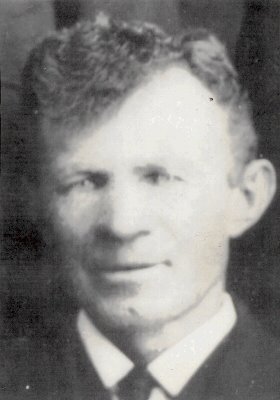
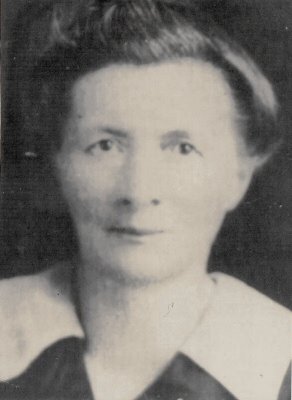
My German Ancestors, George and Elisabeth Sees

My mother's grandparents
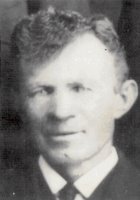

George SeesGeorge C. Sees, born July 24, 1865
Parents: John and Susan Süß
Elisabeth Keller SeesElisabeth Keller Sees, born December 7, 1866
Parents: Andrew and Elisabeth Keller


For a couple of weeks, the Pondering Pig has been writing about Willa Cather. Cather's O Pioneers and My Antonia describe Nebraska during the days when my four sets of great-grandparents were establishing themselves there. And recently, I've been discussing the Gordon (Nebraska) area with Runaway Imagination. His father's people were from Western Nebraska.

I've been meditating on these things, and as I was putting away some photographs yesterday, my hands fell upon the photos of the little German villages my great-grandparents came from. From thence, the following...

_ _ _ _ _ _ _


We spent a few days visiting Dellfeld and Nünschweiler, Germany in November of 1990. The two little villages are located across a field and over a hill from each other in Rheinland-Pfalz near Pirmassens and Zweibrucken. Great-grandma Sees was born in Dellfeld and Great-grandpa Sees was born in Nünschweiler.

We were living in Berlin with my husband's job, and we rented a car and drove out into west Germany, almost to France. Keely was five years old, so she has some memories of the trip, and Isaac was about 16 months.

I labeled the photos I took there and wrote six pages about the trip. When I looked at the notes and photos again yesterday, I was surprised how much I had forgotten about our visit there. Those memories would be gone forever if I hadn't written them down. At the time I did all that documentation to share the experience with my mother. Now I find I was writing for myself as well!

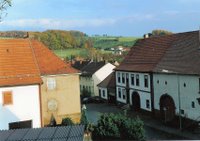
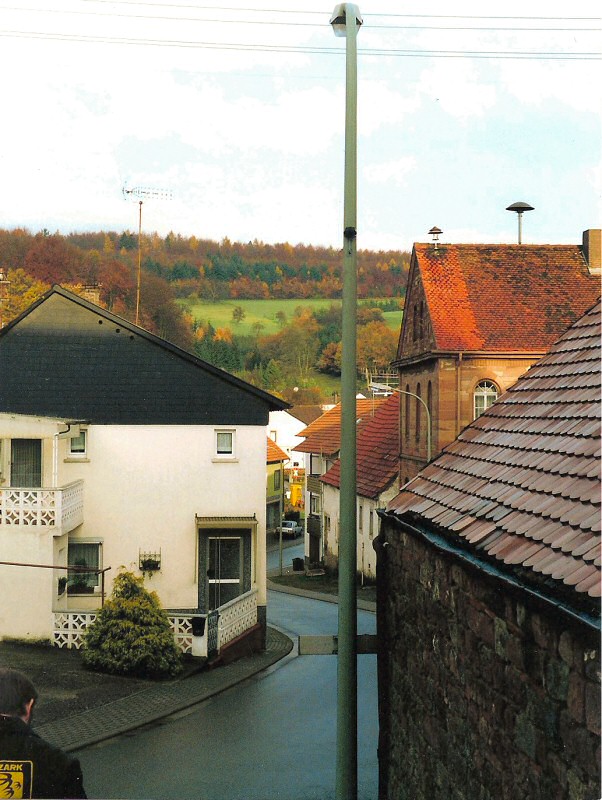
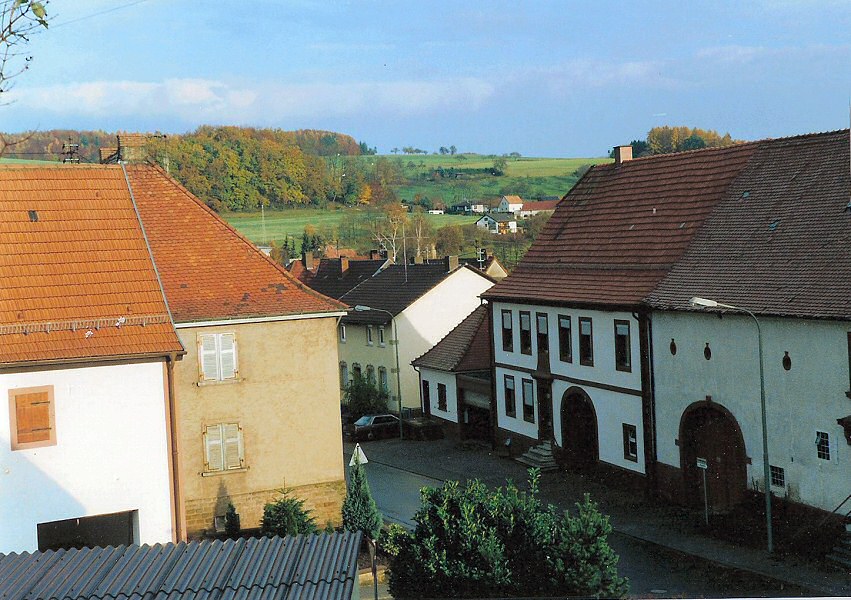
Here are a few images from Dellfeld where Elisabeth Keller was born.
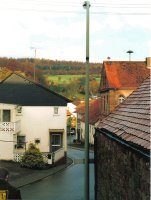
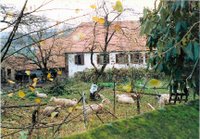
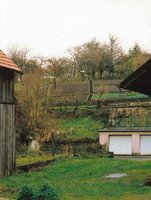
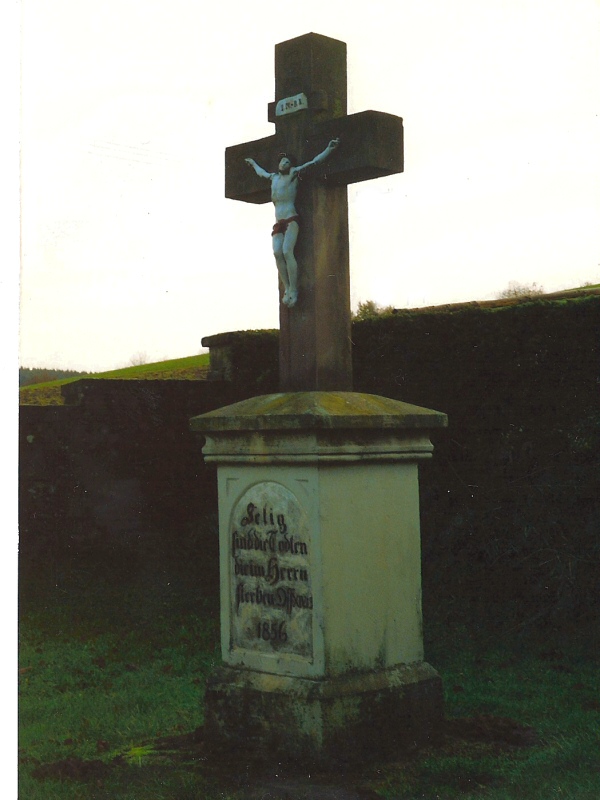
View from a Dellfeld streetDellfeld street and countryside Dellfeld from the cemeteryDellfeld as seen from the cemetery
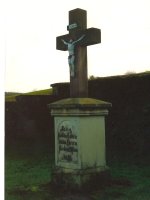
Dellfeld cemeteryIn the Dellfeld cemetery
Our dead in God, 1856 (poor translation)
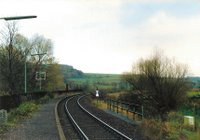
Dellfeld train crossingOutskirts of Dellfeld


And here are some photos from Nünschweiler, the childhood home of George Süß. The name was also spelled "Süss". George americanized it to "Sees" because, he said, no one knew how to pronounce or write his German name.
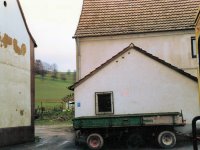
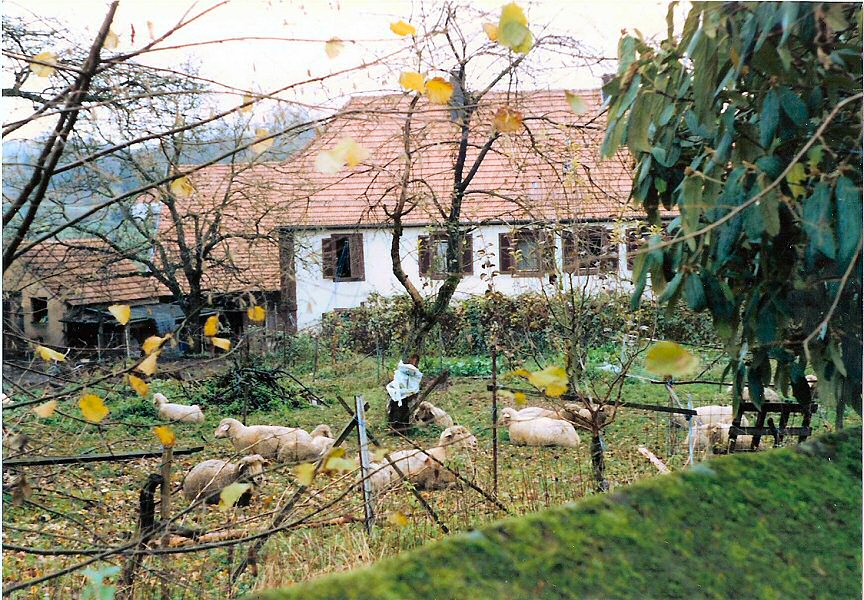
Farm wagonNünschweiler is still a farming village. Sheep in NünschweilerSeen from the back of the cemetery

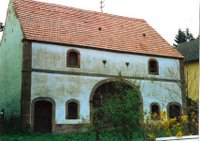
Barn in NünschweilerA barn in Nünschweiler Hillside gardensHillside gardens


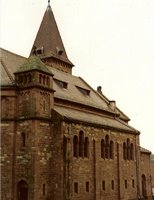
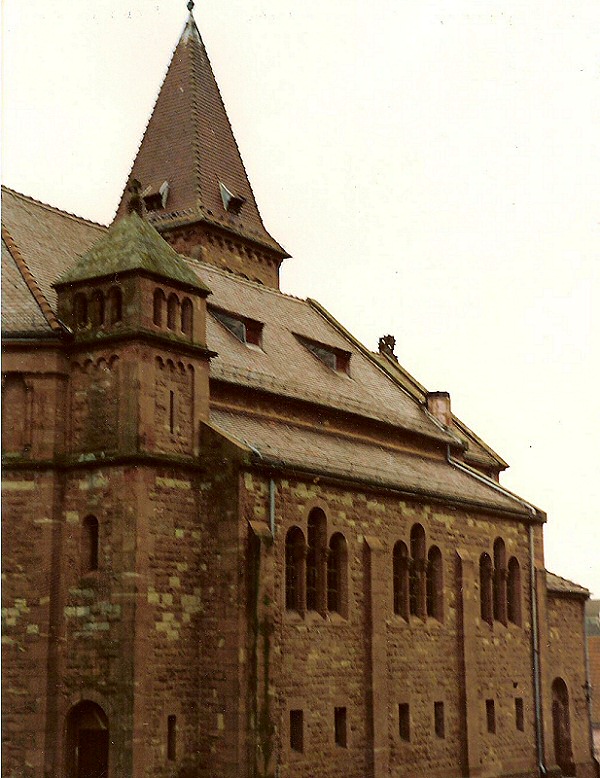
Old church in Nünschweiler
This old church in Nünschweiler would have been around during my great grandparent's time! I believe it is a Lutheran church. George and Elisabeth were Lutherans and they converted to Methodism in Gordon, perhaps in one of the tent revival meetings of that day.

An interesting side story about Elisabeth: as a young girl, Elisabeth was a maid in a house near (or next to) a convent. She learned that children lived in the convent, and she believed their parents to be priests and nuns. Whether or not this was the case, the purity of the Catholic Church was forever tainted in her eyes.

George came to America first and worked for a few years building railroads in the American west. My mother always said that he was about to be conscripted into the German army when he made a break for America. Cousin Alta (like my mother, a Sees grandchild) had a story about George stowing away on a ship. Supposedly, he got so hungry he had to come out, and the captain allowed him to work in return for his board and keep for the rest of the voyage. I view this story with some skepticism, having disproved a similar stowaway story on the other side of my family.

After a few years in America, George decided he needed a wife, so he traveled back to Germany and chose a German girl who was working in Dellfeld, just over the hill from Nünschweiler, the village where he grew up. I don't know whether they were acquainted with each other already or if someone made the arrangements. George and Elisabeth had to leave Germany quickly because when the local government found he was home, they tried again to put him in the army.

George and Elisabeth were married at St. Paul, Nebraska, but the ship's log for their voyage across the ocean shows that they registered as a married couple. Since Elisabeth came through customs as Elisabeth Suss, that is the name she gave for the marriage license. 

America surely held more promise for Elisabeth than Germany did. After her father died suddenly at a young age (from a burst appendix), her mother married a man who raped Elisabeth's twin sister. She died from her injuries, as I understand it. (This was discussed at a Sees cousins' reunion that I attended in about 2000.) I don't know what age the girls were when this happened.

Then Elisabeth's mother died as well, leaving Elisabeth and her brother Andrew orphans. Cousin Alta thinks that Elisabeth's mother also suffered a burst appendix. At any rate, when Elisabeth decided to go to America and marry George, she was on her own without mother or father, and she was earning a living as a servant.

During their first year of marriage, George amd Elisabeth lived with and worked for a cousin of George's near Grand Island, Nebraska. Later, they lived near St. Paul, Nebraska, where an infant daughter (Caroline) was buried.  Thereafter, they lived in New Mexico for a while, and then Agenda, Kansas, before finally buying a farm at Gordon. By then, there were five children.

My mother said her father, Harry Sees, told a story about the arrival of the Sees family in Gordon. As the train pulled in, her father observed some Indians chasing down a stray dog. When they caught it, they butchered it and cooked it over a fire.

I am not sure where George and Elisabeth homesteaded, but it was near Gordon, Nebraska. The land is now owned by descendants of the oldest daughter, Elva Sees Hix.

George knew some English already when he came to America, and he improved it while working on the railroads. (Alta thinks that George's mother may have been English in nationality. I don't know anything to either prove or disprove this. My mother's family tree papers show that George's mother was Susanna Steffan, but no other information is given -- not even a date of birth or death.)

Elisabeth spoke only German when she came to America, and she didn't learn English until her children went to school. Then she made them teach her each night what they had learned at school that day.

My mother told a story about World War I when anti-German sentiment was running high. A group of unfriendly people gathered outside the George Sees farmhouse one night. (I don't know how many people were in the crowd, but I'll bet most of them had been drinking.) My great-grandfather took his citizenship papers in hand and shook them at the people who dared to threaten his family and farm. This is the part of the story that I remember best, but my brother says that George also let the crowd in his yard know that he and his three strong sons (including my Grandpa Harry) would return in kind any damage that they suffered. The thugs left, and that was the end of it.

Another story my mother told was about George's bother Jakob. He came to visit from Germany but he didn't like it in America so he went back home. Elisabeth told my mother that Jakob set his boots outside his bedroom door, expecting her to clean them, but she ignored them. Elisabeth said Jakob seemed to think he was still in Germany, but she was an American woman!

Elisabeth's influence on my mother was significant because Mama's mother, Violet Eaton Sees, had passed away when Mama was eight years old. When my mother went to high school, she lived in town with George and Elisabeth, who were getting older and needed some help. Mama talked about doing many chores for them, particularly taking care of the chickens and cleaning the henhouse. During the four school years she lived with them, she was tutored in the family stories by her grandparents.

When I learned some German, I recognized the German influence in my mother's speech. I think she picked up the German words and idioms from her grandparents as well as her father.

As World War II approached and Nazi Germany began to flex its muscle, George and Elisabeth blamed  power-hungry political and military leaders. They shook their heads and said, "It isn't the people, it isn't the people!"  They did not live long enough to witness the horrors of World War II.  George passed away on July 27, 1940, and Elisabeth passed away on August 26, 1940.

George and Elisabeth Sees are buried in the Gordon cemetery, on the south side. I don't know what George died from, but my mother thought Elisabeth may have had undiagnosed leukemia.  (Leukemia is the curse of the Sees family).

The last communication that my mother remembered with the German branch of the Süß or Süss family was after World War II. They wrote asking the Sees family at Gordon to send soap and other items that were unavailable in Germany. The items were sent, and that seems to have been the last communication.

I don't believe Great-grandma Elisabeth had much (if any) contact with her family after she left Germany. My mother never mentioned anything about the Kellers.

I was not able to meet any relatives when we visited the ancestral villages, but I did find some tombstones in the Nünschweiler cemeteries bearing the names Süß and Süss. There were several Jakobs. We were told of a Dr. Lora Süss from Dellfeld, but she seemed to be out of town and we were not able to return due to the limits of our schedule.

Later, my mother was contacted by descendants of a cousin of George Sees who had also visited Dellfeld and Nünschweiler doing family research. (This explains why the German lady at the Dellfeld post office told me that I was the second American who had come asking about the Süss family.) I believe the cousin's last name was Stenger, Stanger, or something along that line. (Please correct me, if you know.) Mama wrote down some family tree information and passed it on to them.

And there you have it, kids. I wrote it down for you. It's up to you to save it and pass it on. Just remember that my great-grandparents are your great-great grandparents.
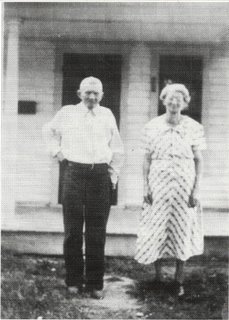

George and Elisabeth Sees, probably during the 1930's.

Related post: Dellfeld and Nünschweiler

Updated 8/27/2010
Please let me know if additions or corrections should be made!
Related Posts Plugin for WordPress, Blogger...

CONTENTMENT: Keep your heart free from hate, your mind from worry, live simply, expect little, give much, sing often, pray always, forget self, think of others and their feelings, fill your heart with love, scatter sunshine. These are the tried links in the golden chain of contentment.
(Author unknown)

IT IS STILL BEST to be honest and truthful; to make the most of what we have; to be happy with simple pleasure; and to be cheerful and have courage when things go wrong.
(Laura Ingalls Wilder, 1867-1957)

Thanks for reading.