Showing posts with label environment. Show all posts

Friday, March 02, 2012

Recreational Mowing

Unfriendly to wildlife


Kentucky Living, a little magazine we receive from our electrical cooperative, has a great column about recreational mowing this month. Dave Baker, the author, writes that unnecessary mowing removes cover and food that wildlife needs to survive.

Baker talks mostly about the regular mowing of pastures for no reason except appearance (vanity.) Clipping a pasture all the time makes it an inhospitable place for the little creatures who share the land. Wildlife needs the cover of tall vegetation for protection and the seed heads of full-grown vegetation for food.

And, though Baker didn't mention it, all that recreational mowing burns a lot of gasoline for no good reason, too.

I know people who mow several acres --even five acres or more -- around their house a couple times a week during the grassy months of the year. If everyone who's doing that would mow half as much, half as often, think of the many, many gallons of gasoline that would be saved.

And think of all the wildlife habitat that would be created on the half that was allowed to grow. Yes, even in your yard, wildlife appreciates vegetation that's allowed to grow and mature.

A freshly mowed expanse,  photographed by Tim Ebbs.

Monday, April 27, 2009

Grasses of the Nebraska Prairies, 1903

Grasslands of Brown County, Nebraska


The Charlie Youngman Ranch, Brown County, Nebraska,
about 1900. Photographer: Solomon Butcher

In a century-old book digitized by Google, I found an interesting fact about Brown County, Nebraska.

At the 1903 state fair, Brown county exhibited over 160 varieties of native grasses, which was twenty-five more than were shown by any other county. For the most part these were forage grasses, and they indicate that Brown county was intended by nature to be the home of cattle and horses. It is not uncommon for them to go through the winter entirely upon the range, though this is not to be depended upon. Probably, the largest single interest in the county is its cattle, and for several years past they have brought to the county a large income.

Source: Resources of Nebraska (page 25), by the Nebraska Bureau of Labor and Industrial Statistics, published in 1904.

It should be noted that buffalo, elk, deer, antelope and many other forms of wildlife made good use of Brown County's grasslands long before they were "intended by nature" as a home for cattle and horses.

Science, a 1901 publication of the American Association for the Advancement of Science, states that 170 different species of grass had been identified in the Nebraska Sandhills. What a wealth of grass! Brown County's exhibit of over 160 different grasses may have represented a variety of Sandhills grasses along with other native grass species. The terrain of Brown County is varied.

Brown County is located in north central Nebraska, near the South Dakota state line. It borders on the east with Rock County, where I grew up. My father grew up at Moon Lake, in southwestern Brown County.

Related:
2.4 MB high definition version of the Solomon Butcher photo at the top of this post
Photos from the O'Hare Ranch in western Brown County

These photo tours have some nice shots of the Sandhills prairie, though no images from Brown County:
Photo tour of the Sandhills and northwestern Nebraska
Another photo tour of the Sandhills

UPDATE:
The primeval prairies of Brown County are described in a little book published in 1937, Days of Yore, Early History of Brown County, Nebraska, compiled by Lillian L. Jones. The following quote is from the section about "Early History".

Let us try to imagine what this portion of Nebraska was like before the coming of the white settlers. A great expanse of prairie, slightly rolling, spread out on every side as far as the eye could reach, most of it covered with a rich growth of grass. Some varieties of this grass were tall with stiff, straight stems, some of low growth with delicate, curling blades. Here and there were running streams which were hidden in canyons or ravines where trees and shrubs were found, but until the edge of the canyon was reached the entire country appeared to be "a sea of grass," which stretched ever on and on toward the setting sun.

In the section titled "Ainsworth, Reminiscent", Jones mentions another first prize won at the State Fair for a native grass collection. The winning collection of "nearly one hundred varieties of native grasses found in this county" was made by C. W. Potter, W. H. Peck and J. E. Stauffer.

Friday, April 27, 2007

Advice for Mushroom Hunters

More About Trees and Plants... Some Interesting News...


This advice comes from the Mammoth Cave National Park mushrooming regulations.

Mammoth Cave is a popular place to hunt morels, and park rangers are concerned that the morel population may be seriously affected by the volume of mushrooms that is removed each spring.

Regulations designed to prevent a depletion include the following:
  • No more than 2 gallons of morels per person per day may be removed.
  • Morels must be collected and carried in a mesh bag (like the bags that onions are packed in) so the spores can fall out and propagate the species.
These are sensible suggestions for mushroom hunters all the time, not just in Mammoth Park, especially the one about the mesh bag. We don't want mushrooms to go extinct. They're too good!

From a news item in Kentucky Living, May 2007, Volume 61, No. 5, p. 21.

Technorati Technorati tags: , ,

Thursday, March 29, 2007

The Nightly Walk

All In The Family... Life in Christian County, Kentucky... The Rural Life...


Rural road with horse and buggy hazard signThe road where we've been walking

Isaac and I have been taking an evening walk whenever we can, and we find ourselves returning to the same little road nearly every time.

It's such a narrow, quiet road that it's like following a path through the woods -- and I suppose that it was a path once. We haven't yet seen a horse and buggy on the road despite the warning sign at our starting point, and we usually meet only one or two automobiles.

A Mennonite family lives along our route, but their place is hidden by the trees. Their buildings are newly-built because no one has ever lived there before. I think they moved here about a year ago.

Young redbud blooming A young redbud tree beside this country road
The cemetery that Isaac restored for his Eagle Scout project (see the links below) is out in the pasture along this road. We can see it from the road, but if we didn't know it was there, we'd never notice it.

We turn around at the point that the road changes from gravel to blacktop, but another Mennonite family lives farther down the road on the blacktop part. The wife runs a greenhouse, and she is one of the most gifted gardeners and landscapers I've ever known.

She doesn't advertise, but she does a lot of business, especially in the spring. Her prices are reasonable, she has a good selection of healthy plants and she always throws in something for free. Cars are always parked in front of the greenhouse with their trunks open, and you will probably see some horses and buggies tied to the hitching posts, too.

After walking the gravel part of this rustic country road a few times, we decided we'd pick up the many aluminum cans in its ditches and recycle them. We got most of them in a couple nights, and we are still finding one every now and then. They are mostly beer cans. Apparently the teenagers party on this road, or perhaps it is the hunters.

Tonight we started picking up some of the dozens of glass and plastic bottles in the ditches. We both filled our Wal-Mart sack in just a short distance. All of the glass is beer bottles, of course, and all of the plastic is soda bottles. We decided we would leave the paper litter since it will bio-degrade eventually.

This project will take a few weeks, but we hope to get that scenic little country road cleaned up.

I don't know the name of the plant below, so please tell me if you know it! It looks like it may turn into a vine? I saw it along the roadside at the base of a tree.

What is the name of this plant? What is the name of this plant?


Related posts:
Mid-March in the Kentucky Countryside
Eagle Project is Taking Shape
Eagle Project Begun
Peaceful Valley

Thursday, September 28, 2006

National Change A Light Day

Some Interesting News...


To help conserve energy, everyone is encouraged to replace one traditional light bulb with a compact fluorescent bulb on October 4 (next Wednesday), National Change A Light Day. If you feel motivated, you can even take the pledge.

I've been replacing our old-style light bulbs for a while. I think I've done all the lights in the house except those in the ceiling fixtures in the bedrooms.

The price of compact fluorescent bulbs makes it difficult to make the switch all at once. At Sam's Club, the bulbs are the cheapest I've seen -- about $13 for a pack of eight fluorescent bulbs with glass spirals (not the pear-shaped fluorescent bulbs.)

I can't say that I've seen a lot of reduction in our electric bill since I've been putting in fluorescent bulbs, but I hope it helps the nation's energy situation. Kentucky Living, the magazine we receive from our electric company, offers the following statistics in the September 2006 issue (print edition):

Organizers note that if every American household replaced one traditional light with an Energy Star-qualified compact fluorescent bulb, it would save enough energy to light 7 million homes, save $600 million in utility bills, and reduce greenhouse gas emissions equivalent to 1 million cars.

One last point of interest that's somewhat related: did you know that the German word for lightbulb --glühbirne -- means literally "glowing pear?"

Technorati tags:


Sunday, June 25, 2006

A Composter, But Not an Organic Gardener

The Rural Life... More About Trees and Plants...


Last fall, I raked some of the fallen leaves in our yard onto a big sheet of plastic and drug them to the garden. There, I dumped them into a cage made from welded-wire fencing and steel fence posts. On top of each load of leaves, I sprinkled a small coffee-can of high-nitrogen granular fertilizer to help accelerate the breakdown of the leaves into compost.

I used fertilizer because I didn't feel like hauling a load of manure. Leaves composted with manure make a great compost. The manure provides nitrogen to accelerate the breakdown of the carbon compounds in the leaves, as well as microorganisms to set the process in motion. (Don't be surprised if some seeds in the manure survive and sprout in the garden.)

When winter set in, I had a daily tray of ashes from the wood stove, so I started dumping them on the leaf pile too. I tried to be careful to let the ashes cool for at least 24 hours, but I did accidentally throw out some live coals one day. Before long, a little column of smoke was rising from the leaves, so I had to get out the hose and water it down. Lesson: be careful with ashes!

I should have tossed the leaves around during the winter to aerate them, but I didn't. By spring, a big pile of ashes had built up, and the ash and leaf combination was a heavy, hard-to-shovel mass. My shoulder was giving me problems at the time, so I had to get Isaac to mix them up. We tossed in some more fertilizer and soaked the pile thoroughly with the garden hose a few times.

I don't know if it was a good idea or not to put the ashes in the compost. Wood ashes contain acid-neutralizing chemicals just as lime does. However, those chemicals leach out rapidly when the ashes are wet, so I don't know how much nutrient the compost has retained from the ashes.

In addition, I recently read that ashes can raise the pH of the compost pile so much that it inhibits the microorganisms that cause decomposition. Maybe that's why the leaves didn't break down much through a long wet winter, despite being laced with granular fertilizer.

The leaves have been composting in their cage for about eight months now. I planted my tomatoes and peppers around the outside edge of the cage, and they are flourishing. I've been using some of the leaf compost as a mulch in the garden, over sheets of newspaper. It keeps the weeds down very well, and of course the leaves don't have any seeds in them to sprout.

GardeningUnfortunately, our yard has a lot of Bermuda grass in it. It's an African grass that spreads aggressively by seed, by casting out long runners, and by sending up sprouts from a tangled mass of wiry roots. It can be eradicated organically by digging out the roots, but every scrap of root must be removed or it will grow back.

After years of trying to keep it out of the garden by hand, I have finally started using a herbicide around the perimeters. Then I dig out by hand any that dares to grow within my declared BFZ (Bermuda-free Zone).

I'm going to spray around the outside edges of the garden this week with an all-season herbicide. I'll do it on a day when the air is still, and I'll use a large piece of cardboard to help keep the spray from drifting into the garden. I plant flowers around the garden edge, so the vegetables have a little buffer zone between them and the herbicide.

Bermuda grass takes much of the joy out of having beds of perennial flowers and plants. I desperately need to get the Bermuda out of my iris beds, for example. I'm going to clip the grass as close to the ground as possible with grass shears, and then spray with Grass-B-Gone, which is an Ortho herbicide that kills grass only.

I used to be a dedicated organic gardener, but Bermuda grass has changed my attitude. I still try to stay mostly organic within the garden, but around the edges and in the flower beds, I don't mind using some chemicals. If the end of this post has started to sound a little like an Ortho commercial, it's because I've learned that their products work!

Technorati tags:


Wednesday, June 14, 2006

Trumpet Vine

Life in The Upper South... More About Trees and Plants...


Trumpet vine

Here's a bit of trumpet vine, growing alongside our lane. It seems to be struggling a little, perhaps because of a lack of sunshine or perhaps from competition from the aggressive alien invader, honeysuckle. I think I see some honeysuckle foliage at the bottom of the photo.

Lack of sunshine is usually just a temporary problem for a trumpet vine. In its passion for a place in the sun, it will cover any available supporting structures, whether trees, bushes, a trellis or arbor or even a house.

The vigor of the trumpet vine should not be underestimated. In warm weather, it puts out huge numbers of tendrils that grab onto every available surface, and eventually expand into heavy woody stems several centimeters in diameter. It grows well on arbors, fences, and trees, although it may dismember them in the process. Ruthless pruning is recommended.

Source: Wikipedia's article about trumpet vine


However, in competitions between honeysuckle and trumpet vine, honeysuckle will choke out trumpet vine and take its place. In the time we've lived here, I've seen this happen in my own yard.

Technorati tags:


Friday, June 02, 2006

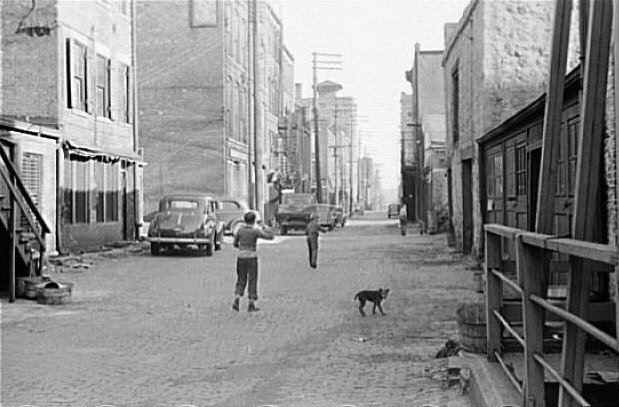
Alleys and New Urbanism

And What I Think About It...


Alley
Boys playing in an alley, Dubuque, Iowa. Photographed by John Vachon, Farm Security Administration, 1940. Library of Congress, Prints & Photographs Division, FSA-OWI Collection, [LC-USF33-T01-001703-M2 DLC]


- - - - - - - - - -

Wikipedia defines an alley as "a narrow street found in urban areas". The article continues:

The reduced usage of alleys has resulted in their decline. Under use, poor maintenance, poor night time illumination and narrow width has contributed to an increase in anti-social or illegal activities such as:

* dumping of rubbish
* sexual assault
* consensual sexual behaviour and/or prostitution
* urination
* burglary
* robbery
* illicit drug use
* murders

Source


Some alleys do host these activities, but it seems to me that the reputation of many a mild-mannered, well-behaved alley is tainted by this list.

I have some pleasant memories associated with alleys. I enjoyed the narrow, ancient alleys in the historic downtown areas of two Bavarian villages -- Sulzbach (history) and Kleinwallstadt -- where we lived in Germany, and never saw a hint of any of the dubious activities listed above or felt I was in any danger.

When we lived in Warrensburg, MO, I walked my dog daily in an alley that ran for ten blocks or more. It was a lovely quiet walk, shaded by the backyard trees of the homes the alley served. Most of the alley was brick-paved, but there was rarely any vehicle traffic at all.

That residential alley wouldn't have been so quiet when the houses were young. It was once used for deliveries of ice, coal, and groceries to the rear of the house, to be carried in through the back door.

Nowadays, homeowners still bring many purchases through the back door, but the deliveries are made by the family automobile, which is driven down the street and parked beside the house or in the attached garage. I suppose that's why planners started omitting the alleys just like they forgot about sidewalks. With cars, who needs them?

New Urbanism is a movement and a school of thought that seeks to reverse urban sprawl and the problems associated with it by better city planning. A community should have connectivity, New Urbanists say-- that is, communities need a network of boulevards, smaller streets, alleys, and sidewalks.

As well as dispersing the vehicle traffic, such a web between homes, stores, and other business places makes walking and biking easier, more efficient and more pleasant. Alleys in New Urban communities often provide access to the home's garage.

This sounds right to me.

Technorati tags:


Tuesday, February 07, 2006

Water problems in Kansas

Problems with the Ogallala Aquifer


ULYSSES - The prairie spreads for miles here in stubby, ashen-colored patches. Irrigation pivots spray out in circles, each minute sucking up hundreds of gallons of cold water from beneath the oil fields...

The vast underground pool that fills Ulysses' faucets, called the Ogallala Aquifer, is running low, forcing towns and farmers to spend beyond their means to tap alternative sources.

Quoted from: "As aquifer dries, 'water is like gold'" by Garance Burke. Associated Press, February 6, 2006.
Map of Kansas courtesy of Wikipedia. The blue county is Grant County
where Ulysses is the county seat.
The red county is Kingman
County, where my brother and sister-in-law live.

This article is based on Ulysses, Kansas, a few counties west of where my brother and sister-in-law live. I talked to Kathy a few days ago, and she said it was very dry there. They hadn't been threatened by prairie fires in their immediate area, but they had smelled the smoke from fires in Oklahoma.

For the past couple of decades, southwest Kansas has been going through a significant dry spell. The chronic lack of rain makes farmers depend on irrigation -- and irrigation is a big drain on the Ogallala Aquifer. "Massive irrigation in western Kansas is depleting the Ogallala Aquifer from 5 percent to 7 percent every 25 years, according to a new report by the Kansas Geological Survey," writes Scott Rothschild in an article in the February 7, 2006, Lawrence Journal-World.

These articles don't say much about big cities that depend upon the aquifer, but they should be required to practice strict water conservation right along with the farmers.

When I was a child in the Nebraska Sandhills, we learned in school that water was easily accessible in the Sandhills because we had the Ogallala Aquifer beneath us. Our teacher told us that the Sandhills were like a big sponge that held water. Even though the land might appear arid, even desert-like, we could be sure that water was just beneath the surface.

Willa Cather wrote that in the Sandhills, the coyotes knew how to dig down to water. We children could have gone outside and dug down to water ourselves. Artesian wells were common in low areas of the valley where I grew up.

We ranch kids saw everyday evidence of the abundance of water in the windmill-powered wells that supplied water to the cattle. Water was one thing we had plenty of in the Sandhills. Rain might or might not come, but there was always water, and usually plenty of wind to pump it.

I am remembering the days before center-pivot irrigation systems were invented -- the days before corn was planted on many pieces of marginally-farmable land.

The depletion of the Ogallala Aquifer will have a great impact on the farm and ranch folks of the Great Plains. I have great affection and respect for those who still make their living from the prairie land. I fear that desertification will drive more of them off the land, and that the land will continue to pass from the hands of individuals to the hands of corporations.

Two related thoughts occur to me.
  1. Is there really any hope of bio-fuels becoming an oil substitute if we're in danger of running out of water in America's bread-basket?
  2. Doesn't the prospect of running out of water make it extremely important to develop drought-tolerant crops? I think genetic modification may become a necessity, not a choice.
Related Posts Plugin for WordPress, Blogger...

CONTENTMENT: Keep your heart free from hate, your mind from worry, live simply, expect little, give much, sing often, pray always, forget self, think of others and their feelings, fill your heart with love, scatter sunshine. These are the tried links in the golden chain of contentment.
(Author unknown)

IT IS STILL BEST to be honest and truthful; to make the most of what we have; to be happy with simple pleasure; and to be cheerful and have courage when things go wrong.
(Laura Ingalls Wilder, 1867-1957)

Thanks for reading.