Showing posts with label bridges. Show all posts

Thursday, January 19, 2012

Bridges at Cairo, Illinois

Railroads and ferries brought prosperity


A. B. Safford Memorial Museum in Cairo, Illinois, built in 1883

Cairo, Illinois, is at the extreme southern tip of Illinois, at the point where the Ohio and Mississippi Rivers converge.

I always have mixed feelings as I drive through Cairo (pronounced "Care-roh".) Sadly, the town has endured a long period of hard times and population loss. In the business district, empty lots suggest that many deteriorated buildings have been bulldozed and hauled away. Some old buildings, still standing, are candidates for the next demolition list.

I'm not sure if this church is in use.
But the town still has some fabulous old buildings. I always enjoy the architecture when life leads me to Cairo.

Cairo became an important railroad hub after the Civil War, and the town enjoyed several decades of great prosperity. Train cars (and other vehicles) were ferried across the rivers, and the ferry business was as important to local fortunes as the railroad and river-shipping businesses.
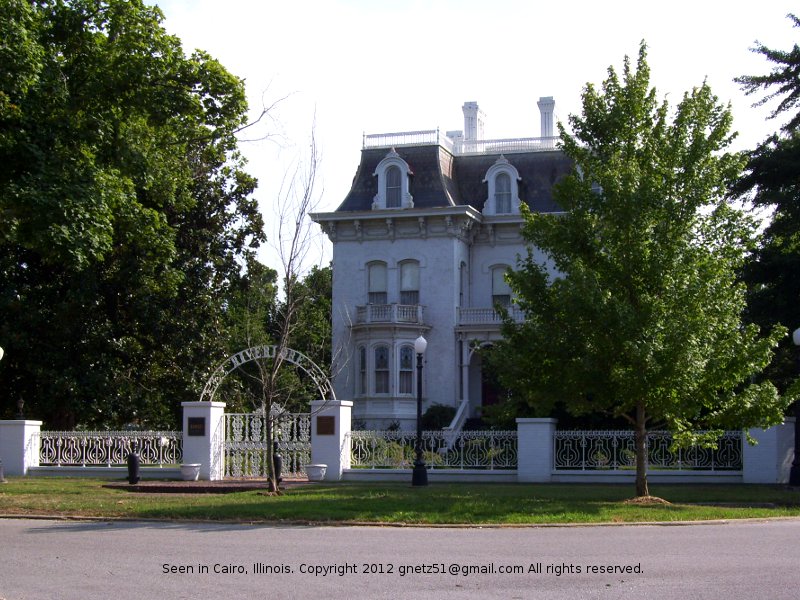
The Riverlore in Cairo, Illinois
During this era, a U.S. Customs House was built in Cairo to process goods from foreign countries.  The Cairo Post Office (a mail distribution center of major national importance) and a Federal court were also located in the Customs House.

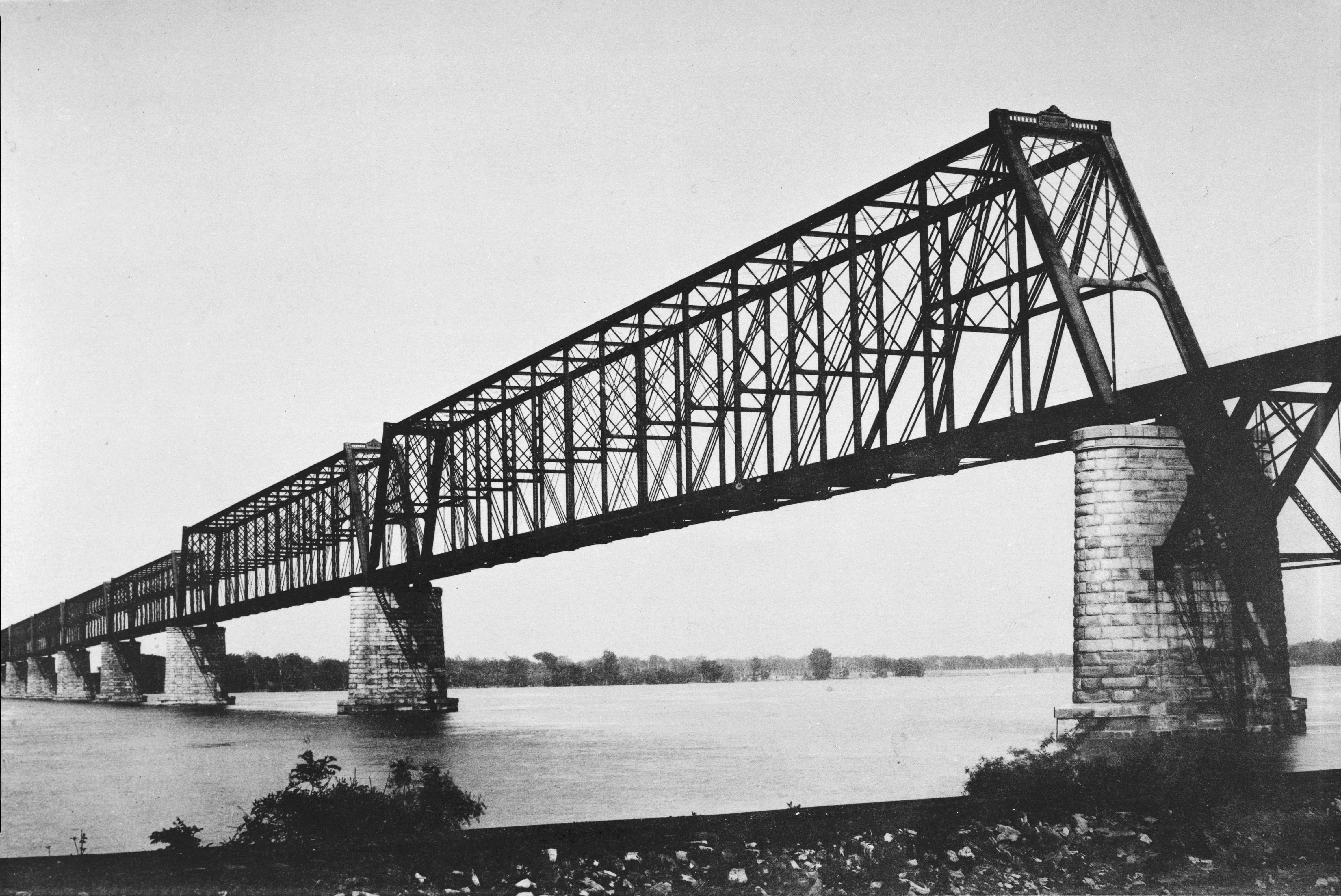
Then in 1889, the Illinois Central Railroad completed the Cairo Rail Bridge across the Ohio River (image, another image). It was a masterpiece of engineering. The metal bridge itself was nearly 2 miles long and the entire structure including the wooden approaches was almost 4 miles long. Freight from Chicago could travel directly to New Orleans via the Cairo Rail Bridge -- a revolution in rail shipping, but a blow to Cairo.

More mansions in Cairo
In 1905, a group of five railroads built the Thebes Rail Bridge over the Mississippi River, eliminating the need for railroad cars to be ferried at Cairo. Thebes, a town on the Mississippi River about 25 miles north of Cairo, was chosen for the bridge because the earth there was much firmer than at Cairo.

Vehicles traveling in the Cairo area still used the ferries until two highway bridges were built -- the Mississippi River bridge (leading to Missouri) in 1929, and the Ohio River bridge (leading to Kentucky) in 1937. The bridges and roads connected a short distance south of Cairo, so travelers could quickly cross both rivers without even entering town.

The loss of the railroad and ferry industries was significant, but it alone did not kill the town. By the early 1900s, other serious problems (racism, corruption, violence, crime) were well-established in Cairo. Over the next century, these evils had a slow-but-deadly effect on the town. You can read about the darker side of Cairo's history at "Cairo, Illinois, Death by Racism."

Overgrowth and disrepair, too!
Last summer, I traveled from Kentucky to Missouri. South of Cairo, I crossed the Ohio River bridge from Kentucky to Illinois, but the Mississippi River bridge south of Cairo was closed for repair. So I drove through Cairo, got on Interstate 57 a few miles north of town, and crossed over the Mississippi River and into Missouri on the I-57 bridge. A few days later, I drove through Cairo again on my way home. That's when I took these pictures.


Related:
A photo I took inside the Customs House some years ago
Seen at Wickliffe, Kentucky

Ohio River bridge, just south of Cairo

Wednesday, September 08, 2010

Eggner Ferry Bridge Repairs

In its final years


Eggner Ferry Bridge
Workmen were repairing one of the approaches to Eggner Ferry Bridge the last time I crossed Kentucky Lake. I found myself sitting on top of the bridge with twenty other cars, waiting to snake through the work zone. While I was parked in that unusual place, I took these photos of the bridge suspension from my car window.

Eggner Ferry Bridge is named for the Eggner Ferry that crossed the Tennessee River at that location for many years. The ferry ceased operation when this bridge was built across the river in 1932. In the early 1940s, the bridge was raised and extended before the Tennessee river was dammed* and Kentucky Lake was formed.

Eggner Ferry Bridge
We are now in 2010, and the Eggner River Bridge is far too narrow for the volume of traffic it sees.   A new 4-lane bridge is supposed to be completed by 2017. Highway 68/80 through Land Between the Lakes (LBL) is being made 4-lane, and a 4-lane bridge will be built over Lake Barkley on the east side of LBL.

In the meantime, the existing bridges must be repaired as necessary to keep them safe. These last few years are going to be especially rough on them because of all the heavy trucks bringing materials for the road and bridge construction.

I got these photos ready to post a couple of weeks ago, and now I see that I misspelled "Eggner" when I labeled them. They will have to stay that way for now. I've been having computer problems, and with the setup I'm using currently, I don't have much for photo-editing software to correct my error.  Like the bridges, my computers need some repair, maintenance, and eventual replacement!

__________

* Kentucky Dam on the Tennessee River and Barkley Dam on the Cumberland River are just two of many dams that were built by the Tennessee Valley Authority (TVA) during the 1930s and 1940s.

When Kentucky Dam and Barkley Dam were built, hundreds of families were relocated from the Tennessee River valley, the Cumberland River valley, and the Land Between the Rivers near the Kentucky/Tennessee border and northward. Hundreds of homes and buildings were torn down. Cemeteries were moved to high ground. The "Land Between The Rivers" became the "Land Between The Lakes" under TVA control. Much of the two lakes' outer shore lines was put under state control.

Related:
Old Bridges at Land Between the Lakes, KY
A Very Windy Day!

Kentucky Lake seen from Eggner Ferry Bridge
 

Sunday, August 12, 2007

Old Bridges at Land Between the Lakes, KY

Eggner's Ferry Bridge and Lawrence Memorial Bridge


The Eggner's Ferry Bridge on August 11, 2007

The Eggner's Ferry Bridge (pictured above) crosses the Tennessee River at Fenton, on the west side of Kentucky's Land Between the Lakes. The Lawrence Memorial Bridge crosses the Cumberland River at Canton, on the east side of Land Between the Lakes.

Both these long bridges were built in the early 1930s, before the rivers were dammed and the lakes were formed. Before Kentucky Lake was filled in 1944, Eggner's Ferry Bridge underwent modifications. According to explorekentuckylake.com, new pilings were built and the bridge was raised in 1943. The Lawrence Memorial Bridge underwent a similar procedure in preparation for the damming of the Cumberland River and the filling of Lake Barkley (which took place in the 1960s) .

Highway 68/80, the road on which these bridges lie, has become a major, well-traveled, east-west route through southern Kentucky. Most of the road is now 4-lane. Land Between the Lakes is a popular recreation spot for both tourists and residents, and many of these bridge-crossers are towing campers or boats behind them. All in all, a lot of traffic pours across these bridges every day.

The two bridges were declared functionally obsolete in their last inspection. They are scheduled to be replaced within the next decade, and that will be a good thing for the motorists who must cross them. The bridges are too narrow for modern traffic. It's not uncommon to hear of someone whose rear-view mirror was knocked off while crossing these bridges.

The new bridges will have 4-lanes with shoulders and an additional lane for foot and bicycle traffic. They will cost an unbelievable $80 to 100 million each. Highway 68/80 will also be made 4-lane through Land Between the Lakes. The project is still in its design phase. Construction won't start until 2008 or 2009, and it will take several years to complete.

School buses from Christian County are not allowed to cross the Lawrence Memorial or Eggner's Ferry bridges. When our high school teams play Murray (west of Land Between the Lakes), they travel about fifty miles farther so the buses can cross the rivers on I-24's wider, safer bridges.


Eggner's Ferry history


The Eggner's Ferry Bridge over the Tennessee River is named for the ferry that was there for many years before the bridge was built. The ferry was established by Milton Eggner, (who also ran a stagecoach business and had a mail-carrying contract) in the 1850s.

During the Civil War, Brig. Gen. Lloyd Tilghman mentioned Eggner's Ferry in a dispatch that warned of Union forces on the road to Murray. According to a listing of tavern licenses, in 1865, both Wm. Price and O. Walsdrop posted bonds and were licensed to operate a tavern at Eggner's Ferry. It is not clear if they operated the same tavern or different ones.

Eggner's Ferry is mentioned as an address in the 1924 obituary of Mr. Temolean ("Mollie" Leneave. An image of the Eggner Ferry when operated by John L. Jackson has been posted at Webshots by a Trigg county resident. Mr. Charles Hill Bradley, mentioned in a 1931 book of Calloway County biographies, owned an interest in the Eggner ferry and store. He may have been one of the last owners, because the bridge was built in 1932.


Read more:
"Bridge forum draws crowd", Murray Ledger

Updated 1/29/2012

Thursday, July 19, 2007

Railroad Bridges of St. Louis in 1920

St. Louis, a shipping and industry center of the Midwest in 1920


This description of the city of St. Louis, Missouri, is from my 1920 geography book:

The largest city on the rivers, corresponding to Chicago on the lakes, is ST. LOUIS, the fourth in size among our cities. It has a very favorable position in the center of the Mississippi Valley, on the Mississippi River near the mouths of its two largest tributaries.

The railway bridges across the Mississippi at this point have also had great influence on the growth of the city. It is an important shipping point both by water and by rail.

Like Chicago, St. Louis is one of our leading markets for grain and live stock; but being so far south, it handles Southern products also, especially cotton and tobacco.

Besides this, it is a great manufacturing center. It manufactures immense quantities of tobacco, beer, flour, clothing, iron, steel goods, and is the greatest manufacturing center of boots and shoes in the United States.

Source: World Geographies: Second Book (pp. 125-126) by Ralph S. Tarr and Frank M. McMurry. Copyrighted in 1920 and published by the MacMillan Company, New York, in 1922,


It's hard to imagine a big city like St. Louis depending on ferry boats to bring goods across the river, but that was the case until the Eads Bridge was built in the 1870s. In those days, ferry and steamboat companies fought against river bridges, fearing that their business would suffer.

In 1866 (just after the Civil War), Congress passed a law that specified minimum bridge height and span requirements to insure that river traffic would remain unobstructed by bridges. One of the bridges authorized in the act was the St. Louis Bridge that later became known as the Eads Bridge for its builder, James Eads.

Eads Bridge, completed in 1874, was the world's first steel truss bridge, a masterpiece of civil engineering. Its foundations were set on bedrock, and the length of its three spans (two are 500 feet and one is 520 feet) were unprecedented. It could carry two trains simultaneously on its lower level, and it carried vehicular and pedestrian traffic on the upper level. The Eads Bridge has been renovated and is still in use today.

The Terminal Railroad Association (TRRA) acquired ownership of the Eads Bridge shortly after it was built. For about 15 years, TRAA enjoyed a monopoly over rail traffic across the Mississippi for about 15 years. Finally, Merchants Bridge was built by a group of merchants who were tired of exorbitant freight rates. It opened in 1890.

For a few years, freight rates were more reasonable. However, following the Panic of 1893, Merchants Bridge was acquired by TRAA, and freight rates regained their former heights. In fact, freight rates were so high that ferries remained an alternative method of getting goods across the river into the 1920s. (Source.)

Merchants Bridge and its approaches were renovated in 1998 and 2005 to accommodate the heavy, tall freight of today's trains. It remains in service.

The McKinley Bridge opened in 1910. It is named for its the president of the company that built the bridge. It joined north St. Louis and Venice, Illinois. Automobile lanes were added to it during the 1930s (for the famous Route 66), but it was built as a railway bridge. It remained an important railroad crossing over the Mississippi until rail traffic decreased in the 1960s. Currently, McKinley Bridge is closed for renovation, but it is supposed to reopen for highway, bicycle, and pedestrian traffic in late 2007.

These are some of the early bridges that enabled St. Louis, Missouri, to become an major Midwestern crossroads of shipping by rail as well as by water. The ability to ship goods encouraged the growth of industry, and industry fueled the expansion of shipping. This is why the geography book's authors wrote, "The railway bridges across the Mississippi at this point have ... had great influence on the growth of the city."

Interesting links:
McKinley Bridge
Merchants Bridge
Eads Bridge
The Eads Bridge
Antique St, Louis Bridge Company stock certificate
Bridging the Ohio, Mississippi, and Missouri
Library of Congress Exhibit on Eads Bridge
St Louis Fun Facts and Trivia at about.com
Old Merchants Bridge postcard
PBS Video tour of the Eads Bridge in St. Louis

Interesting bit of trivia: The first bridge across the Mississippi at Hannibal, MO., was completed 3 years before the first bridge at St. Louis.

Related Posts Plugin for WordPress, Blogger...

CONTENTMENT: Keep your heart free from hate, your mind from worry, live simply, expect little, give much, sing often, pray always, forget self, think of others and their feelings, fill your heart with love, scatter sunshine. These are the tried links in the golden chain of contentment.
(Author unknown)

IT IS STILL BEST to be honest and truthful; to make the most of what we have; to be happy with simple pleasure; and to be cheerful and have courage when things go wrong.
(Laura Ingalls Wilder, 1867-1957)

Thanks for reading.