Showing posts with label poem. Show all posts

Sunday, December 31, 2006

Mouse Nest in the Woodpile

More About Birds and Animals...


Mouse NestWarm and cozy mouse nest


We found this beautiful little mouse nest yesterday while we were restacking the woodpile. I was much impressed with the skill with which the little creatures had made it. The nest was a warm, dry and cozy home in the woodpile, covered over above with split logs and a tarp. It was uninhabited, but I'm sure it's been full of baby mice at least once -- probably many times.

The nest is made mostly of chewed leaves and grass and some sort of hair (or something that looks like hair.) I don't know if they tear hair from their own bodies as some rabbits do or if they found some other source of hair or a hair-like substance.

Mind you, I don't like mice in my house, but they have their place in the ecosystem outside and I respect that. That being said, I've looked at a few dozen webpages about mice and their nests today, and I think this is the nest of a house mouse, a Central Asian species, that was introduced to the U.S. many years ago and is now one of the most problematic rodents in Kentucky (and the rest of the world.) One of their common nesting places is woodpiles!

Still, I felt a twinge of shame as we removed the nest and laid it on the ground. It was constructed so well that it held together when it was moved. I remembered the Robert Burns poem, To A Mouse. On turning her up in her nest with the plough.

I'm sure you've heard a phrase from one of the last stanzas of the poem:
The best-laid plans of mice and men often go awry.


There's much more to the poem, though, so if you haven't read it in full recently, it's well worth reviewing.

Technorati tags:


Wednesday, May 24, 2006

Walking home from school

Growing up in the Nebraska Sandhills


Back in the 1950's and 1960's, I attended a one-room country school like many ranch kids of Nebraska did (and still do!) The little stucco schoolhouse (Duff Valley District 4) was about two miles from our home.

My parents drove us to school in the morning, but in the afternoon we often walked home. The first mile was a county road. It was shaded by tall cottonwood trees until the bridge over Bloody Creek. After that, the road was unshaded and very sandy until we reached our mailbox.

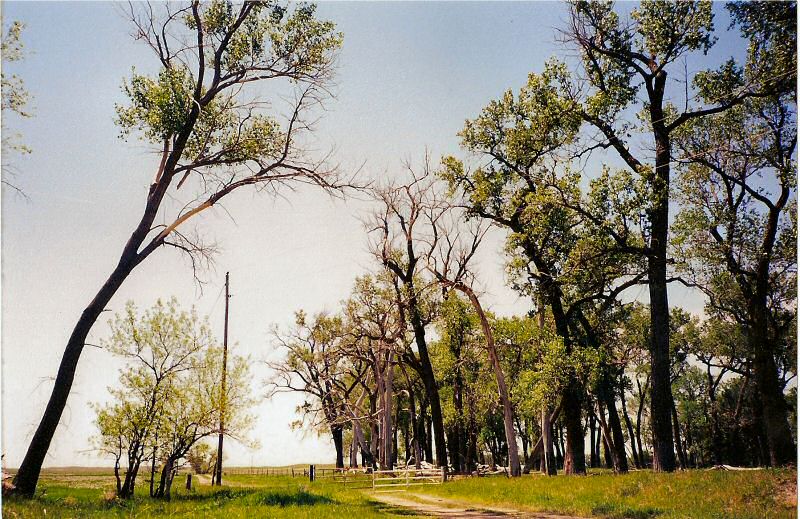
The ranch road
The ranch road, as seen a few years
ago from the corner where our mailbox
stood. In my childhood, this grove of
tall cottonwoods was in its prime.

The county road turned north at our mailbox, but we turned south onto our ranch road. After the first gate, we cut across the meadow and through the milkcow pasture. This route involved crossing two barbed wire fences, but it was worth it because of the distance it cut off.

We dawdled along the way when the weather was nice. I had trees that I liked to visit. One was a squat, prickly, cedar tree that grew along the roadside. I admired its silver berries and tasted the aromatic sap that oozed from its trunk. I was also fond of a big cottonwood that had fallen over in a storm but was still living. It was interesting to climb onto its trunk and walk through its branches.

If the bookmobile had visited our school recently, I clutched my lunchbox with one hand, held my book with the other and plodded along, lost in a story. Cars rarely came down the road, so I didn't worry about traffic.

Sometimes there were Brahma bulls in the Hollenbeck pasture. If so, my brother had to stay with me until we had passed them. He didn't like my dawdling, so he got a little switch and walked behind me to hurry me along. I don't remember him hitting me, but he did "encourage" me.

I regret to say that I may have used the same technique sometimes to hurry my little sister down the road a few years later. Sorry, Charlotte. (I have to confess this, or she will think I have painted an incomplete picture of our walking-home experiences.)

In the fall, we shuffled through dry brown leaves that had fallen from the cottonwood trees. In the ditches, cattails and milkweed pods invited us to pick them. Sandburs gathered in our shoelaces and the seeds of the dry prairie grasses stuck in our socks when we cut across the meadow and pasture.

On winter days, we walked fast. We were glad to turn south onto the ranch road and have the wind at our backs instead of across our faces. Our hands ached with cold before we got home, despite our mittens. Once I made the mistake of running warm water over my frozen hands to warm them. Don't try that-- it hurts!

If a winter storm was blowing in, someone always came to pick us up from school. Our teachers wouldn't have let us walk home in dangerous weather, anyway. Every native Nebraskan has heard the fearful story of the Schoolchildren's Blizzard and respects its lessons.

In the spring, the cottonwoods bloomed and made their little strings of cotton balls. One afternoon, my sister and I picked cottonwood blossoms and filled Laura Zlomke's mailbox with them. We thought it would be a nice surprise for her. (Laura was a widow lady who lived with her bachelor brother about 1/2 mile west of the school.)

When the frost went out and the last snowbanks melted, Bloody Creek ran full. A dirty white foam formed on the water's surface and collected in the weeds. It was obvious to me that the waters of Bloody Creek were at high tide. That's why the water was foamy, like the Tide suds in my mother's washing machine. (It made sense at the time.)

We threw leaves, shreds of bark, and little sticks into the water and watched them float under the bridge, out the other side, and away through the "tides" of Bloody Creek. We knew a little poem about boats that my mother liked to recite. She had learned it when she was a child. " ... Boats of mine a-boating— / When will all come home?"

Spring rains filled the ditches and flooded the meadows. When I waded too deep, the water pushed the tops of my overshoes against my shins just before it flowed inside them. If I carefully retreated when I felt my overshoe tops go wavy, my feet might stay dry. When the water spilled in, the rest of my walk home was squishy and squeaky.

When we finally arrived home, we sometimes found that Mama had left each of us a list of chores to do. She often went with my dad to help him do various things on the ranch, and the lists were intended to keep us out of trouble if we got home before she did. Those lists were what I really intended to write about when I started this, but I've dawdled along the road so much that I think that essay will wait for another day.

Saturday, April 15, 2006

Blogger sparks off 'Fib' poems craze across the internet

Some Interesting News...


Independent Online (UK), by David Usborne in New York
Published: 15 April 2006

Mathematics and poetry may be unlikely companions but a growing army of would-be wordsmiths is taking up a challenge to craft six-line verses that obey the disciplines of the so-called Fibonacci sequence.

It may be premature to call it a craze but it is somewhere close, according to the man who started it. He is Gregory Pincus, a screenwriter in Los Angeles who, two weeks ago, invited readers of his blog, Gottabook.blogspot.com, to try their hand at writing what he calls six-line "Fibs". Links to that invitation have since popped up on other blogs and websites.

Source: Blogger sparks off 'Fib' poems craze across the internet

Just so we can all join in the fun of fibbing, I have posted this article.

Saturday, April 08, 2006

Aging

I came across this in some old files today. When I copied and saved it eight years ago, my mirror wasn't malfunctioning nearly as badly as it is now.

I look in the mirror, and what do I see?
A strange looking person who cannot be me;
For I am much younger, not nearly so fat,
As the face in the mirror that I'm looking at.
Oh, where are the mirrors that I used to know,
Like the ones of thirty years or so ago?
All things have changed, and I'm sure you'll agree
Mirrors are not as good as they used to be!

Author Unknown

Tuesday, March 28, 2006

Try Again

History and Old Stuff...


Who hasn't heard the saying, "If at first you don't succeed, try, try again?" But have you ever read the poem from which it is taken?

Try Again

'TIS a lesson you should heed,
Try, try again;
If at first you don't succeed,
Try, try again;
Then your courage should appear,
For if you will persevere,
You will conquer, never fear,
Try, try again;

Once or twice, though you should fail,
Try, try again;
If you would at last prevail,
Try, try again;
If we strive, 'tis no disgrace
Though we do not win the race;
What should we do in that case?
Try, try again;

If you find your task is hard,
Try, try again;
Time will bring you your reward,
Try, try again;
All that other folk can do,
Why, with patience, may not you?
Only keep this rule in view,
Try, try again;

by William Edward Hickson (1803-1870)

Wednesday, March 01, 2006

Hopkinsville's Railroad

Life in Christian County, Kentucky... History and Old Stuff...
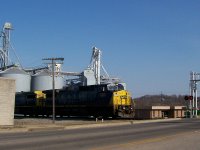


Train

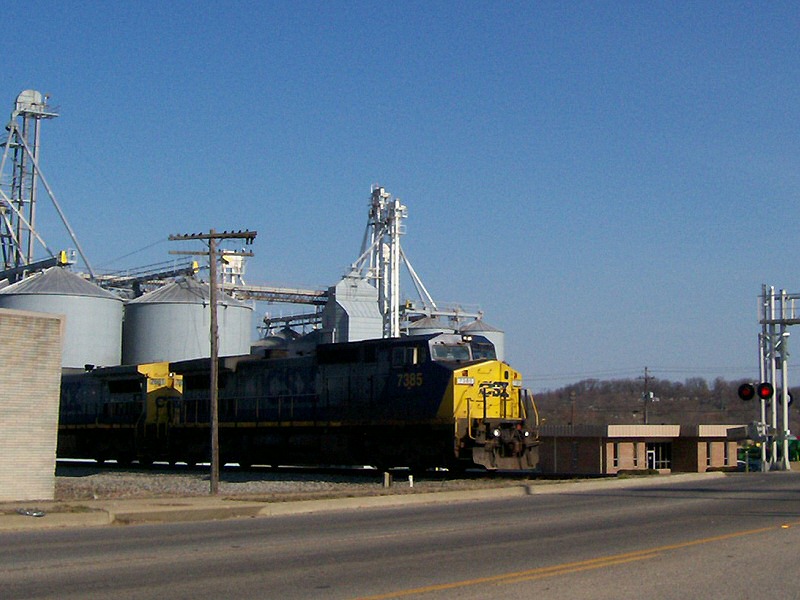
I had to stop this morning for a train that was rolling across Skyline Drive. A portion of the Hopkinsville Elevator Company can be seen at left. Grain is sometimes shipped from here on the railway, but coal from mining areas north of here is one of the main freights carried through town. The coal goes to Nashville and ultimately to coal-burning electric plants of the Southeastern U.S. (or so I have read.)

The CSX, formerly the Louisville-Nashville Railroad, is the line that goes through Hopkinsville. A nice article about the topic at hand: "Railfanning in Hopkinsville, Ky." can be read online. My photos here and the few lines of commentary I'm writing are not nearly as authoritative or researched. I took the photos below a few weeks ago on a day when the sky was gray, instead of nicely blue as it is today.
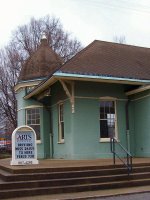

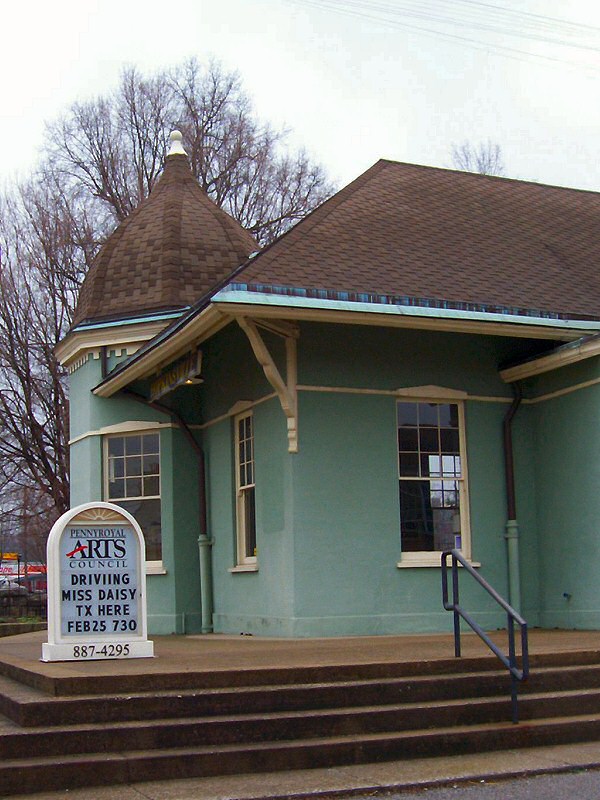
We have a picturesque old train station in Hopkinsville on Highway 68/80/41 (these highways converge for several blocks.) The old L&N (Louisville and Nashville) station is now the home of the Pennyrile Arts Council. The folks at the station are nearly always selling tickets for some sort of local cultural event and there's sometimes an art exhibit inside.
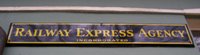

Several of these signs are posted high on the outside walls of the station.
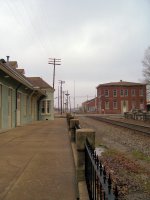


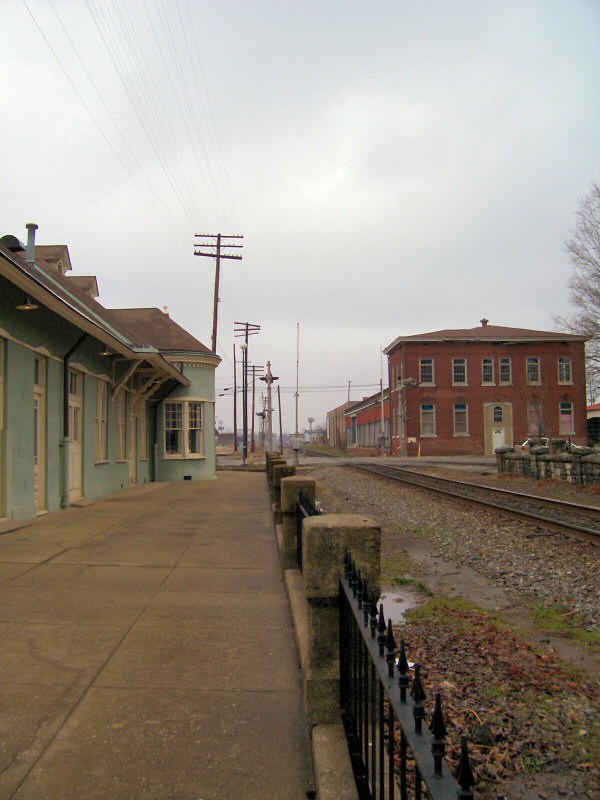
This photo looks north from the station's platform. The big brick building at right is the former L & N freight depot that currently houses a movie rental business. At the far right, a corner of the stone wall that encloses Peace Park can be seen. A tobacco warehouse owned by John O. Latham once stood on that block of real estate. After the warehouse was burned during the "Tobacco Wars" around 1910, Mr. Latham donated the land to the city as a park.
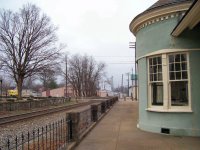


This photograph looks south from the station's platform. On the left of the photo, Peace Park is seen again. Farther down the tracks you can see a large pinkish tobacco warehouse. Tobacco companies buy directly from the farmers now so the warehouse is no longer used for storing or shipping tobacco. The grain elevators in the distance are one of the tallest features in Hopkinsville's skyline. I drove by them a few days ago, and I wasn't able to spot any convincing evidence that they are still in use.

The depot was built in 1892 and was still used for sending and receiving freight through the late 1960's. I like to imagine the depot at the turn of the century (about 1900, I mean), when the arrival of the trains were the biggest events of the day in Hopkinsville. The poem below describes the life of a retired farmer who enjoys meeting the train every day. I know it's long and it's in dialect, but try to read it. I think you'll enjoy it.

When The Train Comes In

By Nixon Waterman
From A Book of Verses
Copyrighted 1900 by Forbes & Co.

Well, yes, I calkerlate it is a little quiet here
Fer one who's b'en about the world an' travelled fur an' near;
But, maybe 'cause I never lived no other place, to me
The town seems 'bout as lively as a good town ort to be.
We go about our bizness in a quiet sort o' way,
Ner thinkin' o' the outside world, exceptin' wunst a day
We gather at the depot, where we laff an' talk an' spin
Our yarns an' watch the people when the train comes in.

Si Jenkins, he's the jestice o' the peace, he allers spends
His money fer a paper which he glances through an' lends
To some the other fellers, an' we all take turns an' chat,
An' each one tells what he 'u'd do ef he was this er that;
An' in a quiet sort o' way, afore a hour's gone,
We git a purty good idee o' what's a-goin on,
An' gives us lots to think about until we meet agin
The follerin' to-morrer when the train comes in.

When I git lonesome-like I set aroun' the barbershop
Er corner groc'ry, where I talk about the growin' crop
With fellers from the country; an' if the sun ain't out too hot,
We go to pitchin' hoss-shoes in Jed Thompson's vacant lot
Behin' the livery-stable; an' afore the game is done
As like as not some feller'll say his nag kin clean outrun
The other feller's and they take 'em out an' have a spin
But all git back in town afore the train comes in.

I see in the papers 'at some folks, when summer's here,
Pack up their trunks an' journey to the seashore every year
To keep from gettin' sunstruck; I've a better way 'an that,
For when it's hot I put a cabbage-leaf inside my hat
An' go about my bizness jes' as though it wasn't warm--
Fact is, I ain't a-doin much sence I moved off my farm;
An' folks 'at loves the outside world, if they've a mind to, kin
See all they ort to of it when the train comes in.

An' yit I like excitement, an' they's nuthin' suits me more
'An to git three other fellers, so's to make a even four,
'At knows the game jes' to a T, an' spend a half a day
In some good place a-fightin' out a battle at croquet.
There's Tubbs who tends the post-office, an' old Doc Smith an' me
An' Uncle Perry Louden -- it 'u'd do you good to see
Us fellers maul them balls aroun'; we meet time an' agin
An' play an' play an' play until the train comes in.

An' take it all in all I bet you'd have to look aroun'
A good, long while afore you'd find a nicer little town
'An this'n is. The people live a quiet sort o' life,
Ner carin' much about the world with all its woe an' strife.
An' here I mean to spend my days, an' when I reach the end
I'll say, "God bless ye!" an' "Good-bye," to every faithful friend;
An' when they foller me to where they ain't no care ner sin,
I'll meet 'em at the depot when the train comes in.

Related Posts Plugin for WordPress, Blogger...

CONTENTMENT: Keep your heart free from hate, your mind from worry, live simply, expect little, give much, sing often, pray always, forget self, think of others and their feelings, fill your heart with love, scatter sunshine. These are the tried links in the golden chain of contentment.
(Author unknown)

IT IS STILL BEST to be honest and truthful; to make the most of what we have; to be happy with simple pleasure; and to be cheerful and have courage when things go wrong.
(Laura Ingalls Wilder, 1867-1957)

Thanks for reading.