Showing posts with label Bolivia. Show all posts

Tuesday, February 17, 2009

A Good Sense of Direction

Internal compass, fairly accurate


I've had a good sense of direction since I was old enough to remember. I usually have a strong opinion about where north, south, east, and west lie, and I'm usually right.

Sense of direction is probably a skill I learned from my parents. I grew up in rural Nebraska where section lines and county roads are laid out in a checkerboard of square miles, aligned to the compass. I heard my parents speak of directions every day of my childhood -- the north wind, the cows in the pasture west of the creek, and so on.

Or, my cells may be blessed with a generous measure of magnetite and a genetic ability to respond to it. Magnetite is an iron oxide ( Fe3O4,), and it's the most magnetic substance known on earth. Man and many other mammals, including bats, have magnetite in their cells. Tests that expose bats to strong magnetic fields seem to show that bats navigate partly by responding to magnetism. Cows seem to orient themselves to magnetism, as well.

In a study of bird navigation, scientists exposed migrating birds to strong magnetic fields and then released them at night. All night long, they flew in the wrong direction, but when the sun came up, they did a 90° turn and headed in a different (correct) direction. This suggests that migratory birds are guided by magnetism, but they also orient themselves to the sun.

The position of the sun is an important indicator of direction with me, too. When I lived south of the equator for two years, I was constantly befuddled about north and south. Shadows fell to the south instead of the north, and cold weather came with strong south winds. The directional clue-gathering that I do subconsciously in the northern hemisphere was a mental juggling exercise in the southern hemisphere because the sun was shining on the wrong side of me. Thank goodness for maps!

Nor am I good at right and left orientation. If I ask for directions and someone describes a series of right and left turns, I have to write them down. I cannot remember the instructions, and I can't form a mental map of where they are leading me.

In Kentucky, most of the roads aren't straight. Country roads wind around the hills following ancient animal paths used by the Indians and early settlers. Major highways may be straight enough, but minor highways are just un-straightened, black-topped country roads. In most of the towns, the streets aren't oriented with the compass, and the blocks aren't reliably rectangular in shape. Roads radiate from the towns like spokes from the hub of a wheel.

However, I still drive around here with a good sense of the general compass direction in which I'm proceeding. At least the shadows are on the right side of the trees. Just give me a map, and I can find my way anywhere.

_ _ _ _ _ _ _ _ _ _

Related: A website about topographical disorientation (getting lost so easily that it is a serious handicap)

Tuesday, January 13, 2009

The Corner with the Pink Church

Landmark in Santa Cruz, Bolivia


This church of unusual hue was a landmark in our neighborhood when we lived in Santa Cruz, Bolivia (1980-1982). In my mind's eye, it is a brighter pink than this image shows it.

We lived seven or eight blocks from this intersection, and directions to our house began with, "Go to the pink church and ..." I hope the building is still there because I remember it affectionately as a distinctive and useful landmark. And I hope it is still a church, as well.

We taught at an English-speaking school in Santa Cruz. When school was dismissed in the afternoon, we often rode a micro (red-and-white bus in the photo) to this corner and walked the rest of the way home.

An Indian lady with big skirts and a little bowler hat always had her pushcart on this corner, near where I stood to take this photo. Vendor pushcarts like hers were miniature convenience stores where passersby could get an aspirin, a handkerchief, a comb, a piece of candy or gum, a rubber band, a T-shirt, or whatever.

I smoked in those days, and one day, I stopped at the cart and asked for a pack of cigarettes. I didn't look carefully at the cigarette box before paying, and when I got down the street, I found that she had opened it and replaced all the cigarettes with rolled up pieces of paper.

A little note inside the box said (in Spanish), "Ha ha, stupid gringo." She knew that only gringos would buy a whole pack of cigarettes from a market cart. Any Bolivians who were shopping at a market cart would buy one cigarette at a time.

If I had taken it back to her, she'd have professed innocence or pretended not to understand my Spanish, so I accepted that I'd been taught a lesson. I never bought anything from her again, so in the long run, she was the loser. Or maybe she won, because I still remember the incident to this day.

Friday, January 09, 2009

Film and Slide Scanner

New computer toy


Dennis and the kids got me a little Vupoint film and slide scanner for Christmas and I've been playing with it for a couple of days.

I have about 150-200 slides from our school teaching days in Bolivia and I'm looking forward to scanning them. I already have prints of most of the negatives I own, but I'm sure I'll play with negative scanning too.

I have mixed feelings about the scanner. It seems to do fairly well on a typical image with scenery, but it loses all the detail in any large light areas. The adjustments I can make don't have much effect.

How can I complain too much, when I've created a number of acceptable digital images of slides that I haven't viewed in years?! However, it is frustrating to look at a perfectly good image through the viewfinder and then be unable to transfer what I see.


Screen shot of the preview of the slide

The scanned image -- best one I got after much tinkering

The scanner came with a program called Photo Impressions 6, but I am experimenting with scanning the images into some other image processing programs.


Here's one of the slides I scanned tonight. Dennis took this photo of me in Cochabamba, Bolivia, in 1981. If I remember correctly, there was a monument on this hilltop to the brave women of Cochabamba who defended the city against attack when all their men were doing battle elsewhere.

I'm not sure if this was before or after someone tried to cut into my purse with a razor blade at La Cancha, the huge, crowded open market. Fortunately, the purse was made of heavy leather with lots of seams, and the thief couldn't make a big enough hole to get anything out. I didn't feel the attack, and I was shocked when I saw the slashes.

Thursday, December 04, 2008

Deck the Halls

Unpacking the ornaments of the season


The Christmas tree is decorated. (Thanks, Keely, Taurus, and Isaac!) It's a new, smaller tree, and the old, larger tree has gone to Keely's house.

At the stores, I've been seeing themed trees -- woodland, gingerbread, jewels and sparkles, etc. If our cheery little tree has any theme at all, it must be "nostalgia."

The Christmas village is on the mantle, and the Santa Clauses have rendezvoused on the old steamer trunk in the hallway. The nativity scene is in its place of honor, atop the china cabinet.

One Christmas curiosity I always enjoy getting out is a very gaudy Peruvian nativity retablo that we were given when we lived in Bolivia. It was made for tourists, and it isn't valuable, but I like it.

The little box is white, outlined with red, on the outside. Under a triangular peak, giant purple flowers adorn the doors. The doors open to reveal a nativity scene, with a Peruvian point of view.

Mary and Joseph kneel, watching over Baby Jesus in the manger. In the foreground, a little boy and girl in Andean costume play the flute and drum. Below the manger, two dogs rest. (Or maybe it's a cow and a donkey -- it's hard to tell!)

 On the back wall of the box, golden clouds and stars dance across a black sky, and above all, the brilliant  star of Bethlehem shines.

The little retablo is a good reminder that the Christ Child and Christmas belong to all the world, not just to people who look and talk like me.

Sunday, June 22, 2008

Bolivian Mennonites

Glimpses of their lives


When Dennis and I taught school in Santa Cruz, Bolivia in the early 1980s, we were quite surprised to see Mennonites there. However, we soon became accustomed to seeing them around town in their horse-drawn farm wagons.

The Mennonite ladies always wore long sleeved dresses, and I always thought that they must be sweltering in the heat. I certainly was, and I didn't have long sleeves. They did make a few concessions to the tropical climate -- they wore broad-brimmed hats rather than bonnets and they didn't bother with black stockings.

Our main contact with the Mennonites was at the markets where we bought their cheese -- queso menonito. It was a white cheese that was a bit watery, salty, and squeaky. Our Wisconsin friend, Dan Sands, said it reminded him of "new cheese." It didn't melt well, but we used it in grilled cheese sandwiches anyway.

I didn't know anything about the history of the Bolivian Mennonites then, but I've learned from the Global Anabaptist Mennonite Encyclopedia Online (GAMEO) that the first colony around Santa Cruz was established in the late 1950s, and other colonies were established in the Santa Cruz area during the 1960s.

I taught a little Mennonite boy from Kansas in my 6th grade class at the Santa Cruz Cooperative School. His family was in Bolivia as workers from the Mennonite Central Committee, the outreach of the North American Mennonites. His father's job was to teach improved farming methods to the Bolivian Mennonite men, and his mother's job was to teach the women various skills for the home.

Recently, I've read several articles about the Bolivian Mennonites and the land reforms in Bolivia. They're worried about losing their farms. They have cleared and created a lot of farmland, and while they hold title to some of it, they don't have papers for all of it. (This is not surprising in Bolivia.) My sympathies lie with them. They've worked hard for what they have.

Slide show about the Bolivian Mennonites (New York Times)
Jordi Busque's photo essays about the Bolivian Mennonites (scroll down)

Tuesday, April 15, 2008

Potatoes to Feed the World

Versatile potato has great potential


Today on the Scotsman.com, I read an interesting article about potatoes. Reporter Terry Wade writes from Lima, Peru, about a new-found respect for the potato's potential:

Potatoes, which are native to Peru, can be grown at almost any elevation or climate: from the barren, frigid slopes of the Andes to the tropical flatlands of Asia. They require very little water, mature in as little as 50 days and can yield between two and four times more food per hectare than wheat or rice.

"The shocks to the food supply are very real and that means we could potentially be moving into a reality where there is not enough food to feed the world," said Pamela Anderson, director of the International Potato Centre in Lima, a non-profit scientific group.

Like others, she says the potato is part of the solution to the hunger caused by higher food prices, a population that is growing by one billion people each decade, climbing costs for fertiliser and diesel, and more cropland being sown for biofuel production.

Source: "How potatoes could save the world" by Terry Wade, at news.scotsman.com


I've often had volunteer potatoes pop up in the garden from potato peelings or from small potatoes that I missed when digging up a crop. The potato's ability to survive and thrive has made me wonder what it is like where potatoes grew wild. In the countryside of Peru, are there places where the wild potatoes grew together so thickly that they choke out other plants?

I grew my best-ever crop of potatoes the year that my Mennonite neighbor brought me a load of straw bedding from his barn. It had a lot of manure mixed with it. I used it to mulch my little potato patch. Truly, it was a very small patch, but I harvested three 5-gallon buckets of nice potatoes.

When we lived in Bolivia, we ate some different sorts of potatoes. One type that I remember particularly was in the soups that we ate in La Paz. It was called chuño. To make chuño, the potatoes were spread outside to freeze overnight. After they thawed the next day, the juice was squished out of them (by walking on them}, and they were left in the sun to dry. This process was repeated every day for a couple of weeks, until the potatoes were completely dehydrated.

I could ramble on and on about potatoes. I could tell a few stories about my Grandpa Sees's potato farm at Gordon, Nebraska. I could even give some potato recipes.

2008 is the International Year of the Potato, so that gives me a good excuse to revisit this topic another day.

Monday, March 17, 2008

Palm Sunday Stories

Palms and processionals


Palm Sunday crosses

Palm Sunday was celebrated this morning across the Christian world. In my church, the little crosses above were given to the worshipers as part of the observance.

Each little cross is made from a folded palm leaflet. We carry them into the sanctuary in a procession that represents Jesus's arrival at Jerusalem. (As you probably remember, the people greeted him carrying palm branches and shouting "Hosanna!")

Woven palm fronds in La Paz


The palm crosses and the procession at our church always bring to mind a couple of Palm Sundays spent far from home, years ago.

In 1981, we were teaching school in Santa Cruz, Bolivia, and we were traveling over our Easter vacation. We spent Palm Sunday in La Paz, Bolivia. That morning, in the oldest part of La Paz around la Iglesia de San Francisco (the St. Francis Church), Aymara vendors were selling palm leaves to the churchgoers.

The leaflets of each palm leaf were loosely woven into several square shapes, so each leaf looked like a stem that had sprouted a series of miniature mats. I bought several of those palm leaves, and I still have them. They're not green anymore, of course, but they're still interesting. (UPDATE: I had always imagined the woven palm fronds to be a South American custom, but I learned this morning that even Pope Benedict XVI carried a woven palm frond on Palm Sunday.)

Palm Sunday procession in Germany


I also remember the Palm Sunday of 1988 in West Germany. We were living in a little Bavarian village called Kleinwallstadt am Main. I read in the free German newspaper that everyone who was in the Palm Sunday parade should meet at a certain place.

I wasn't sure what to expect, but I decided that little Keely and I should go and watch. The parade turned out to be a procession, led by the priest. A brass ensemble was next, and dozens of worshippers followed. They walked through the streets to the church, accompanied by stirring music.

I think Keely and I were the only observers. Everyone else was participating. I took Keely home, feeling rather lonely and left-out.

By the next Palm Sunday, we had been transferred to Berlin. There, I began taking Keely to an English-speaking Lutheran Sunday School, and to make a long story very short, that is how we came to be Lutherans (LCMS) today. God, in His wisdom and in His time, brought us to a Bible-teaching church that was right for us.

Thursday, December 06, 2007

An Unforgettable Glimpse of Genuine Poverty

Many of America's "poor" are rich by world standards.


This is a true story about an experience I have never forgotten.

When my husband and I were first married, we taught school in Bolivia for two years.

Bolivia is a landlocked country in South America. It's tropical, and it lies south of the equator. Some of the Amazon lowlands lie in eastern Bolivia, but on the western side of the country, some of the peaks of the Andes Mountains are nearly 4 miles in elevation (over 21,000 feet.)

We were in Santa Cruz, Bolivia, which is a major city in the lowlands (but not in the Amazon basin.)

In the early 1980's when we were there, the socio-economic structure was much as it had been since early colonial days--

  • a small wealthy upper class, mostly of European ancestry
  • a large, extremely poor, and mostly illiterate lower class, mostly of Indian ancestry
  • almost no middle class at all.

Many beggars lived on the streets. Many of them were people who were mentally retarded, insane, or physically handicapped. They coped as best they could, with the help of family if they were lucky.

And now, the little story I want to tell ...

We bought our fruits, vegetables, and many necessities of life in the open air markets because grocery stores simply did not exist. I was at the Siete Calles market one afternoon, and I had bought some cloth in a group of booths under a roof.

Coming out of that building, I saw a very short Indian man coming toward me. He would perhaps have come up to my waistline. As he caught my eye, I thought, "My goodness, that man is a 'little person'!" (I thought he was a dwarf.)

Then I looked closer and saw that he was "walking" on his knees, and I thought, "Oh dear Lord, he has somehow had his legs cut off!"

All this time, I was walking toward the man as he hobbled along. And as I met him, I saw how he really was: his poor, withered legs from the knees down were dragging along in the dirt behind him as he walked on his knees.

When I hear the saying, "I felt bad because I had no shoes, until I met a man who had no feet," I always think of that man in the market. To be so handicapped and to cope with it as he was doing is beyond my imagination.

I am so fortunate to have been born an American. Though I'm not rich by American standards, I'm wealthy by world standards. Many Americans do not comprehend what real poverty is.

Please be generous with your favorite world charity this Christmas. If you don't have a favorite charity, I suggest the Lutheran World Relief, an organization that uses 92.5¢ of every donated dollar to help people in need around the world.

Tuesday, August 07, 2007

"Back to School" in 1980

The first two weeks of teaching in Santa Cruz, Bolivia


In mid-July of 1980, Dennis and I arrived in Santa Cruz, Bolivia. We had accepted a two-year teaching contract at the Santa Cruz Cooperative School (SCCS).

Just a couple of days after we arrived, Bolivia had a military coup. We sat it out at the school director's house, with several other newly-arrived teachers who didn't have apartments yet.

In a couple more days, the markets and shops reopened, and everyone came out of their houses and went back to work. The new government established checkpoints on the main roads, military patrols of the streets, new papers for foreigners to carry, and a midnight curfew for one and all.

For us newcomers to the country, these restrictions were just part of the overall strangeness. We settled into our little apartment and got ready to teach school.

The seasons are reversed south of the equator, so it was winter when we arrived in July. The school year at SCCS ran from August through May. This put the seniors on the right schedule to go to college in the U.S., and also worked well for hiring teachers from the U.S. It also put us in school through the hottest months of tropical summer!

Instruction at SCCS was in English, but its students came from everywhere. Some were the children of rich Bolivians. Others were the children of foreigners working in Santa Cruz -- Americans, British, French, Israelis, Taiwanese, Koreans, Germans, Swedes, etc.

Many of the foreign families in SCCS were connected with sugar plantations and refineries or gas drilling and pipelines. Some families were in Santa Cruz with U.N. programs, as representatives of their home countries, missionaries, entrepreneurs, or expert advisors in some field.

When I look at the SCCS website, I am astonished at the growth and apparent prosperity of the school. When we taught there, the school didn't have as many buildings as it does today.

Here's an excerpt from a letter I wrote to my family on September 1, 1980:

School has started and it has kept us busy and mentally, if not physically, exhausted. We have two weeks under our belts now. We had a week of orientation and then students on Monday the 18th.

I think this has been the most difficult two weeks of school teaching I have ever done. The kids came in absolutely wild, and it has taken stern measures to keep them quiet and in their desks long enough to attempt to teach anything. Also, of my 18 kids, only one speaks English at home, so I explain and show, and re-explain and show again, endlessly. In Reading class, I teach not just the recognition of the word, but also the meaning. The language barrier makes everything about twice as hard as it would ordinarily be.

They are starting to shape up a bit as far as keeping quiet. We have very high ceilings and a brick tile floor, so any chair scraping or whispering echoes badly! If one other person is making noise, it is hard to hear whoever should be talking. So I'm sure my second graders think Mrs. Netz is really a grouch about being quiet.

However, I am learning the vocabulary that they can understand and adjusting to them somewhat--as they are to me. It is frustrating much of the time, but still it's rewarding when someone does understand.

I have 7 girls and 11 boys in my room. Dennis has 22 in his room. He has been having the same language problems as me, though to a lesser degree because his are 4th graders and have had more years of speaking English. With all this and the stress of being a first-year teacher, I'm sure he will always vividly remember these next months.


Related information:
Welcome to Santa Cruz
Free Wisdom about Santa Cruz, Bolivia
Michael Simon's photo blog about travel in South America

Technorati tags: , , ,

Friday, July 27, 2007

Midnight Bus Ride in Santa Cruz, Bolivia

Riding through dark streets in a collectivo


When we lived in Santa Cruz, Bolivia, in the early 80s, we didn't have a car. We went everywhere in buses or taxis.

Santa Cruz had two types of buses -- micros and collectivos. Micros were small, fast buses, used by residents who could pay a premium fare.

Collectivos
were old, slow, full-size buses that transported the masses. Their fares were cheap. Often, the passengers carried huge bundles of their belongings, garden produce, or even live animals.

One night, Dennis and I found ourselves out late and too far from home to walk. We waited at a bus stop, knowing that we needed to take any transportation that came along because the 1:00 A.M. curfew was getting close.

Eventually, a lumbering old collectivo appeared, and it was headed in the direction that we needed to go. We climbed on board and were surprised at the darkness inside. The only light came through the windows. The bus lurched away with a great roar, and we groped for a handhold as we staggered in the aisle.

Even at that late hour, every seat was taken and many passengers were standing. No one was talking. The only sounds were the grinding and groaning of the bus's worn-out gears and engine.

It was summer and the night was warm. Inside the bus, the air had a peculiar, dank odor of unwashed bodies and dirty bundles. It was the smell of hardscrabble third-world poverty, steamed for years.

The bus roared through the shadows of the old, narrow streets, and we struggled to hold our balance when it pitched around corners. As passengers moved to and from the doors, their bodies and burdens bumped against us.

I realized that I was, at that moment, in the most foreign place I had ever been.
I was as close to an experience of the life of Bolivia's urban poor as I might ever be. The cloak of darkness over my anglo appearance had made me just another needy, late-night traveler.

"Señora?" A woman offered me a seat. She pulled her billowing skirts closer to make room for me beside her. I gratefully accepted her offer, but I kept my purse tight under my arm on the side away from her. I had been in Bolivia long enough to know how quietly a razor blade could slash into a bag in a moment of jostling.

Soon enough, we recognized landmarks of our neighborhood. We called to the driver and the bus stopped. We got off and became gringos again, scurrying home before curfew. Our fellow passengers rode on into the night.

Technorati tags: , ,


Thursday, May 24, 2007

Die-Hard Coffee Quaffer

Another Trip Down Memory Lane... Life in Germany... Life in Bolivia...


Cup of CoffeeEvery coffee drinker has a little story about when and why he/she started drinking coffee.

Here is my story. I attended a parochial boarding school during my high school years. The school had strict rules and policies that were heavily influenced by Mennonite thinking (at that time).

In such a restrictive place, small privileges were treats. Students were allowed to have a cup of coffee at breakfast -- so I had one. It wasn't very good-tasting coffee, but I drank it anyhow, and that is how I became a coffee drinker.

Except for two years in Santa Cruz, Bolivia, where I drank hot tea, I've been a coffee drinker ever since -- over forty years now.

I drank hot tea when we lived in Bolivia because I couldn't stand the coffee there. Believe it or not, everyone drank instant Nescafé, imported from Brazil. They took a cup of boiling water and thickened it with sugar and Nescafé to make a black syrup. Ugh. No matter how I mixed it, I didn't like it.

In Germany, I learned to drink coffee with cream in the hotel restaurant, while we were waiting to move into our first apartment. The coffee was too strong to drink black, but it was delicious with a slosh of rich, sweet cream from the pitcher that was delivered with the coffee.

To this day, I still make strong coffee and top it off with skim milk. (I can't drink all that cream without getting fat, and besides, I'm supposed to watch my cholesterol.) I've never liked sugar in either coffee or tea, not even iced tea, which makes me a bit of an oddity here in Kentucky.

I recently bought a new coffee pot. It's retro in appearance, and it makes a nice chugging sound while it perks. My brother commented that it sounds like an old-time John Deere tractor.

I also have a stove-top percolator , so I can make coffee in just about any circumstance. I've used it on the woodstove when we lost power during ice storms, and I use it on the camp stove when we go to the lake. I could even make coffee with a campfire if necessary.

How about you? Are you a coffee drinker?

Coffee percolator
Related posts:
Enjoy Your Coffee
Coffee Is Good For You

Seen on a refrigerator magnet:
"Coffee! You can sleep when you're dead!"

Technorati Technorati tags: , ,

Monday, February 26, 2007

Rich with Avocados

Avocado tree at our Bolivian home


The second year (1981) that we lived in Santa Cruz, Bolivia, we rented an older stucco and adobe-brick house on a large lot. The house was built a long time before the gas boom brought a lot of new people and new construction to Santa Cruz. I suppose that area of town was the "historic district."

As is typical in Santa Cruz, the lot had a tall spiked fence along the front of it and tall masonry side walls that were topped with broken glass. The house sat at the back of the lot, and it was the fourth side of the long rectangle.

The space inside our walls was too nice to be called a yard. It was a tropical garden with fruit trees, grass, ground covers and many ornamental plants.

Enormous elephant ears (taller than my husband by a couple feet!) grew in a long strip between the driveway and one of the side walls. Various "houseplants" grew in beds along the sidewalks and patios, including a long hedge of "mother's-in-law tongue" in front of the house. "Wandering Jew" was one of the ground covers in the shade under the trees.

We had a pot-bellied toborochi tree and a mango tree and two banana trees and a funny little citrus tree that was neither lemon nor lime, but what I really want to tell about is the big avocado tree.

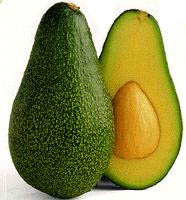
The avocado tree stood near the center of the garden, and during our year, it bore fruit. Its paltas (as avocados were called in Santa Cruz) were jumbo size -- as big as a large grapefruit, but pear shaped and heavy. They were bright green in color -- and there were a lot of them. I have read that some avocados (like oaks) bear heavily one year, then lighter the next year. Our tree must have had a heavy year.

We had all the avocados we could eat for weeks. We gave avocados to our friends and co-workers and to everyone who came to visit. Maria, the little Quechua woman who washed the clothes and swept the floor, and the man who cut the grass took avocados home with them every time they worked.

USDA image: AvocadoDennis and I didn't fool around with making guacamole. We cut the avocados in half and ate the soft meat with a spoon right out of the skins. Sometimes we spread mashed avocado like butter on the fresh rolls that the bakery peddler sold out of the basket on the back of his bicycle.

We were rich with avocados in a way that we probably won't experience again.

I thought about our lovely Bolivian garden today when Dennis and I split a huge green avocado that I bought at the grocery store. I paid $2.56 for it, but it was worth it. Its meat was creamy, rich and very faintly sweet. It was delicious, just as I knew it would be when I saw it. We ate it out of the skin with our spoons.

Thursday, February 01, 2007

Rat Stories

Life in Christian County, Kentucky... Life In Bolivia... Life In Missouri... More About Birds and Animals... Some Interesting News...


I read an interesting article about rats in Anchorage, Alaska. No rats are allowed in Anchorage. If a rat is sighted, it's tracked down and killed. Even pet rats are illegal.

"Anchorage is the only certified rat-free port in the world that we know of," said Ramone Wallace, an environmental specialist with the city health department. "We don't want rats in Anchorage."

Source: "Anchorage airport rat pack down by two" by Katie Pesznecker, Anchorage Daily News, February 1, 2007.


My husband will be interested in this article because he despises rats. When he saw them in the barn when he was a kid, they scared him. His family lived just a few miles from the Missouri River and the river-bottoms industrial area in Independence, Missouri (greater Kansas City, MO). Dennis says the rats were extra big, and I don't doubt that they were.

When we lived in Bolivia, he went in the bathroom one morning and found a rat swimming in the commode. He slammed down the lid and yelled, "There's a rat in the toilet. What shall I do?" "Flush the toilet," I yelled back, and so he did, about 20 times. I refused to go near the bathroom, but after a time, Dennis did lift the lid cautiously and peek inside. The rat was gone, presumably down the drain from whence it came. Its memory inspired a degree of caution in us, as you can imagine.
Dennis says that the rats were everywhere at Camp Doha in Kuwait. The story he heard was that the base had a huge population of stray cats and the commander didn't like it. He had the cats exterminated or otherwise removed, and soon there was a huge population of rats that the cats had previously kept under control.

I have seen twice seen a rat in Kentucky. One time when I went on a school picnic with Isaac's class, there was a white rat running around under the picnic tables at the far end of the shelter. He was picking up food scraps in his little paws and eating it, and the kids thought he was really cute. I thought he was too close for comfort. I wondered if he was a pet rat that had been released. He wasn't scared of people at all.

The other time I saw a wild rat, I didn't see all of him. I just saw his white head and his pink tail which Skittles left lying by the front step. Presumably she ate the rest of him. I couldn't believe how big his head and tail were -- Skittles surely had quite a battle with him. I have convinced myself that she caught him around our neighbor's barns, where there is corn, cattle feed, etc. that a rat would like.

I have just one wildlife guide -- Reader's Digest North American Wildlife, edited by Susan J. Wernert published in Pleasantville, NY and copyrighted in 1982. It says that there are several species of rats in this part of Kentucky. They include the Hispid cotton rat, the Norway rat ("the world's most destructive mammal," according to the guide), the eastern woodrat and the marsh rice rat. None of these rats are nearly as white as the rat head that Skittles left on the doorstep, but maybe it was a some other woodrat subspecies.

The big rats Dennis saw as a child were probably Norway rats, but he says that the rats he saw in Kuwait were the biggest rats he's ever seen. They had long brown hair, and he called them "Fred" because he got to know them so well. (Dennis-type humor, here.)

When I told my brother about the rat that Skittles caught, he talked about working in grain fields late at night in Missouri. He was amazed at the hundreds of rats that he saw in the headlights. Maybe those rats were Hispid cotton rats which my book says are common in farmlands and a serious agricultural pest. There is documentation of up to 500 rats per acre in heavily infested fields.

The behavior of the eastern woodrat seems to be more benign. "Adult woodrats feed on fruit, seeds, and nuts, and do man no economic harm, although some people dislike them merely because of their name and appearance." (Quoted from the above-cited Readers Digest book.)

The marsh rice rats swim as easily as they run around on land. Something like a marsh rice rat was swimming around in the toilet that morning in Bolivia when Dennis had such a shock. I suppose it was a Bolivian species, though.

Bar

Technorati tags:


What do you think about rats? Do you have any rat stories?

Thursday, November 09, 2006

Five Memorable Purses

Carrying a purse

The histories of five great purses I have owned


I can't tell you how many purses I've had in 55 years. I think the number might be more than 2 dozen but less than 55. Or maybe not. I just can't estimate. Anyway, here are five I remember fondly.

  • A square wooden box that looked like a miniature picket fence, with bright green flower-print cloth above and two circular handles. It was a cute, unique purse of the early 70's. The one bad thing about it was that the wooden part tended to snag nylon stockings. Keely played with this little box purse when she was little, and I think she still has it.
  • A pearl-beaded envelope clutch. I bought it for some formal event when I was in my early 20's. It served me faithfully for many years and I had many compliments on it. Unfortunately, I decided to hand-wash it a few years ago. The stain in the lining that I wanted to remove is still there, and the innards of the purse were terribly weakened in the water. It must have had some kind of cardboard in it.
  • A "man-purse" I bought in Bolivia. It was the smallest purse I ever owned. All the Bolivian guys carried them. It was larger than a wallet, but much smaller than most women's purses. It was leather, and it had a wrist strap. If I couldn't close it, I knew I had too much in it. It died when its main snap stopped working. I still have it somewhere, unless I purged it in a clutter-control attack.
  • A handmade leather patchwork purse. It was another of the purses I bought in Bolivia. At the market in La Paz, someone sliced into it with a razor in a pickpocket attempt. (They did this sort of thing there; you had to be on guard constantly in crowds.) The seams of the patchwork were too tough for them, and they didn't get into the bag. I took it back to the shop where it was made, and they were horrified but proud the purse had resisted the attempt. They removed the cut patches and replaced them, and the purse was good as new.
  • A huge alligator-skin bag I had when the kids were little. I bought it at the Army Post Exchange (PX) in Berlin, Germany. It had been priced at $125, but I paid about $20 for it on clearance. Did I mention that it was huge? It was long and deep with two short shoulder straps, and it fit nicely under my arm. It held everything I needed and everything the kids needed too -- books, toys, diapers, and more. I never carried a diaper bag.
The purse I'm currently carrying is a black Duck Head® shoulder bag with a zipper closure, and an outside pocket for my cell phone. If it becomes a memorable purse, it will be for its durability. It's going into a second year of hard use, and it still looks decent.

Technorati tags:


Wednesday, October 04, 2006

Cornbread for Supper

Another Trip Down Memory Lane... Chores and Duties...


I usually try to make a well-balanced and fairly attractive meal for supper. Sometimes I just don't feel inspired though, and tonight was one of those times. I ended up fixing chili, cornbread, and sliced cucumbers. (Wow -- lots of "c" words there.)

As I was stirring up the cornbread, I realized that I've been baking cornbread for 45 years or more. I've probably baked over a thousand pans of it. (Mental math done while stirring suggests this is a reasonable estimate.)

Cornbread was one of the first things that I ever learned to bake. Mama always told me how good my cornbread was. I don't know if she was telling the truth or if she said that to keep me interested in baking. However, I did have a secret ingredient that I always added -- 1 teaspoon of vanilla.

Whenever we had cornbread, Mama heated a pan of milk. You could crumble a piece of corn bread into a cereal bowl, sprinkle it with a little salt and pepper, and pour a little hot milk over it. I liked it with just enough milk to soak the corn bread, but not to fill the bowl. I haven't eaten it that way for many years.

When we lived in Bolivia, the little Indian lady who did our laundry often told me, "Oh, Señora! Your cornbread is just like cake!" Dennis and I laughed about that because she had previously worked for an American named Steve. Steve was (in)famous for his cornbread and proud that he never used a recipe. We had tasted Steve's cornbread at a potluck dinner. It was a gummy, baked, cornmeal mush -- apparently made without baking powder.

If we have soup, Dennis always wants cornbread with it. He crumbles it over his bowl and it becomes one with the soup. Isaac, Keely and I all agree that we don't want to waste our cornbread or ruin our soup that way. We'll just have butter and maybe a little jelly or honey on ours, thank you.

When I was a little girl, I used the cornbread recipe on the back of the Quaker Cornmeal box. In about 1972, I bought a Fannie Farmer Cookbook, and ever since, I've used its recipe for cornbread. Here the Fannie Farmer recipe, doubled as I usually make it:

Corn Bread

Stir together:
1-1/2 cups corn meal
2 cups flour
2/3 cup sugar (or Splenda)
2 tablespoons baking powder
1 teaspoon salt

Mix in:
2 cups milk
2 eggs
1/4 cup canola oil

Spoon into two 8x8" baking pans. Bake about 20 minutes at 350°. Or bake in a 9x13" pan for 25-30 minutes or until bread tests done.

- - - - - - - - - - - - - - -
Update: I've posted this recipe and another for Mexican Cornbread on my recipe blog.

Technorati tags:


Friday, September 15, 2006

Bagged Spinach Warning

Some Interesting News...


U.S. E.coli outbreak is linked to spinach
Thu Sep 14, 2006 9:02pm ET147
Reuters by staff

WASHINGTON (Reuters) - An outbreak of E.coli bacteria that may linked to bagged fresh spinach has killed one person and sickened dozens of others in eight states, the U.S. Food and Drug Administration said on Thursday.

"The FDA is advising consumers not eat bagged fresh spinach at this time and that any individuals who believe they may have experienced symptoms of illness associated with E. coli 0157 contact their health care provider," Dr. David Acheson, head of the FDA's Center for Food Safety and Applied Nutrition, said in a teleconference with reporters...

Source: U.S. E.coli outbreak is linked to spinach


I use a lot of bagged raw spinach in salads, so I really hate to hear there's a problem. I'm sure I don't hate it nearly as bad as the spinach growers do, though.

When we lived in Bolivia, we had to soak all vegetables and fruits that would be eaten raw because of the use of "night soil" (human excrement) as fertilizer. The soaking solution was 10 drops of iodine to a gallon of water. Before soaking, we washed them thoroughly.

I am not sure what strength of iodine we were using, so please consult your health department before you soak anything and eat it. I think you can also use a tablespoon of bleach to a gallon of water, but here again, I'm not an expert.

I'm not suggesting that night soil has been used in the growing of the spinach sold in bags. E coli contamination could come just from animals passing through the fields.

UPDATE: Feral pigs were probably the source of the contamination. According to an AP story published October 29, 2006, there is evidence that they had broken through the fence to get to the spinach on one of the farms where the contaminated spinach seems to have come from.

Technorati tags:


Wednesday, July 19, 2006

Hot Weather Stories

Some of my experiences with enduring the heat


It's too hot, and that's not just my opinion. It's a fact, verified by the National Weather Service. They've been issuing a Heat Advisory every day for a week or so in Kentucky. Our Heat Advisory for tomorrow reads in part:

Conditions may be more oppressive Thursday afternoon... as highs are expected to reach near 100 degrees [in] many areas... with heat indices forecast to range from 105 to 115 degrees.

A heat advisory means that a period of hot temperatures is likely. The combination of hot temperatures and high humidity will combine to create a situation in which heat illnesses are possible. Drink plenty of fluids... stay in an air conditioned room... stay out of the sun... and check up on relatives and friends.

(Source: Weather Underground for Hopkinsville, KY)


Hot!This summer, one thing after another has broken at our house, and the most recent thing was the air conditioning. Thank goodness, it's back on tonight, but we spent about a week and a half without it. That's enough time to make a person remember how truly wonderful air conditioning is.

Back before AC was invented, houses in Kentucky (and throughout the South) were built to resist the heat and promote air circulation. The second story and full attic helped to insulate the first floor. Ten-foot ceilings and six-foot windows promoted natural air circulation. A grove of trees around the house could reduce the temperatures another five to ten degrees.

We have trees, but no second story and no sets of big opposite windows so air can flow through easily. This house begins to get hot around 10 a.m. and it doesn't cool down until around 10 p.m., even with fans.

Hot Summer of 1980 in Missouri


While sitting around here too hot to move, I've thought about other hot summers in my past. I remember the hot summer of 1980 quite well. In Missouri, heat records were broken day after day. We lived in a second-floor apartment without air conditioning, and it was so hot even at night that we could barely sleep. Somehow in that heat, we packed everything up, moved out, and got ready to go teach school in Bolivia. It was 112° the day we flew out of Kansas City.

When we came back to Kansas City a year and a half later to spend Christmas, it was -15° the night we arrived. Those are good examples of the temperature extremes that Missouri can produce. I haven't seen it any hotter in Missouri than 112°, but I have seen it colder than -15°.

1980-82: Hot weather in Bolivia


We were near the equator in Santa Cruz, Bolivia, but life without air conditioning there really wasn't any worse than in Missouri. Our house was built with thick, solid brick walls that resisted the heat, and the whole place was shaded by trees most of the day. The floors were ceramic tile, and they were always cool. We had patios on three sides of the house. In the shade on an airy wicker chair with a cold drink, it was warm but not uncomfortable.

Of course, it was hot when we got out of our chairs and left the shade -- to go to work, for example. Bolivia is south of the equator and our school followed an American schedule, so the school months of September through May spanned the seasons of spring, summer, and autumn.

My classroom was in a new building with no trees around it, and it was very hot throughout the summer. I put the children under our one ceiling fan so they would be comfortable enough that they might be able to learn something. Most summer days were three-shower days --before and after school and before bed.

As warm as the summers were, the winters could be surprisingly cold. When cold surazos blew in from the Argentine Pampas, nighttime temperatures fell into the forties. Our house had no form of heat and it could be darned chilly. We couldn't even run the oven much because its gas supply was a small propane cylinder.

1985: Hot summer of pregnancy


And then there was the memorable summer when I was pregnant with Keely. We were trying to survive on just one income during my last few months of pregnancy. The bigger I got, the hotter the weather got, and I was miserable. Our rental house had no air conditioner, not even a window unit, and we couldn't afford to buy one.

I wouldn't have survived if it hadn't been for lime slushes and Debbie. When I got too hot, I got two big lime slushes at Quick Trip and went to Debbie and Leroy's waterbed store to sit in the air conditioning for a few hours.

Debbie was pregnant too, and business was usually slow at the store so she was glad for company. We drank our slushes, watched TV, played cards, and sat around being pregnant. Luckily, Quick Trip was practically giving away lime slushes that summer. We drank so many that it's a wonder our babies didn't turn out green.

Debbie's baby was born at the end of July, and about the same time, the weather miraculously cooled down and August's temperatures stayed mostly in the 80's. It wasn't too bad. Keely was born on August 28, and not long after that, the cooler days of autumn arrived.

"This heat doesn't bother me one bit!"



Hot SunIn Kentucky, we usually have high humidity along with the heat. Our temperatures have been in the mid-90's this week, but the humidity has pushed the heat indices to 105° and above, day after day.

One day this week, a nice older lady who is a native Kentuckian told me with pride that this heat doesn't bother her one bit. I am sure it doesn't. She has a lovely home with central air, and she works part-time in an air conditioned office. She drives around in a large air-conditioned Buick. In my opinion, she really has no idea what the heat is like.

Many of my farmer neighbors have tobacco fields, and this time of the year, they spend a good part of each day walking through them with hoes in their hands and sprayers on their backs. When I worked at the little country store down the road, the farmers often stopped in for a cold drink and a few minutes in the air conditioning. They were drenched in sweat and sometimes they looked like they were near heat exhaustion. I don't think any of them would ever say that the heat doesn't bother them one bit.

Two survival tips for hot weather


The truth is, heat like this is dangerous. I learned a couple of survival techniques during the years when we had no air conditioning, and I used them again when our AC was out the last couple weeks. I'll share them here because they might help someone else who's trying to just endure:

  • You can cool down pretty well if you lay a wet towel across your body and rest in front of the fan.
  • It's also helpful to wrap a few ice cubes inside a wet hand towel and lay it around your neck.


Technorati tags:


. , , . , , ,

Friday, March 03, 2006

Rescue of Kitty

Life in Bolivia... Another Trip Down Memory Lane...


Bolivian catKitty in 1981

When Dennis and I were young, newly-wed, and just out of college, we took a job teaching school in Santa Cruz, Bolivia. There we adopted a cat, a sweet kitty-cat whose name turned out to be Kitty. I went with another teacher to the home of his in-laws and chose Kitty from a tangle of kittens who were playing on the clean-swept dirt floor. She cried all the way home because she didn't want to leave her family, but in a few days, she overcame her heartbreak and went back to being a cute playful kitten. It didn't take long to become fond of her.

After a couple of weeks, she disappeared. I walked all over the neighborhood calling her. Two days passed. I began to give up hope. On the third day, I went out to look for her again when I got home from school, and as I called her name, I heard a faint meow in reply. I finally saw her on the roof of the neighbor's house. The neighbor had a tall iron fence around his house and two big Dobermans. They patrolled the perimeters tirelessly and tried to attack passersby through the bars. Kitty had ventured into their territory and now she couldn't come back down to the ground for fear of being killed.

We had only been in Bolivia a few months and my Spanish was limited. I pushed the buzzer at the gate and a servant came out of the house. I tried to explain what I wanted, but I couldn't make myself understood. He went back inside and got the master of the house.

The master was not happy about being disturbed. I said politely in the best Spanish I could manage, "Please! Pardon me! I need help! My kitten is above the house." I didn't know how to say "on the roof", so I was trying to approximate it. "Above the house? Above the house?" he said angrily. "Sí , señor, mi gatita está sobre su casa!" I insisted. (Yes, sir, my kitten is above your house!)

Fortunately Kitty decided to plead her own case. She peered over the edge of the roof and meowed pitifully to me. The master sent his man to get a ladder, and in short order, Kitty and I went home. After a hearty meal of tuna, several long drinks, and a long nap, Kitty was herself again.

That was just one of Kitty's many adventures. We brought her back to the United States with us, and she lived to be 15 years old. She was a sweet, funny kitty -- maybe a little neurotic, but after her rooftop experience and some of the other close calls she had, it was understandable.

Kitty on the patio. She was a long cat.
Related Posts Plugin for WordPress, Blogger...

CONTENTMENT: Keep your heart free from hate, your mind from worry, live simply, expect little, give much, sing often, pray always, forget self, think of others and their feelings, fill your heart with love, scatter sunshine. These are the tried links in the golden chain of contentment.
(Author unknown)

IT IS STILL BEST to be honest and truthful; to make the most of what we have; to be happy with simple pleasure; and to be cheerful and have courage when things go wrong.
(Laura Ingalls Wilder, 1867-1957)

Thanks for reading.