Monday, June 05, 2006

Wilder, Cather, and Sandoz - Writers of the Prairies

History and Old Stuff...


Laura Ingalls Wilder (1867-1957) saw the Great Plains when it was still virgin prairie and wrote about it from a child's viewpoint for children. I am a big fan of Laura's writing. We have visited the Little House on the Prairie Museum at Independence, KS, and also the Wilder House and Museum at Mansfield, MO (twice!) What a thrill to see Pa's fiddle and to visit the very room where Laura wrote her stories by hand on a tablet of paper.

Willa Cather (1873-1947) was born only six years after Laura, but she wrote about the settlement of the Great Plains with an adult viewpoint for adults. Willa Cather's birthdate is similar to my great-grandparents. Some of my great-grandparents came to America and the Nebraska prairies as immigrants, very much like those around Red Cloud (Nebraska) whom Willa Cather wrote about. I have always loved Willa Cather for seeing and recording the very soul and spirit of that historic place and time.

Many people have told me that I should read Mari Sandoz (1896-1966). She wrote many books about the Nebraska Sandhills and the Great Plains, but I have only recently bought several of her books. I have started reading Love Song To The Plains, and I've posted a quote from it -- the opening paragraph of the book -- here in the sidebar.

My mother's family were early residents of Sheridan County, Nebraska, as was Mari's family. My grandmother and many other people from Gordon thought Jules Sandoz was a crazy, dangerous old coot, and that Mari painted too glowing a picture of him in her book, Old Jules. I heard this talk when I was a child, and my opinion of Mari Sandoz was tainted by their remarks. I didn't know that Mari herself had been abused both physically and mentally by her father, yet wrote of his accomplishments as a pioneer with respect.


Technorati tags:


Sunday, June 04, 2006

Treasure at Pilot Rock or Apex in Christian County, KY

Life in Christian County, Kentucky... History and Old Stuff...


map

I've noticed that several visitors have come to my blog lately, searching for information about the treasure that is supposedly buried in the Pilot Rock area of Christian County, Kentucky.

The treasure is described on Linda Linn's Kentucky Home and Ghost Stories as follows:
Christian County: Lost Treasure
There is a bag with three thousand dollars worth of gold coins buried in the area around Pilot Rock, near the town of Apex.


Folks around here say that the gold coins were payment for a large tobacco harvest that a prominent farmer in the area had sold. On the way home, the farmer and his party were ambushed and attacked, but some of the group eluded the robbers and buried the gold. They planned to retrieve it later, but they could never locate it again.

The distance between Pilot Rock and Apex must be at least 12 miles, maybe 15, as the crow flies. Trails between the two points would have meandered around and through the natural obstructions, so I am amused at the phrase, "in the area around Pilot Rock, near the town of Apex". That's very vague and it encompasses a very large area.

Most of the old trails, except those that have become paved roads or that are still used by farmers, have been abandoned and forgotten. Furthermore, much of the area is rough terrain, covered with trees, rocks, bushes, and poison ivy.

I understand that this treasure is mentioned fairly often in treasure-hunting magazines. And who knows? Someone may find it someday and be a hundred thousand dollars richer. The $3000 in gold coins is said to have appreciated that much in value.

I'd be careful about trespassing over that way. Landowners are sick and tired of meth manufacturers abusing the area, and they might lump treasure hunters into the same category.

Technorati tags:


Saturday, June 03, 2006

Pantries

And What I Think About It...


Floorplan

This bit of houseplan was drawn in 1900. It was part of this week's Dover clipart sampler. The full floorplan shows a house with 2-1/2 stories and a full basement. The kitchen is located at the back of the first floor.

Notice that the kitchen has two pantries. The pantry at the head of the back stairs would be a perfect place for canned goods. The pantry at the entry to the dining room would be a good place to keep crackers, cold cereals, condiments, table spices, and all the items needed to set the table.

Earlier this year, I attended a tag sale in an old home that had a pantry between the kitchen and dining room. It was a "butler's pantry", I guess. I didn't photograph it, but it was a short hallway with a floor-to-ceiling cabinet along one entire wall, much like the built-in cabinets in the dining room. It probably functioned as a final staging area for the serving of the meal.

My Grandma Barb had a walk-in pantry off her kitchen when I was a little child, and I remember it smelling like graham crackers. My friends Sammie and Rick have a walk-in pantry in their 100-year-old home in Nebraska. I have lived in some homes that had nice old-fashioned features (such as a laundry chute), but I've never had a pantry.

I could really use a pantry. Even though I have a L-shaped bank of cabinets against 1-1/2 walls of my kitchen, I need some shallow, open shelves, like those in the back pantry in the floorplan above. (Floor-to-ceiling shelves aren't drawn in, but I'm sure that's what was there.)

In my kitchen (in our 1960's ranch house), I keep the cans in one of the lower kitchen cabinets. It's hard to see them and hard to find what I want, and it's hard to reach the ones that are in the back corner on the bottom shelf. If I had a pantry, I'd keep the cans in it!

I don't know why the idea of pantries was given up, apparently over the years between 1920 and 1950. I have been trying for years to think of a way to retrofit one into my kitchen or even into my utility room, but there really is nowhere to put it.

I notice that walk-in pantries are being built into some of the new homes. I'm glad their usefulness is recognized again.

Friday, June 02, 2006

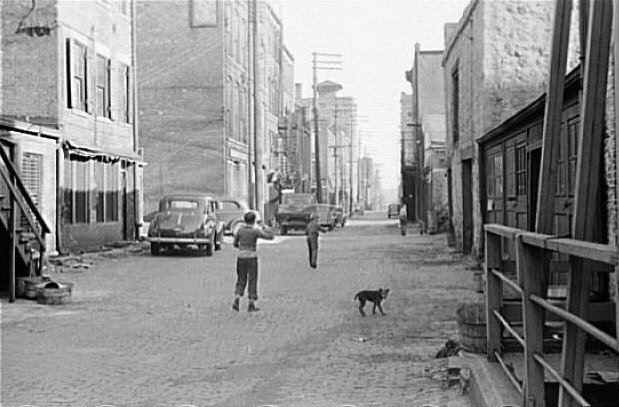
Alleys and New Urbanism

And What I Think About It...


Alley
Boys playing in an alley, Dubuque, Iowa. Photographed by John Vachon, Farm Security Administration, 1940. Library of Congress, Prints & Photographs Division, FSA-OWI Collection, [LC-USF33-T01-001703-M2 DLC]


- - - - - - - - - -

Wikipedia defines an alley as "a narrow street found in urban areas". The article continues:

The reduced usage of alleys has resulted in their decline. Under use, poor maintenance, poor night time illumination and narrow width has contributed to an increase in anti-social or illegal activities such as:

* dumping of rubbish
* sexual assault
* consensual sexual behaviour and/or prostitution
* urination
* burglary
* robbery
* illicit drug use
* murders

Source


Some alleys do host these activities, but it seems to me that the reputation of many a mild-mannered, well-behaved alley is tainted by this list.

I have some pleasant memories associated with alleys. I enjoyed the narrow, ancient alleys in the historic downtown areas of two Bavarian villages -- Sulzbach (history) and Kleinwallstadt -- where we lived in Germany, and never saw a hint of any of the dubious activities listed above or felt I was in any danger.

When we lived in Warrensburg, MO, I walked my dog daily in an alley that ran for ten blocks or more. It was a lovely quiet walk, shaded by the backyard trees of the homes the alley served. Most of the alley was brick-paved, but there was rarely any vehicle traffic at all.

That residential alley wouldn't have been so quiet when the houses were young. It was once used for deliveries of ice, coal, and groceries to the rear of the house, to be carried in through the back door.

Nowadays, homeowners still bring many purchases through the back door, but the deliveries are made by the family automobile, which is driven down the street and parked beside the house or in the attached garage. I suppose that's why planners started omitting the alleys just like they forgot about sidewalks. With cars, who needs them?

New Urbanism is a movement and a school of thought that seeks to reverse urban sprawl and the problems associated with it by better city planning. A community should have connectivity, New Urbanists say-- that is, communities need a network of boulevards, smaller streets, alleys, and sidewalks.

As well as dispersing the vehicle traffic, such a web between homes, stores, and other business places makes walking and biking easier, more efficient and more pleasant. Alleys in New Urban communities often provide access to the home's garage.

This sounds right to me.

Technorati tags:


Thursday, June 01, 2006

FAQ

Blogs and Blogging


Q: How does she get her dusting done when she's always blogging?

A: Oh, she doesn't do any dusting. She claims she has a lame shoulder. Strange how that shoulder doesn't bother her a bit at the keyboard.

Q: What does she do when Important Family Visitors are arriving the next day?

A: She cleans the entire house from top to bottom in 12 hours. Of course, she doesn't start cleaning seriously until 4 p.m., so she doesn't finish cleaning until 4 a.m. And that's just surface cleaning, you know. Heaven help us all if the visitors look under the kitchen sink.

Q: How does she drive to the Nashville Airport the morning after she stays up cleaning until 4 a.m.?


A: That's what caffeine is for.
Related Posts Plugin for WordPress, Blogger...

CONTENTMENT: Keep your heart free from hate, your mind from worry, live simply, expect little, give much, sing often, pray always, forget self, think of others and their feelings, fill your heart with love, scatter sunshine. These are the tried links in the golden chain of contentment.
(Author unknown)

IT IS STILL BEST to be honest and truthful; to make the most of what we have; to be happy with simple pleasure; and to be cheerful and have courage when things go wrong.
(Laura Ingalls Wilder, 1867-1957)

Thanks for reading.