Wednesday, November 14, 2007

Mennonite Immigration from Russia to America

Russian Mennonites on the North American prairies


If you are interested in the Mennonites, I've found an old article that you may enjoy reading. It appears in an 1878 encyclopedia that has been digitized by Google. You can read the first paragraph at the bottom of this post, and then go to the link to read the remainder of the article (about two pages in all.)

The article explains some of the circumstances that led Mennonites to immigrate in large numbers from Russia in the 1870s and settle on the North American prairies.

Brief history of the Russian Mennonites


Thousands of Moravian and Prussian Mennonites went to Russia during the 1600s and 1700s to escape cruel persecution in their homelands. However, in the 1870s, they were threatened with conscription into Russian armies, which was against their religious beliefs.

Because of their reputation as an industrious, law-abiding, productive people, the government of Canada sent a special messenger in 1874 to invite Russian Mennonites to settle in Manitoba. Canada even lent them money to help them resettle.

Settlements were also established in Kansas, Dakota, Nebraska, and Minnesota. In some cases, whole villages of Mennonites left Russia and resettled on the prairies of North America.

The author (name not given), writing in 1878 during the surge of Russian Mennonite immigration, comments that they are hardworking and thrifty farmers, but reluctant to associate with outsiders and fond of their own language. The women are good housekeepers and the men are good farmers. He is impressed with their ability to establish attractive, well-equipped, productive farms despite limited funds and adverse weather conditions.

The historic marker in the photo below tells a little about the hard red wheat ("Red Turkey Wheat") that the Russian Mennonites brought with them to Kansas. This wheat made Kansas the "bread basket of the nation." I took this photo along Highway 50 in Harvey County, east of Walton, Kansas.

Russian Mennonites brought red wheat to KansasRed Turkey Wheat: Mennonite gift to agriculture.
Text on this historic marker is also available here.


Mennonite immigration to America began in the 1600s.


It is curious that the encyclopedia author writes as if the Mennonites from Russia were the first Mennonites to come to the New World. That's not correct at all.

In 1683, William Penn extended an invitation to the Mennonites to settle in Pennsylvania, and that was the beginning of a large settlement of Mennonites in Pennsylvania. Penn was a Quaker, and he viewed the Mennonites as gentle people of similar faith.

By 1735, there were already close to 500 Mennonite families in Pennsylvania. (Source) I suspect that number included families that we would call Amish today. The Amish were Mennonites who followed Jacob Ammen's teaching about church discipline.

1878 encyclopedia article about Russian Mennonites


Here's the first paragraph of the old encyclopedia article about the Russian Mennonites. The link below it, will take you to the full article.


If the small print is difficult to read, there's a text version. Just follow the link above, and when you get to the Google page, look in the upper right hand corner for the "View Plain Text" link.

Tuesday, November 13, 2007

A Set of Oxymorons

Double dose of contradictions


Set of oxymorons

I love the small print at the bottom of the banner: "First time customers only." The second time you're a customer, the oxymorons do not apply.

In truth, these money lenders aren't funny. They say they're providing a service to people who don't have other resources. That may be true, but when people get started with check advances, it's hard for them to escape from the trap. The interest rates are exorbitant. The customer may repay the loan and interest after he gets his check -- but then he has to get another loan to make it to the next check.

Monday, November 12, 2007

Kentucky Hopes for a Rainy Winter

Recent rains have greened the autumn landscape


Rainy sky

After a very dry summer, rain surprises us. Even though rainy weather is normal for November, my reaction this year is, "Look! It's raining! I'd better take a picture!"

The National Weather Service announced a couple of weeks ago that the drought has ended in the Pennyrile, our region of Kentucky. However, we remain 12 to 16 inches short of rain for the year. We need a rainy winter.

According to the NWS and the National Drought Monitor, only the southern border of Christian and Todd counties, across the Oak Grove and Trenton areas, are still under drought conditions. The drought in those areas has been downgraded to abnormally dry, the least severe categorization.

Source: "Officials declare end of drought" by Blair Dedrick, Kentucky New Era, Nov. 2, 2007


Recent rains have insured good seed germination for the winter wheat. The fresh green color of the newly sprouted wheat is good to see. The grass in some of the pastures is looking better also.

Hay for the winter remains a problem for livestock owners. The late freeze followed by drought reduced the hay harvest by half in many areas. In an effort to help, Kentucky's Department of Agriculture has a hay hotline (1-888-567-9589) where buyers and sellers can list their contact info. Weight and size restrictions have been eased for trucks hauling loads of hay.

Some farmers have baled their drought-damaged soybeans. Others have left the beans standing in the field, saying that the expense of baling is greater than the value of the fodder.

Farmers who are feeding crop residues (corn stalks, etc.) are cautioned to have them tested for nutritional value and nitrate content. High nitrates can kill livestock.

In our neighborhood, it was a good summer for the bulldozer operators. While water levels were low, many farmers took the opportunity to clean out their ponds and dig them a little deeper. New ponds have been constructed as well. Now we need a rainy winter to fill them.

Recent rainy afternoon

Technorati tags: ,

Sunday, November 11, 2007

60th Wedding Anniversary Celebrated

A nice event at our church


Wilbert ("Hap") and Marion Heilman, were married in 1947. The image above (my snapshot of their photograph) shows them on their wedding day.

The Heilman's celebrated their 60th wedding anniversary today. Their four children had a small reception for them this afternoon at our church.

Mrs. Heilman told me she weighted 115 pounds the day she was married, and her mother made her wedding dress. They were married in a Lutheran church, in or around Evansville, Indiana.

They made their home in the Evansville area, and over the years, four children were born. As it happened, they had some neighbors whose name was Roeder. In the mid-1960s, the Roeders opened a John Deere implement in Hopkinsville, KY. They invited Hap to work in the repair shop, and Hap accepted the offer.

The Heilmans moved to Hopkinsville, and they've been here ever since. I think the implement had been open a few years already, before they moved here, 35 years ago or so. The three daughters all stayed around Evansville, but their son (the youngest of the family) moved to Hopkinsville with them. He still lives in Christian County.

Hap has retired now, and he and Marion live on a small farm near St. Elmo, in southeastern Christian County. They don't get out much anymore, due to their health. I know that this was quite a day for them.

All of their children were at the reception, and a number of grandchildren and great-grandchildren were present also. Hap and Marion raised a nice family. I enjoyed seeing them together today.

Saturday, November 10, 2007

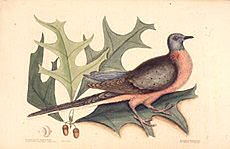
Passenger Pigeons in Christian County, KY

Extinct birds credited with creating a farm's rich soil


Passenger pigeon Passenger Pigeon

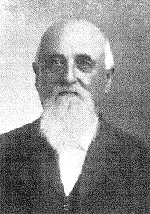
In Judge W. T. Fowler's little book, Christian County, Kentucky, written in 1915, he makes some interesting comments about Mr. R. F. Rives and his farm:

Mr. R. F. Rives is one of the largest wheat growers and tobacco growers in Kentucky. He has in ten years produced 250,000 bushels of wheat on his farm. He is Christian county's largest farmer taxpayer, and is second largest in the county, Forbes Mfg. Co. being the first.

His farm is in the heart of what is known as the "Pigeon Rooset [sic]" section. The wild pigeons in Audubon's day had for their roosting place a forest in Christian county which covered thousands of acres. This is the most productive land in the county. Its yields of wheat, corn, tobacco, clover and alfalfa are marvelous...

[This splendid farm] is a model for stately buildings and neat arrangement. Its master is one of Christian county's sages in agriculture and a man who has mastered the problems of system and management as few have.

The R. F. Rives farm was surely located somewhere in the fine farmlands of southern Christian County. Perhaps it was in the vicinity of today's John Rives Road, a few miles southeast of Hopkinsville, where the Rock Bridge Branch meanders through the fields.

At any rate, it's interesting that the soil had been enriched by passenger pigeon droppings.

Mr. R. F. RivesMr. R. F. Rives
Huge flocks of passenger pigeons gathered in Kentucky in the fall to feast on acorns and beech nuts. When he mentions "Audubon's day", he's referring to the observations of the incredibly large passenger pigeon flocks that Audubon recorded.

Nowadays, we'd be worried about histoplasmosis in a place with concentrated bird droppings. Health officials would test for the fungus, and if present, they would place the area under quarantine.

In fact, Hopkinsville spent several hundred thousand dollars just a couple of years ago to replace soil contaminated heavily by bird droppings in a park where big flocks of birds roosted.

A century ago, R. F. Rives just plowed the bird manure into the soil and made the most of his good luck. Ignorance was bliss -- and a whole lot simpler and cheaper.
Related Posts Plugin for WordPress, Blogger...

CONTENTMENT: Keep your heart free from hate, your mind from worry, live simply, expect little, give much, sing often, pray always, forget self, think of others and their feelings, fill your heart with love, scatter sunshine. These are the tried links in the golden chain of contentment.
(Author unknown)

IT IS STILL BEST to be honest and truthful; to make the most of what we have; to be happy with simple pleasure; and to be cheerful and have courage when things go wrong.
(Laura Ingalls Wilder, 1867-1957)

Thanks for reading.