Saturday, May 13, 2006

Howling coyotes

Howling Coyotes

Life in Christian County, Kentucky... More About Birds and Animals... The Rural Life


This evening, I did a nasty job that I've been putting off for a while. I emptied out some jars of applesauce that I canned several years ago but we never got around to eating.

I took the jars out to the porch and emptied them into a bucket and then took the bucket to the garden and emptied it onto my compost pile. Tomorrow morning, there will probably be a bunch of sick or drunk possums lying around the yard. (Just kidding.)

While I was doing all this, the coyotes started howling in the neighbor's field just over the road. It is eerie to hear coyotes at close range. When you hear them in the distance, you get the main melody of their howls, but you miss the subtle details. When they are just a couple hundred feet away, you hear every yip, chortle, warble and squeak.

Isaac came out and we listened for a few minutes. Then he went back in, and I went around the side of the house to use the hose. I nearly tripped over one of the cats in the dark, and I said something sharp to it as I stumbled. The coyotes instantly stopped howling. I guess they saw me, or they knew from listening that I had moved closer to them.

I didn't hear them howling in the field again, but about 15 minutes later, I heard coyotes howling in the distance north of us. It could have been the same pack -- or a different one. We seem to have lots of coyotes here.

When we first moved out here, I never heard coyotes, but in the last ten years it has become a frequent thing to hear them howling. They come so close some nights that we can hear them howling from inside the house. I always check to make sure the cats are inside when I hear the coyotes.

I have read that coyotes will kill foxes and drive them out of their range. It is true that I have not seen a fox around here for probably six or eight years now, but there are lots of coyotes.

Coyotes are omnivorous and they are scavengers, so there may be sick and drunk coyotes lying around the compost pile tomorrow morning along with the possums. (Just kidding.)

Coyote

Technorati tags:

Friday, May 12, 2006

Feed stores and egg cartons

Another Trip Down Memory Lane... Life in Christian County, Kentucky... Life in The Nebraska Sandhills...


When I was in grade school, I made a little money selling egg cartons. They were worth a penny apiece at the feed store in Bassett, Nebraska. Mama didn't keep chickens, so we bought eggs from the store, and a stack of egg cartons would slowly accumulate. When at last I had 25, I would take them to the creamery, which was located in a special room at the front of the feed store.

The creamery bought cream from people who had milkcows and sold it to a dairy products company. My mother sometimes sold cream there. The creamery also bought eggs. I am not sure where the eggs went after the creamery bought them, but they needed egg cartons and were always happy to buy them.

With 25 cents of egg carton money in my pocket, I could go to the dime store and buy a fat comic book. Or, I could buy a skinny comic book for a dime, a soda for a dime, and a candy bar for a nickel.

But even without the joy of money, the visit to the feed store would have been interesting. Mountains of bagged grains and animal feeds and stacks of salt blocks filled the long room. A fine dust from the grinding of grain danced in the light and lay over every surface. Even the cobwebs were powdered. A sweet fragrance of molasses filled the air.

And there were cats everywhere. It was an old building, and the cats helped with rodent control. They probably did their best work at night when the people went home and the mice came out. During the daytime, they napped on the piles of empty gunny sacks and lounged on the counter tops. Kittens played hide and seek around the stacks. They were hard to catch, but their mothers graciously allowed customers like me to pet them.

By the mid-1960's, the creamery had closed. I am not sure why. It might have been because of food safety regulations. Not too long after that, the little feed store closed too. I don't know why it closed. It might have been the loss of the creamery combined with stiff competition from Bassett's other feed store which was much larger and more modern. Or maybe the owners just wanted to retire.

Nowadays, I sometimes have a reason to go to Southern States, a farm store in Hopkinsville. I always enjoy walking into the feed and seed area by the back loading docks. They mix custom livestock feeds back there, so the cobwebs are a little dusty. Bags of corn, pet food, chicken mash and all kinds of livestock feed are stacked high. There aren't any cats, but there's a familiar smell of ground grain and sweet molasses. It makes me think of egg cartons.

---------------------


Alabama feed store, 1936

Photo: An Alabama feed store, about 1936. Library of Congress, Prints & Photographs Division, FSA-OWI Collection, LC-USF342-T01-008089-A DLC.


The feed store in the photo reminds me of the one that I remember in Bassett , even though the photo was taken 15 years before my birth. I remember the feed store as a a long narrow frame building that faced north, around the corner from the Ford garage and near the alley.


On the general topic of creameries:

A sale by the Stock Auction Company in April 2006 at Wolbach, Nebraska, included "Old Cowboy Gear, Quality Hand & Leather Tools, Sewing Machines or Antiques" (many interesting photos on the page.) Among the items auctioned were these cream cans.


The Stearns History Museum of St. Cloud, Minnesota, has a wonderful online exhibit titled "Bringing Home The Cows." If you remember milkstools and cream separators, you will enjoy the Catalog of Artifacts.


I well remember what a pain it was to wash the many parts of the cream separator, particularly a stack of about 20 disks that was in it.


Technorati tags:

Thursday, May 11, 2006

Stormy Weather

Life in Christian County, Kentucky...


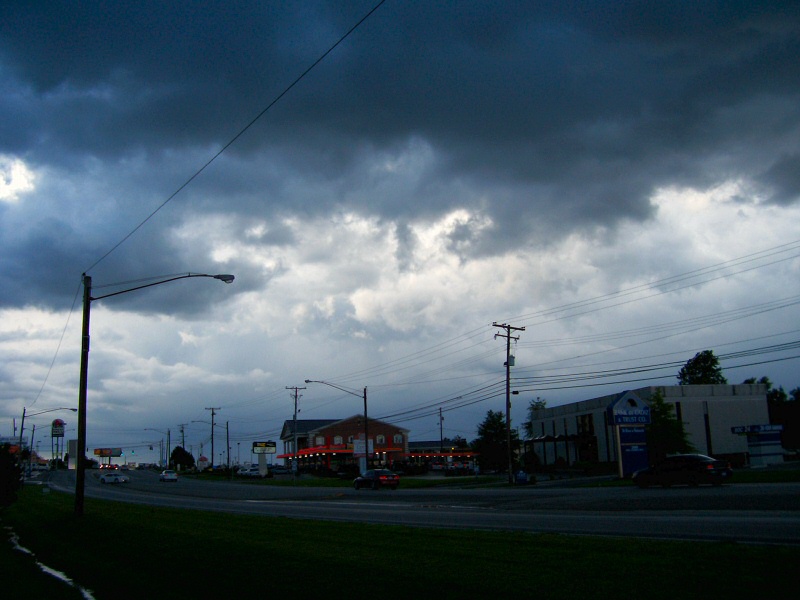
The weather has been odd all day. A cold air mass has been moving in, and as the front advances, numerous squalls have swept through Christian County.

I drove through heavy rain when I took Isaac to school. Twenty minutes later, the sun was shining. I went in WalMart and bought some cat food, and when I came back out, it was raining again. And so it continued all day.

This afternoon about 6:00 p.m., some of the most threatening clouds of the day passed over with great blasts of rain and wind. Afterwards, the sun came out and shone brightly for a while. A hint of a rainbow appeared over Hopkinsville.

Storm in Hopkinsville
Just before the rain
Storm in Hopkinsville
After the squall

I started a little fire in the woodstove after we got home from Scouts this evening. It's supposed to drop down to 45° tonight. The weather report says that temperatures will be in the mid-40's for the next two nights as well.

Now I don't feel so bad about not having my garden all planted. It's still a bit chilly for peppers and tomatoes to really flourish anyway.

Technorati tags:

Emigrants at Ellis Island

History and Old Stuff...


Emmigrant children, Ellis Island
Photo courtesy of the National Archives.
Emigrant children at Ellis Island, 1908.


I am fond of old books, and I bought another one at a tag sale last Saturday. It is Volume 5 of The New Student's Reference Work for Teachers Students and Families, and it was published by F.E. Compton and Company of Chicago in 1911. The set of books must have been an ancestor of today's Compton's Encyclopedia.

Much of the book is educational stories about various topics. I enjoyed the description of emigrants arriving at Ellis Island. This contemporary description is informative both in its factual content and in its inadvertent documentation of attitudes of the time. With the current furor over immigration to America, it is interesting to get a glimpse of immigration in a different time.

I believe that my great-grandparents Sees came from Germany through Ellis Island. I am not sure of the year, but I think it would have been between 1900 and 1910, about the time of the photo above and the description that appears below. (Aunt Becky or other family members, you can correct me if you read this.)

Here is an excerpt from the Ellis Island story. The punctuation and spelling are as they appear in the book. (Any obvious typos are mine.)

A child on the top deck of a ship, is observing emigrants arriving in New York City...

...A great ocean steamer is five or six stories deep, you remember. You have lived in the top story, or first cabin. You have never seen the people below you. You can see them now, as they go ashore over the gang plank, if you stand by the deck rail and look down.

A crowd of the strangest looking people pour over the gang plank from the third deck, or steerage. They look like little bits of all the countries you have seen or read about. Few of the women wear hats. They have handkerchiefs or caps or shawls on their heads. They carry babies in their arms, on their hips or their backs. Little childrren cling to their short, wide skirts. The men and boys carry mountains of queer shaped bundles and boxes and bags on their heads and shoulders. They stand by these bundles on the dock, as if they feared to lose them. Men in uniform keep the crowds moving. They shout orders in a dozen languages. The people are weary from the long journey, but oh, so interested in everything, so eager and hopeful. They wait patiently with their babies and their bundles and do everything they are told to do.

They will not be allowed to leave this dock, as do the cabin passengers. Although they are on American soil, they have not been admittted to make their homes here yet. In the old days, every one could come in freely. They cannot do that now. We found that a great many very old people, and orphan children, and blind and crippled and feeble-minded people, came. They did not belong here, but we had to take care of them. Many bad men came, too. They had been in prison in their own land, and they gave us much trouble. So laws were passed to admit only those who were strong and well and good honest workers. Every one who comes must have some money to give him a start. Children and old people must have some one to care for them.

All these people must get on a barge, or open boat, and go back to the emigrant station on Ellis Island. Ellis Island is just inside the harbor. You can buy a ticket and go there to see these people examined and questioned by government officers. Your boat is fast so it passes the barge.

When you leave your boat, hurry across the open space to a big building like a railway station. Go up a side stairway to a gallery that runs around a big white-tiled room and look down. Up the wide central stairway come the people from the barge. There are thousands of them. See if there are any you know.

Oh, there are the Dutch children. They wear wooden shoes just as they did three hundred years ago. That is an Irish family. The children have merry eyes. That is a German family. The children are stout and fair and rosy, You wonder if "dear mother" has a Christmas tree in that beautiful linen chest she sits on. There are some English or Scotch people. The little girls are shy, the boys independent little fellows. And there are such a lot of people who never came to America at all, in the old days.

Those big black-bearded men in long overcoats, caps, and high boots are Russian farmers. They will go out to wide western plains to grow wheat. We need that kind of Americans. The smaller, long-bearded men who are near them, are Russian Jews. They have had trouble about their religion, and come to us for peace and safety. They will work in tailor shops in the big cities. Some will be peddlers. By and by they will have good shops of their own.

Those men in velveteen jackets with nickel buttons and bright red vests, are Hungarians in their Sunday clothes. Some are in sheepskin coats. Their women have short skirts, bare heads, and embroidered aprons. These people will work in mines and packing houses and steel foundries. There are no women with those red-capped Turks who have come to sell us Oriental rugs. Those handsome Greeks will be peddlers of fruit or of plaster casts of old Greek statues. The Italians with dark, rosy faces, have dozens of little ones with them. The men are small but they can do the hardest kind of labor on railroad beds and street sewers. The Norwegians are tall. In their old home they are sailors. They will not be afraid to do iron work on sky-scrapers and bridges. Those fair, very clean, young women are Swedes. With the German and Irish girls, they make the best housemaids in the world. There are very few people among these new-comers who cannot do some useful work.

Men in uniform are at every door and stair landing. They can speak many languages and they know what country every one comes from by his dress and face. They are kind to these strangers. Now, one says to a scared little Italian woman, in her own language:

"Signora (madam), come in out of the draft. The bambino (baby) will catch cold." She smiles happily to hear her own dear tongue in this strange America. So it goes, all along the line. Five thousand strangers are made to feel at home.

On one stair landing stands a government doctor in uniform. He looks closely at every man, woman and child. Now he pulls a man out of line and marks a cross on his sleeve with chalk. The doctor thinks this man has tuberculosis. That is a "catching" disease, and few people get well of it. He must go to a special room and be examined. Another doctor looks at people's eyes. Another looks at their faces to see if they are bright enough to earn a living. People who are a little sick from the journey are sent to a hospital right on the Island and made well. Children with measles or other "catching" disease that they can be cured of, are sent to city hospitals.


Inspectors look at the numbered tag pinned to each emigrant's coat and tell him which wire-screened room to go to. There he finds an officer who speaks his language. The officer has a long paper that tells all about him. It was filled out in the seaport town from which he sailed. Now he must answer all these questions again. What is his name, his age, his birthplace? What useful work can he do? How much money did he bring with him? Has he friends in America? Where does he want to go? Has he ever been in prison; or in an assylum; or dependent on charity? What is his health? If his answers are satisfactory and truthful he pays a fee of $4.00. This is to pay the expenses of the emigrant station.

Then, if he is going farther than New York, an officer goes with him to the ticket office. He buys his ticket and checks his baggage. He finds that, in America, people do not drag heavy bundles about with them, but have them carried safely in trains, for nothing. Then he is put onto a barge with other people going his way, and taken to his railway station. There, another agent puts him on the right train. He is not allowed to go wrong. No one can cheat him or get his money away from him. Many have to wait until friends claim them, or until the sick members of the family come from a hospital. Such people have a big, steam-heated room to sit in. They have good food at low cost. They have white iron and canvas beds to sleep in.

Everyone who is admitted to America leaves the emigrant station through a certain swing door. A smiling man in uniform stands there, looks at the admission ticket and points the way. On the door is a sign that reads:
"Push: to New York."
That is the front door to America.

Once the new-comer is through that door he can go anywhere he likes, in our broad land, to live and work. Some days five thousand emigrants go through that door, and every year a million or more. In a few years they learn to speak English and all other American ways. Their children go to our schools. They all change into Americans so quickly you think there must be some magic in the words on the front door:
"Push: to New York."

Excerpted from Volume 5 of The New Student's Reference Work for Teachers Students and Families, Chapter XIX, "The Front Door of America", pp. 2299-2302. The book was published by F.E. Compton and Company of Chicago and copyrighted in 1909 and 1911.

Technorati tags:

Wednesday, May 10, 2006

Tornado damage to trees

Life in Christian County, Kentucky...


Many readers here know that an F-3 tornado hit the Hopkinsville, Kentucky area in early April. The twister (actually two twisters) left a path of damage 30 miles long. It passed through our part of the county about five miles north of us.

Today I saw a bit of the damage that was done to the trees along a road which runs through a remote rural area.

On the one hand, they're "just trees". On the other hand, many have suffered great damage. I know they don't have a brain and nerves to feel pain like animals and humans do, but somehow in their instincts of how to grow, they must sense that they've been hurt terribly.

Furthermore, they are (were) valuable property to the landowner who was probably planning to log them someday. Many are now virtually worthless, many will die from their wounds, and many more will never attain the size they might have.

These photos were taken on the Shiloh Church Road, just a mile or so north of Pilot Rock Road, in eastern Christian County, Kentucky. They don't really capture the scope of the damage at all. It is a sad thing to see so many broken, uprooted, and gravely leaning trees.


Tornado damage

Tornado damage

Technorati tags:
Related Posts Plugin for WordPress, Blogger...

CONTENTMENT: Keep your heart free from hate, your mind from worry, live simply, expect little, give much, sing often, pray always, forget self, think of others and their feelings, fill your heart with love, scatter sunshine. These are the tried links in the golden chain of contentment.
(Author unknown)

IT IS STILL BEST to be honest and truthful; to make the most of what we have; to be happy with simple pleasure; and to be cheerful and have courage when things go wrong.
(Laura Ingalls Wilder, 1867-1957)

Thanks for reading.