Showing posts with label hayfield. Show all posts

Thursday, July 21, 2011

The Hayfield Water Jug

Cool water in a hot place


My dad prepared thoroughly for the haying season. He overhauled all the tractors and hay-making machinery and got each component into the best working order possible. He stockpiled sickle sections and guards, rake teeth, sweep teeth, belts, hoses, tractor gas, oil and grease, hydraulic fluid, and so on. In the back of one of the pickups, he mounted the gas tank for fueling the tractors. He also mounted the wooden carrier that held the big Igloo water cooler where a thirsty hay hand could get a drink.

I didn't participate in the pre-season work in my father's machine shop, but I did make a new hayfield water jug every year. In the hayfield, I worked separately, away from the group that was putting up the cured hay. I was on the mowing machine at the edge of the uncut grass. I needed a personal water jug so I didn't have to travel far to get a drink.

Here's how I made my hayfield jug. I raided Mama's collection of jars and acquired a big glass vinegar or cider bottle. Then, I raided her cloth scraps and acquired some rags and pieces of old jeans.  I wrapped several layers of rags around the bottle, fitting the cloth to the curves, and I tacked the layers in place with enough stitches to hold them together.

Then, I enclosed the bottle in a layer of denim that I cut from the old jeans. I made some  tucks and folds so the denim would fit the bottle's shape, and I sewed it in place as neatly, tightly, and firmly as I could.

I didn't invent this method of making a hayfield jug. I watched my mother make them when I was a little child.

Every day, before I went to the hayfield, I filled my jug with cold water, and I also saturated its cloth shell. When I got to the hayfield, I found a shady place to stash it. The evaporation of the moisture from the cloth wrapper helped keep the water in the jug cool.

In the hayfield on a summer day, the hay crew got hot and dirty. We didn't have air-conditioned cabs on our tractors. The only shade was from our hats. Dust and pollen and chaff stuck to our sweat-dampened skin  and clothing. Sometimes we got off our machinery and worked up an extra sweat by moving hay around by hand or fixing something that was broken. The hottest work of all,  in my experience, was to lie in the prickly grass stubble under my windrower and pull a hot, wet, sappy clog of hay out of the crimper.

Sunbaked, gummy with sweat and dust, my arms green with grass juice after a crimper episode -- then, how sweet it was to pull my still-damp jug from its shady nook and drink deeply. If cool water ran down my face and soaked my shirt as I tipped the jug, it was a well-earned bonus.

By the end of the hay season, the denim cover of the water jug showed hard use. It had been damp to some degree all summer. It had lain on the ground and rolled around on the grimy floor of the pickup truck, day after day. The stitching had come loose in places, releasing odd folds of cloth, and threads had raveled where the cut edges of the denim were exposed. It didn't matter. By then, the water jug had served its purpose.

I would make a new jug next summer, as we prepared again to go to the hayfield.

Thanks for reading this memory of my childhood in the Nebraska Sandhills.

- - - - -

Related:
Hayfields I Have Known
The Hayfield
Newport, Nebraska: Hay Town
Bull Stories
Horse-drawn Hay Rake
Horse-drawn Hay Sweep-Rake

Thursday, June 30, 2011

Hayfields I Have Known

Meadows I've mowed


Around Christian County, KY, the first cutting of hay has been taken, and across the nation, many farmers and ranchers are making hay. If you pass a hayfield, you should slow down, open your window, and breathe in the sweet scent of fresh-cut, sun-warmed hay. Ahhh. Hay has smelled like that for thousands and thousands of years -- there's a nice thought to enjoy.

I grew up on a cattle ranch in some of the best hay-producing country in the world -- Rock County in the Nebraska Sandhills. Making hay was the main work of the ranch every summer. All of my family's energy and focus was directed toward harvesting enough hay to feed the cattle during the next winter.

I spent seven summers mowing in the hayfield. The first year, I had a little tractor with a six-foot bar. It broke down a lot, so the next year, my dad put me on a better tractor with a new mowing machine that had a nine-foot bar. Don Saar, a grown-up neighbor boy, ran the double-bar mowing machine, and I followed him -- together, we did the mowing. A few years later, my dad got a self-propelled windrower, and on it, I became the only mower of our haying crew.

This rig predates my mowing years.

Several areas of the ranch were primarily hay-lands, and we always hayed them in a set order. First we cut the Little Meadow. just east of our house. (I am capitalizing because this name was just as official as the Black Hills or the Platte River. We never called that meadow by any other name.)  We always made haystacks on the Little Meadow. In the fall, my dad moved the stacks to a "stack yard" (a fenced enclosure) near the house. He saved those stacks for feeding the cattle on the very worst days of winter, because they were closest to home.

"Under the 1785 [Federal land surveying] ordinance, section 16 of each township was set aside for school purposes, and as such was often called the school section. Section 36 was also subsequently added as a school section in western states. The various states and counties ignored, altered or amended this provision in their own ways, but the general (intended) effect was a guarantee that local schools would have an income and that the community schoolhouses would be centrally located for all children."  (Quoted from Wikipedia)
After we finished the Little Meadow, we moved the hay equipment across the ranch road to a piece of land we called the "School Section". (In the early 1960s, the State of Nebraska sold the school sections in Rock County, and my dad bought a tract of the local school section that he had previously leased. I think it was about a third of the section.) Bloody Creek ran through that piece of land, and it always produced a lot of hay.

When we were done making haystacks on the School Section, we stacked the Big Meadow, which adjoined the south end of the School Section. Then, we went to the west side of the ranch, and mowed the meadows along Skull Creek. I think we always baled (made hay bales on) the west side of Skull Creek, because the bridge was not wide enough to pull the stacker across.

And finally, we went back to the extreme east side of the ranch and baled the Long Quarter. The Long Quarter was so named because it was 1/4 of a mile wide and l mile long (a quarter section of land). We had to cross John Dearmont's long quarter to get to our Long Quarter, so we always waited until John had finished haying before taking our equipment across his meadow.

There, on the Long Quarter, was Bloody Creek again, somewhat bigger and wetter than it had been on the School Section. And there were the angriest bumblebees of all the meadows on the ranch! They had been building their nests and hoarding their honey all summer long, and they didn't appreciate any disturbances. Someone nearly always had a bad encounter with them!

This photo of my brother was probably taken before I was born.
It was always exciting to mow around the sloughs (or "wetlands" as people say now) of the Skull and the Bloody. The challenge was to mow as much lush grass as possible without getting your tractor stuck in the mud. There were no set boundaries for what could be mowed. It varied from year to year. Sometimes I got off the tractor and waded through the grass ahead to feel how wet the ground was. And I always watched the tractor tires. If water started dripping off them or they were muddy (bad news!), it was time to get back to higher ground! And another bad omen was when the ground beneath the tractor tires began to quiver. (The soil was so saturated just below the surface that it was like a huge pudding with a slightly hardened crust.)

My dad hated "streaks" -- narrow strips of grass left unmowed because the person on the mowing machine was being careless. I had plenty of time to think while I was driving my tractor around the endless patches of grass, but every time I let my attention wander too far, I left evidence. And once a streak has been left, it's quite difficult to back up, drop the mower bar into all that loose hay, and mow that little narrow strip. Mower bars like nothing better than clogging up in loose hay.

Looking back now at the summers I worked in the hayfield, I realize that was my first experience with work responsibilities. I particularly remember being disgusted one Saturday when I wanted to spend the day at the rodeo. It was good haying weather, and my dad didn't want to let me off my windrower. I had to mow as late as possible the night before and mow a while in the morning before I could leave. I hadn't thought my hayfield job was that essential -- but of course it was.

I understand it all much better now. Our very livelihood depended on the hay.

My dad welded the hydraulic arm that's
 lifting the hay -- and built the tractor cab too!
Related:  
Newport, Nebraska: Hay Town
Horse-drawn Hay Sweep Rake
Horse-drawn Hay Rake
The Hayfield 

Great photo of an old-time hay crew on Flickr

Friday, September 11, 2009

Big Thunderhead

Cumulonimbus over the prairie


We saw this big thunderhead about five years ago in northern Nebraska. We were camping at Smith Falls State Park on the Niobrara River. I stopped to take this photo on a very hot afternoon, as we drove back to camp from sightseeing in Valentine. We were glad this cloud was east of us, and not likely to turn around.

As I stopped along the sandy road and got out with my camera, I explained to the kids that this photo would be pure Nebraska -- a hayfield, a barbed wire fence, sunflowers, and a huge thunderhead. "Hurry up, Mom!" they earnestly replied.

I was using a film camera; I hadn't crossed over to digital photography yet. I scanned the snapshot tonight to post it here.

Later that night, it rained very hard, and some in our group got wet inside their tents. We heard them slamming car doors as they scrambled for dryer quarters. Our trusty Coleman Forester wasn't leaking, so we just went back to sleep.

I'm sure the rancher who owned the hay was glad he finished baling it before the rain. The bales shed a lot of the water, whereas all the hay would have been wet, had it still been lying on the ground. When he heard it raining, he probably just rolled over and went back to sleep, too.

As for us, we got up the next morning and broke camp. The plastic dropcloth from beneath the tent had a lot of wet sand and grass sprigs sticking to it, and the rainfly that covered the tent was a little damp. We dried them in the parking lot as we did our laundry in Valentine. Then we packed up everything properly and drove on to visit friends who live near Amelia (NE).

These are pleasant memories. I've been smiling as I type.

Related posts:
Landlubber
My Coleman Forester Tent

Thursday, May 14, 2009

Newport, Nebraska: Hay Town

The Gilg family's hay shipping heritage


In the pioneer days of Nebraska, many villages formed and (with luck)  flourished. Many of the little prairie towns had distinct personalities. Farm towns were centers where farmers bought and sold. Cow towns developed along the railroads, as shipping centers for the cattle of the Great Plains. And hay towns were shipping centers for Nebraska's great natural resource, the wild hay of the prairies.

Newport, Nebraska was established by the railroad as a hay town in the early 1880s. Located in the heart of northern Nebraska's hay country, Newport became the largest hay-shipping center in the world within a few years, a distinction noted in various books of the period:

... [A] little northwestern town, Newport, ships more hay than is marketed from any one other point in the world. (Source: The Strategy of Great Railroads (p. 206) by Frank Hamilton Spearman. Published by C. Scribner's Sons, 1904)

As an example of the quality of the lands, Rock County actually ships more hay to market via The North-Western Line from the town of Newport than is shipped to market from any other one point anywhere in the world... (Source: The Open Door to Independence: Making Money From the Soil (p. 129), by Thomas E Hill. Published by Hill Standard Book Co., 1915)

Nebraska is the first State in the Union in the production of prairie hay and grass. The largest hay-shipping station in the world is within her borders — Newport, Rock County. (Source: The Encyclopedia Americana: A Library of Universal Knowledge (p. 25), published by Encyclopedia Americana Corp., 1919.


When prairie hay was marketed, it was tightly packed and tied into square bales that stacked nicely in a boxcar or warehouse. Hay shipping offices weighed the hay and coordinated the supply with the demand. The photo at right, provided by Bob and Elaine Gilg of Newport, NE, shows horse-drawn hay trailers ("hay racks") of baled hay waiting for the train in Newport.

The Gilg family operated a hay shipping business and later, a lumber yard in Newport for over 80 years. Joseph Gilg, hay shipper, is mentioned by Keith Terry in his book Nebraska's Cowboy Trail, A User's Guide (p.67) The hay business was purchased by Mr. Gilg in 1915, a time when Newport was busy with hay nearly every day of the year.

The image below shows the office of Newport Lumber (in earlier days, the hay shipping office) when it was sold at auction several years ago. Elaine wrote that the office interior remains today much the same as it appears in the vintage photos at the end of this article.


Hay was a vital commodity because hay-eating animals -- horses, mules, and oxen -- performed much of the nation's work and provided much of the transportation until automobiles and tractors came into widespread use. The marketing of hay was an important industry, and investors studied the hay market much as they might watch the price of crude oil today.

The vast meadows between O'Neill and Bassett, Nebraska, were (and still are!) some of the most productive grasslands in the world. Today, much of the hay is used and sold locally for cattle on area ranches. Some hay is still shipped to distant buyers, but it is transported by trucks. The railroad line that served Newport has been closed since my childhood.

The Gilg hay office in Newport, Nebraska

Thanks for sharing these images, Bob and Elaine. I should add that the photos were of particular interest to me because I grew up in Rock County, Nebraska, where Newport is located. Elaine is a cousin's cousin to me, through the Davis family. My great-aunt Goldie Clark Davis and Elaine's uncle Paul Davis (of Ainsworth, Nebraska) were husband and wife.

Related articles in the Prairie Bluestem archives:
Before Cars, The Importance of Hay
Reports of Prairie Fires and Wolves
The Hayfield
Remembering Pony Lake School

Credit: Map of Newport's location from Wikipedia.

Monday, July 14, 2008

Horse Drawn Hay Sweep-Rake

Making hay with horses


In the hayfield, the hay sweep (or sweep-rake) moved hay. The driver lowered the sweep's teeth (the long wooden tines) to ground level and took the sweep down a windrow of raked hay. As the sweep moved forward, the hay piled onto the buck (the platform of wooden teeth.)

When the buck was full of hay, the load was taken to the haystack. A good man on the sweep planned his route so he was close to the haystack when the buck was full and heavy.

Mowing machines and dump rake were pulled from the front. However, horses could not walk in front of the sweep-rake -- they would have been wallowing through the hay windrows that the sweep was supposed to gather. This problem was solved by having the horses pull the sweep from the sides.

In the image below, the load of hay has been deposited on the haystacker buck (another platform of wooden tines.) The sweep driver has backed the horses away from the load. Now he is approaching the hay again to push it farther onto the stacker buck. The driver is physically lifting the sweep teeth. Men and horses worked hard in the hayfield.

Out of the camera's range, the stacker team waits. The horses are harnessed to the pulleys that take the stacker buck to the top of the triangular frame and throw the hay onto the haystack. The man who is standing by the stacker buck is probably the driver of the stacker team. This was a fairly easy job, perhaps one that a grandfather might be assigned to do.

By the time I was a child, the hay sweep was a tractor, with its transmission reversed and its seat turned around. Its big wheels were in front and its small wheels were in back. The sweep buck was mounted in front of the big wheels, and it was raised and lowered with hydraulic power. It could carry much larger loads of hay than a horse-powered sweep, and it went much faster.

A tractor pulled the load of hay to the top of the haystack. However, the tractor driver was still said to be "driving the stacker team." Maybe "stacker team" was easier to say than "stacker tractor."

Photographs in this post were taken between 1935 and 1945 by John Vachon (top-left image) and Russell Lee (the other three images) for the Farm Security Agency.

Related posts:
The Hayfield
Horse-drawn Hay Rake
Winter Memories

More images
Solomon Butcher's Nebraska images of hay equipment (stacking)

Thursday, May 08, 2008

Horse-drawn Hay Rake

Raking hay with horses


Photo by Howard W. Marshall, 1978, at Paradise Valley, Nevada
From the Library of Congress "Buckaroos in Paradise" collection


Old horse-drawn machinery, lined up along a fence, was a familiar sight when I was growing up in the 1950s and 1960s . Most farmers and ranchers had a few relics of horse-powered equipment, like this hay rake, that were quietly rusting away.

Rakes like the one above were used in hay-making. Step 1 in the hayfield was mowing the hay and letting it dry in the sun. Step 2 -- gathering the dry hay into a windrow -- was accomplished with the hay rake. Step 3 was gathering the windrows and either making a haystack or hauling the hay to a barn.

The hay rake was pulled by one or two horses, across the mowed, dry hay, with the long, semi-circular teeth lowered to the ground. When the rake was full of hay, the teeth were raised and a windrow of hay was dumped. Then the teeth were lowered again, and the rake continued across the field, until it was full enough to dump again.

The next time the rake came across the field, its rider dumped the hay each time he came by a windrow from his first trip. In this way, the windrows were made longer and longer, until finally, all the hay was raked into long lines that stretched across the hayfield.

The man on the rake lifted the teeth with a lever. Some strength was required to operate it. He also had to be attentive in order to dump the hay exactly at the end of the windrow.

This rake looks like it might be 10 feet wide. What a radical change the tractor made in the hayfield! With tractor power, dump rakes doubled and tripled in length, greatly reducing the time required to rake a field of hay.

Related posts:
The Hayfield
Caring for Our Own

Interesting websites:
Hay in Art
Hay Time
Horse-powered Haying, 1880-1940s

Wednesday, May 23, 2007

Christian County, Kentucky, in 1843

History and Old Stuff...


Snooping around in Google Books for "history Christian County Kentucky" tonight, I came across a description of Christian County written in 1843. It's rather interesting so I decided to post it. It was written in one long paragraph, but I have broken it up into separate lines to make it more readable.


CHRISTIAN, county, Ky. Situated in the s. part of the state and contains 612 sq. ms.

The land in the N. part is poor but covered with timber; in the S.W. are fertile barrens, as they are called. The soil is a fertile clay, and produces tobacco, corn wheat &c.

It is the 3d county in wealth in the state. Watered by Little r[iver] and its branches and Pond and Tradewater r[iver]s. Capital: Hopkinsville.

There were in 1840,
neat cattle, 15,053,
sheep 18,196,
swine 52,656,
wheat 103,833 bush. produced,
rye 13,284,
Ind. corn 1,022,850,
oats 290,585,
potatoes 22,846,
hemp and flax 177 tons,
tobacco 3,400,502 pounds,
cotton 43,040,
sugar 19,190,
bituminous coal 11,475 bushels;

31 stores, cap. $136,875;

8 tanneries,
19 distilleries,
3 potteries,
13 flouring [mills],
23 grist [mills],
13 saw [mills],
1 oil [mill],
1 printing office,
1 weekly newspaper.

Cap. in manufac. $81,640.

4 acad. 234 students, 19 schools, 517 scholars.

Population whites 9491, slaves 5,997, free col'd 99; total, 15,587.

Source: A Complete, Descriptive and Statistical Gazetteer of the United States of America... (page 127) by Daniel Haskel and John Calvin Smith. Published in 1843 by Sherman & Smith of New York.
The "fertile barrens, as they are called" in southwest Christian County (mentioned in the second sentence above) were areas of treeless prairie. Some of the grasses that once grew on those prairies were eastern gamma, Indian grass, big bluestem and little bluestem. Today, the land in that part of the county is mostly farmed.


May 23, 2007
A hayfield in Christian County, KY


Technorati Technorati tags: , , , ,

Friday, June 30, 2006

The Hayfield

Making hay in the Nebraska Sandhills, 1960s
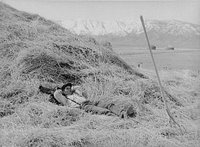


Ranchhand resting on haystackRanchhand resting on haystack. March, 1940, Dangberg Ranch, Douglas County, Nevada. Rothstein, Arthur, 1915- photographer. Library of Congress, Prints & Photographs Division, FSA-OWI Collection, LC-USF34-029989-D DLC.


I followed a link to the blog of Montana's Prairie Mary and read an interesting post titled "The Scent of Hay". I wrote a long comment there about hay stackers and hay stacks which started to look a blog entry, so I decided to stop writing there and continue my remarks here.

Here's what I wrote on her blog:

There are many references in the pioneer literature to the sweet fresh scent of a freshly-stuffed hay mattress.

I wondered, Mary, if the "beaver slides" you mention are the same as the "slide stacker" where a load of hay is pulled by cables and pulleys to the top of a triangular frame and dumped? The "buck" on which the hay rides is lying flat against the stacker's frame in the photo at this link.

When I was a child in Nebraska, we stacked hay with a similar contraption. In the old days, the load was pulled to the top by horses and they were called "the stacker team". In my day, a tractor was used to pull the load up, but the person who drove it was still said to drive "stacker team".

After the haystacks were made, the next big job was to get them off the meadow. They were drug to a stackyard, usually at the corner of the meadow, to await the day that they were fed to cattle. A well-made haystack withstood moving, but a poorly constructed one would fall apart.

Eventually, haymaking went to mostly square bales, and now I see a lot of big round bales when I visit the area.


I did a little research after writing the remarks above and answered my own question. Yes, "beaver slides" and "slide stackers" are the same piece of hayfield equipment. And yes, this is the same type of haystacker that we used when I was a child in the Nebraska Sandhills.

The first step in making a haystack was mowing the grass. When the grass was dried by the sun ("cured"), it was gathered into long windrows by a dump rake.

Then the sweep ran down each windrow and gathered the hay in a big bunch. The sweep was a tractor with its steering, transmission, and seat switched around so the big wheels were in front. It had a large "buck" mounted on the front (formerly the back) of the tractor. The buck was a rack of long wooden prongs ("teeth") that slid under the windrow to gather the hay into a big pile in front of the tractor.

The sweep pushed the load of hay to the stacker and onto the stacker buck. The stacker buck was much like the sweep buck -- a rack of long wooden teeth. With an arrangement of pulleys, the loaded stacker buck was then pulled to the top of a triangular frame and the hay was dumped into the stacker cage.

In the cage, the hay was leveled and packed by a man with a pitchfork. It was very important to get the hay firmly and evenly packed so that the stack would remain standing when the stacker cage was removed. It was also important to create a rounded top on the haystack so it would shed water.

In the hayfield, my father always ran the sweep because it was the command position. From there, he controlled the tempo of the work. The rake was kept busy providing him with windrows to sweep up, and the stacker was kept busy by the loads of hay he brought to it.

The long wooden teeth on the sweep were polished by the hay to an ultra-smooth, shiny finish that was pleasant for a child to stroke. Sometimes a tooth jammed into the ground and broke, and haymaking came to a halt until the tooth was replaced. New teeth were pre-shaped into a point at the factory, but they felt rough and splintery compared to those that had been in use for a while.

The most dangerous job in the hayfield was making the haystack. When the big heavy load of hay whizzed up the slide and shot into the cage, a careless hayhand could be buried or knocked off the stack if he wasn't safely out of the way. It was also a very hot, dirty job that required stamina and strength.

My own grandfather, Ralph Hill, broke his back somehow in a haystacker accident. I am not sure if he fell from the top of the stack, or if he was knocked off it by a load of hay. Perhaps someone in my family will tell me exactly how the accident happened. I believe he had climbed up there to help the hired man. At any rate, he was left partially paralyzed from the accident, a man in his 30's with a ranch to run and a family to provide for. Much responsibility fell on my father, the oldest son, from that day on.

I am sure that my grandfather's accident as well as efficiency in the hayfield played a part in my father developing a hayfield innovation that eliminated both the man in the stacker cage and the man at the stacker team. My dad welded a large tower onto an old truck chasis. The tower was positioned by the stacker cage, and a man on the tower brought the load of hay up the stacker slide and dumped it in the cage by remote controls and then used a hydraulic arm and hand to pack the hay into the haystack.

My father once commented that when he was a boy, it took a team of six or eight horses to pull a load of hay up the stacker, and there they stood all day, all that horseflesh for that one job. How glad they were, he said, to put a tractor to the stacker team position. Later, his invention reduced the stacking job to just one person.

Mowing was my job in the hayfield. I inherited this job from my mother. When we were little girls, she helped with the mowing. When I got old enough to drive a tractor, I helped with the mowing which kept me out of trouble and allowed my mother to do other things such as cook for the hay crew, ride the pastures to check on the cattle, and run to town for machinery parts.

When I first started mowing, I drove a little Allis Chalmers CA with a mowing machine that had a six or seven foot bar. I honestly think it was just a six foot bar.

I was the secondary mowing person. Don Saar, our hired man, was the primary mowing person and he had a double bar mower that cut a swath of 15 feet or more. My little mowing rig was fairly reliable about breaking down every afternoon at 4 p.m., so I usually got to go home early from the hayfield.

The next year, my dad bought a new 9-foot mower for me, and it didn't break down so I had to stay in the hayfield all day after that. A few years later, he bought a New Holland windrower, a big self-propelled machine that cut the hay, crimped it to accelerate the curing, and kicked it out into a windrow. When we got that machine, I became the only person mowing and I learned a lot about responsibility.

Mowing was a solitary job, and I had a lot of time to meditate while steering the machine down the edge of the uncut grass. Still, I had to pay enough attention to avoid leaving streaks of uncut hay from careless steering or from failing to notice that a clog of grass had developed on the mower bar. My dad hated streaks.

Making hay is the most important thing a rancher does every summer, because it's the winter food for the cattle. We had fine "sub-irrigated" hay meadows along the Skull and Bloody Creeks in Duff Valley, and I don't think our hay crop was ever poor enough that we had to buy hay. The hay meadows around Newport, Nebraska (in the same county that I grew up) are some of the finest in the world.

Truly, the bounty of the prairie is its grass.

Thursday, February 23, 2006

Kentucky countryside

Life in Christian County, Kentucky... The Rural Life...


Just across the creek from David J.'s house

This is a typical view of the countryside in northern Christian County, Kentucky -- open fields, high ridges in the background, lots of trees, always a tobacco barn within view. This photo was taken on the Laytonville Road. A little creek runs through the valley, hidden from view by the trees at right.

In Kentucky's English, the word "field" means any open area of ground. To me, an area that is plowed would be a "field", but a flat expanse of grass would be a "meadow". (If it were hilly, it would probably be a "pasture".) During the process of cutting and baling the grass, the meadow would become a "hayfield", but when the harvest of the grass was finished, it would revert to being a "meadow". I would call the grassland in the photo a "meadow" except that I've gotten used to saying "field."

I once said something to a neighbor about his meadow, and he gave me a puzzled look and said, "Where are you from?"
Related Posts Plugin for WordPress, Blogger...

CONTENTMENT: Keep your heart free from hate, your mind from worry, live simply, expect little, give much, sing often, pray always, forget self, think of others and their feelings, fill your heart with love, scatter sunshine. These are the tried links in the golden chain of contentment.
(Author unknown)

IT IS STILL BEST to be honest and truthful; to make the most of what we have; to be happy with simple pleasure; and to be cheerful and have courage when things go wrong.
(Laura Ingalls Wilder, 1867-1957)

Thanks for reading.