Showing posts with label Camp Alcorn. Show all posts

Saturday, October 15, 2011

Missing Confederate Graves at Hopkinsville's Riverside Cemetery

A chance to set the record straight


I've written several times in the past about Camp Alcorn in Hopkinsville, KY, where about 300 Confederate soldiers died of disease and exposure during the Civil War. If this topic interests you, you'll enjoy the well-researched article at the link below:


This link leads to a Rootsweb military page about the Camp Alcorn burials in a potters field in Riverside Cemetery, and the later re-burial of  "unknown" Confederate soldiers.

The author of this paper is William Meacham, Honorary Research Fellow at the Centre for Asian Studies at the University of Hong Kong. He lives in Hong Kong, as you might imagine, but he has family ties to Christian County, KY.  Mr. Meacham's research indicates that 72 or more Confederate soldiers are still lying in unmarked graves in Riverside Cemetery.

I am a "damyankee" transplanted in Christian County about 20 years ago, and most (though not all!) of my ancestors fought on the Union side of the Civil War. But, despite my own leanings, I think that we in Christian County should locate and mark the graves of these Confederate soldiers if we can. It is the decent thing to do, especially considering the mishandling of important records and the mistakes made with the Camp Alcorn graves in the past.


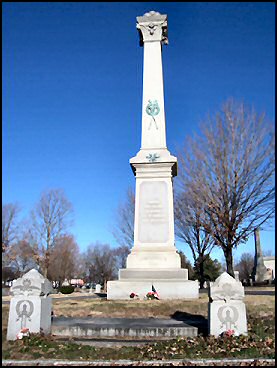
Historic marker about grave of unknown Confederate soldiers Monument to unknown Confederate soldiers, Riverside Cemetery, Hopkinsville, KY

Friday, February 04, 2011

Camp Alcorn Memorials in Hopkinsville, KY

Graves of Confederate soldiers in Riverside Cemetery


Cemetery and census records at the Christian County library

Recently, I received an email from a gentleman with Christian County (KY) roots who works at a Hong Kong university. He asked some questions about the Camp Alcorn Confederate graves in Hopkinsville, which he is researching. I didn't know the answers, but I looked up some things at the Christian County library and sent him the information that I was able to find.

Two memorials to Confederate soldiers


While finding the information this gentleman wanted and corresponding with him, I learned more about the two Confederate memorials at Riverside Cemetery. Those memorials are:
   1) The Latham Confederate Monument to unknown Confederate soldiers, erected during the 1880s by John C. Latham, a wealthy New York banker and Hopkinsville native, and
   2)The Camp Alcorn Cemetery, where 293 Confederate soldiers are memorialized with individual gravestones.

Latham Confederate Monument imagined and realized


The Latham Confederate Monument has an interesting history. Mr. John C. Latham was a Hopkinsville boy who went to New York and became wealthy but never forgot his hometown. He gave many donations of land and money to make Hopkinsville a better place, even though he no longer lived here.

The booklet, The Story of a Monument: Memorial of the Unveiling of the Monument to the Unknown Confederate Dead, May 19, 1887, at Hopkinsville, Ky, tells the story of the Latham Confederate Monument. In 1886, John C. Latham visited his father's grave at Riverside Cemetery. A friend pointed out an overgrown area in the old part of the cemetery where the Camp Alcorn soldiers were buried.  Mr. Latham, a Confederate Army veteran and a good-hearted man, was troubled that their graves were unmarked and untended.

The Latham Confederate Monument
With an admirable spirit of reconciliation, Latham proposed to donate a monument honoring all unknown Civil War soldiers buried at Riverside Cemetery. However, the unknown Union soldiers had already been moved to the military cemetery at Fort Donelson. Thus, Latham dedicated the monument to unknown Confederate soldiers.

Latham bought a large triangular site, on a high spot in the new part of the cemetery. The graves of the Camp Alcorn soldiers were opened, and such remains as could be found were moved to the new site. A large granite monument with four bronze plaques was made in Maine and shipped to Hopkinsville. It was dedicated and presented to the City of Hopkinsville on May, 19, 1887.

Discovery of the notebook


Another decade went by. Then, in 1899, Mr. Harry C. Gant, president of the Bank of Hopkinsville, was going through an old desk at the bank. In it, he discovered a notebook that had belonged to George K. Anderson, a Confederate soldier from Cotton Gin, Texas. It contained 213 deceased soldiers' names, and for each, the location in the cemetery where he was buried. Also, the record included 15 unnamed soldiers of Camp Alcorn and their final resting places. Apparently when Anderson's unit left Hopkinsville, the notebook was placed at the bank for safekeeping -- and there it stayed, forgotten for almost 40 years.

Of course, by the time the notebook was found in 1899, the remains of the soldiers had already been moved from their original graves. They had been reburied together in a circle around the Latham Confederate Monument, making it impossible to assign a name to any gravesite or set of bones.

Tombstones erected by Sons of Confederate Veterans


John C. Latham's goal of giving these fallen soldiers the dignity that they deserve was completed by the Camp Alcorn Cemetery memorial, erected by a local chapter of the Sons of Confederate Veterans. It honors 293 Confederate soldiers who died at Camp Alcorn with individual markers that give their names, military information, and dates of death if known.

Gravestones at the Camp Alcorn cemetery memorial

I don't know all of the sources the Sons of Confederate Veterans used in ascertaining the names of the 293 soldiers. (According to a newspaper report at the time of the discovery of the notebook, it revealed the identities of 101 men. This report seems to be in error because the notebook actually contained the names and burial sites of 227 men.) I also don't know if the tombstones were erected on the site of the original cemetery.

When I looked through the Camp Alcorn information in the Riverside Cemetery book. I was saddened to see that many of the dead Kentucky soldiers had enlisted in Hopkinsville. I suppose they were local fellows who came to town and signed up with the Confederate Army. They moved into the camp, and soon thereafter, fell ill and died from one of the several deadly diseases that were circulating through the troops that winter.

Note: On 3/15/2011, corrections were made, regarding the number of names in the notebook.
----------------------

If you're interested in Camp Alcorn, you might want to look back at these Prairie Bluestem posts:


Monday, April 28, 2008

First Presbyterian Church in Hopkinsville, KY


Church buildingFirst Presbyterian Church in Hopkinsville, Kentucky

First Presbyterian Church is located in Hopkinsville's historic downtown area, just a few blocks east of Main Street on the corner of 9th and Liberty.

A Presbyterian church was built on this site in 1849. It is described as "a large, substantial brick building, with basement offices, etc." (source), and it was used during the Civil War as a Confederate hospital. In 1880, the building in this photograph was erected and put into service, replacing the previous structure.

I've attended a reception in a meeting room at this church, but I haven't yet visited its sanctuary.   I suppose I could visit on any Sunday morning, but I generally go to my own church then!

I always enjoy seeing the cheery red doors when I drive past. If they are meant to spark interest and appear welcoming, I think they achieve their goal.

Related post: Camp Alcorn at Hopkinsville, Kentucky

Tuesday, July 24, 2007

Camp Alcorn at Hopkinsville, Kentucky

A Confederate States Army camp near Hopkinsville during the Civil War


I've mentioned before that Riverside Cemetery in Hopkinsville, Kentucky, is the final resting place of about 300 Confederate soldiers who died of measles, dysentery, tuberculosis, pneumonia, typhoid, and other illnesses while camped at Camp Alcorn during the Civil War.

I was quite interested when I stumbled across some correspondence to, from, and about Camp Alcorn in an old book that has been digitized by Google.

The book is The War of the Rebellion: A Compilation of the Official Records of the Union and Confederate Armies. It was published in 1902 by the U.S. Government Printing Office, with input from many authors and sources, including the United States War Dept, United States Congress. and the United States War Records Office.

I've written the following brief history of Camp Alcorn based mostly on Confederate letters that are recorded in this book...

Bar

How Camp Alcorn was established


After a number of skirmishes with Union troops in this part of Kentucky, Confederate General Albert Sidney Johnston and Brigadier General Felix Kirk Zollicoffer took Bowling Green in the fall of 1861. Meanwhile Confederate General Simon Buckner occupied Hopkinsville.

These victories led to a Confederate plan to create a "Kentucky Line." The idea was to stop the Union forces in Kentucky, and thus to prevent the Union from gaining control of rivers and railroads that led to Nashville, Tennessee, and beyond. Also, there were iron furnaces of importance to the Confederacy along the Tennessee and Cumberland rivers of western Kentucky.

Shortly after taking Hopkinsville, General Buckner was promoted and moved to Central Division of Kentucky headquarters to Bowling Green. Buckner left Brigadier General J. L. Alcorn in camp near Hopkinsville with a brigade of Mississippi volunteers and two small regiments. Alcorn had brought these troops from Mississippi as part of a response from that state to a request for 10,000 men for sixty days service in Kentucky.

Alcorn was supposed to defend the Cumberland River and the railroad bridge over it at Clarksville, Tennessee, from an overland attack from the north/northeast. However, widespread illness among his soldiers limited his ability to do this job.

General Alcorn returns to Mississippi after escorting the troops to Kentucky and setting up camp at Hopkinsville


On October 19, 1861, Alcorn wrote to General Buckner, to give a scouting report and to inform him of the health situation in camp.
My command, after furnishing nurses for the sick, is reduced to a battalion. It appears that every man in my camp will directly be down with measles. The thought of a movement in my present condition is idle. I am not more than able to patrol the town.

Source: Letter from Alcorn to Buckner, Oct. 19, 1861 (pp. 464-465)

At the end of the letter, he requested to be relieved of command at Hopkinsville so he could return to Mississippi.
[T]he cause for my continuance no longer exists in force sufficient to detain me. I wish to leave for Mississippi; and ask your permission to fix the 27th instant as the day for my departure. This post is an important one, and should not be commanded by one who has not the confidence or is distasteful to the Government at Richmond. My service as brigadier-general of Mississippi is due that State only. If the Confederate Government wished me, I would be appointed. This not being done, I am an intruder. My self-respect, my own honor, is dearer to me than country or life itself. The hope of being able to make an early movement has lured me; that hope dissipated, common decency requires me to leave this command. Besides, to stay here and labor and toil as I do, struggling with disease and death, to be superseded presently, or, if continued, to be a mere interloper, a nondescript, every impulse of my nature says, "No; death first," My command will complain, but this will soon be hushed, for now they are bound. I shall leave with them my son, a captain of a company, as hostage that my heart is with them.

In conclusion, I thank you most sincerely for the kind manner in which you have treated me since my return to my native heath, and beg that you will have some one to take my command, if not before, on the day indicated. Do not neglect this, I beg you.

Source: Letter from Alcorn to Buckner, October 19, 1861 (pp. 464-465)

My research leads me to believe that General Alcorn survived the war and later became a U.S. senator from Mississippi.

General Tilghman assumes command and learns of conditions at Camp Alcorn


Shortly after Alcorn requested permission to go home, Brigadier General Lloyd Tilghman was assigned to command the troops at Camp Alcorn. Tilghman was a West Point graduate from Baltimore, Maryland, and a civil engineer by trade. He had served in the Mexican War and had helped to build the Panama railroad. Railroad construction brought him to Paducah, Kentucky, and in the 1850s, he built a home there that you can still visit today.

When General Tilghman took over Camp Alcorn, the men were apparently living in very sad conditions. He wrote to General Johnston at Bowling Green on October 27, 1861:
I have been detained here [at Clarksville, Tennessee] to-day, preparing matters to aid my organization at Hopkinsville, where I learn a vast deal of suffering exists, owing to the exposed condition of men. I have made arrangements to put 200 women to work on clothing, and hope for a contribution of blankets and clothing from the society at this place. I regret deeply to hear of the condition of things at Hopkinsville, but hope to overcome them. I am sorry also to hear of the inefficient condition of things at Fort Donelson [along the Cumberland River, west of Clarksville, Tennessee). I fear our interests there are well-nigh beyond our control.

Source: Letter from Tilghman to Johnston, October 27, 1861 (p. 479)

Reports from Hopkinsville by General Tilghman


By the 29th of October, General Tilghman had arrived in Hopkinsville. He reported the following to Bowling Green:
I had hoped that the picture, sketched to me of matters here might not have been realized, but I am compelled to think it not too highly colored. Under all the circumstances, 1 doubt not General Alcorn has made the best of things, his camp being merely one large hospital, with scarce men enough on duty to care for the sick and maintain a feeble guard around them, with insufficient pickets at prominent points. Over one-half the entire command are on the sick list, with very grave types of different diseases. Those remaining and reported for duty leave not enough really well men to do more than first stated. The Kentucky Battalion of Infantry, numbering 547, have only 45 cases reported sick. The measles have made their appearance, and the battalion will average 20 new cases per day, judging from to-day's report. The morning brigade report, herewith inclosed, shows only 716 for duty out of a total of 2237.

Source: Letter from Tilghman to Col. W. W. Mackall, October 29, 1861 pp. 485-486

On November 2, General Tilghman wrote again to Bowling Green:
You will have some idea of [the situation in Hopkinsville] when I tell you that in endeavoring to get up a little command last evening to move on Princeton, 1 found that the First Mississippi had 151 for duty, the Third 128. Out of these, guards and pickets had to be taken, giving me only 100 men from each regiment, half of whom were really unfit for the night march (raining in torrents). I managed, however, to get together 400 men and two pieces of artillery, the poorest clad, shod, and armed body I ever saw, but full of enthusiasm. I soon found that half the infantry were so unfit, that the surgeon stated that humanity demanded they should not go. I was relieved by a courier from my embarrassment and delayed until this morning, when a second courier relieved me entirely, by stating that the enemy had turned off from Princeton and [were] making northward. This morning I learn again that they have retired again (as their gunboats have done) towards the mouth of the river. You may therefore consider me relieved of the pressure for a few days.

Source: Letter from Tilghman to Buckner, November 2, 1861 (p. 500)

On November 7, 1861, reinforcements arrived -- volunteers from Texas led by John Gregg. They were partially armed and not yet organized into a regiment. Gregg wrote the following to command in Bowling Green:
Except a number of sick men on the road our nine companies are all here. The number is 749. Five of our number died on the way. From exposure to cold and wet on our journey we have more coughs and colds than I ever saw among the same number of men. Under General Tilghman's direction we will organize and elect our officers to-day or to-morrow. We have the consent of the Secretary of War to that purpose.

Source: Letter from Gregg to Mackall, November 7, 1861 (p. 524-525)

Health at Camp Alcorn improved under General Tilghman's command


By November 11, 1861, General Tilghman was a bit encouraged about the health of the camp. He wrote the following along with a long report of scouting and skirmishes north of Hopkinsville:
I am glad to be able to report "improvement" in my whole command, and the gradual assuming of form and energy in every department. A thorough change in my entire hospital arrangement, by the use of appropriate buildings and the procurement of proper supplies, aided by thorough police, has produced the results usually attainable through such means. The cheerful and able assistance rendered me by those of my own staff, as well as many of the regimental officers, is deserving of high commendation. The command, however, is yet very insufficient for the objects I know you would desire to have attained, and as it seems my only hope is in a patient waiting for re-enforcements, I can only hope I may now be allowed a little respite from the constant danger, real, that has surrounded me for the last ten days.

Source: Letter from Tilghman to Mackall, November 11, 1861 (p. 535-537)

At the end of this letter, he asked that funds for clothing be allocated immediately for the troops under his command.

The First Presbyterian Church of Hopkinsville was one of the sites used as a hospital during the winter of 1861-62, according to a historic marker at the church (corner of 9th and Liberty.)

General Tilghman's letter of November 13 to Bowling Green contained a mixture of good and bad news. A batallion of Colonel Nathan Bedford Forrest's cavalry had arrived from Fort Donelson. The forested area around the river was not good for cavalry maneuvers and furthermore, there wasn't enough food for the horses. General Tilghman had already sent out a joint cavalry and infantry group to prevent Union theft of a large herd of pigs that had been purchased by the Confederate agent in Clarksville. Tilghman also wrote, "My command still improves; are getting into their new hospitals." Source: Letter from Tilghman to Mackall, November 13, 1861 p. 549)

General Tilghman transferred to Forts Henry and Donelson


On November 14, orders were issued by General Buckner in Bowling Green, transferring Brigadier General Tilghman to the Cumberland River. He was given command of Forts Donelson and Henry, where a dangerous lack of discipline and organization existed, even as the Union was getting new and better gunboats. A Brigadier General Charles Clark was put in command of the two Mississippi batallions at Hopkinsville.

This is the end of the Camp Alcorn paper trail I've been following. I can add that General Tilghman did his best in December, 1861, and January, 1862, to get the troops and fortifications at Fort Henry and Donelson ready for battle. The Union attack came in February, 1862 -- 15,000 Union troops and seven Union gunboats -- and both forts fell into Union control, opening the way to Clarksville, Nashville, and beyond. It was the first big Union victory of the war.

General Tilghman surrendered with his men and was imprisoned for about six months. After he was released in a prisoner exchange, he rejoined the Confederate forces in Mississippi. He died in battle at Vicksburg, Mississippi, in 1864, and it is reported that his men wept when he fell.

The end of Camp Alcorn


As for Camp Alcorn, some of the sick were sent to a Confederate hospital in Clarksville, Tennessee, in November due to the likeliness of a Union attack upon the camp. 53 of Camp Alcorn's volunteer Texans died in Clarksville, and I am not sure how many others.

A historic marker at Riverside Cemetery states that Colonel Nathan Bedford Forrest lived in a log house in Hopkinsville with his wife and daughter during the winter of 1861-62 and withdrew from Hopkinsville to Tennessee when the CSA left Bowling Green. Kentucky's historic markers document a busy winter of raids and reconnaissance by Forrest in the area around Hopkinsville, though many of his men fell sick while camped here.

Camp Alcorn was apparently broken up when all its able-bodied troops were sent to the defense of Fort Donelson in February of 1862. As far as I know, the only remaining evidence of its existence at Hopkinsville is the Camp Alcorn cemetery.

A local Sons of Confederate Veterans group (Jefferson Davis Birthplace Camp # 1675) has worked hard to honor these fallen Confederate soldiers by compiling records, providing individual tombstones for each known soldier, and faithfully placing flags for them.

Bar

Related articles on this blog
Civil War Graves at Riverside Cemetery in Hopkinsville, KY
A Walk In Riverside Cemetery
More About Riverside Cemetery

Letters sent from Camp Alcorn
From a Confederate soldier to a lady he admired
Description of the sickness at Camp Alcorn and the weather, Winter of 1861-62  (Scroll down to "Letter from the 'Bass Grays'.”)

A description of the housing at Camp Alcorn

Additional related material:
That Dark and Bloody Ground: The Kentucky Campaign of 1861
One Camp Alcorn soldier's history
Tribute to General Lloyd Tilghman
Norwegian reenactment group for the 7th Texas Infantry, includes a list of all soldiers who died at Camp Alcorn
Lloyd Tilghman at Wikipedia
Tilghman monument at Vicksburg
Another photo of Tilghman monument
Captain J. M. Sparkman's Tennessee Light Artillery Company
My Civil War, Before, During, and After -- Memoirs of a Union soldier who fought in this part of Kentucky with the 5th Iowa Cavalry

Tuesday, March 13, 2007

Civil War Graves at Riverside Cemetery in Hopkinsville, KY

Camp Alcorn Cemetery and Unknown Confederate Soldiers Monument, Hopkinsville, KY..


Robin at south gate of Riverside CemeteryI sometimes walk in Riverview Cemetery in Hopkinsville. It's very quiet there and I always hear birds singing. The perky little robin at right was squabbling with another robin near the cemetery's south gate. They didn't break it up until I came very close. Maybe they were male robins, arguing about a female?

I find cemeteries very interesting when they contain graves from long ago. I read the stones and ponder the lives of people who lived before my time. The details on some tombstones hint at tragic stories, but others record long and apparently prosperous and happy lives. All this reading and pondering makes for a leisurely stroll instead of a brisk walk-for-exercise!

Riverside Cemetery is interesting because it contains many graves of Civil War soldiers. At the main gate, several historic markers document the burial of Civil War soldiers within, including a Union General. Another marker documents the fact that Colonel Nathan Bedford Forest spent the winter of 1861-1862 in Hopkinsville.

Historic marker of Union general's grave Historic marker of Confederate general's grave


About 300 Confederate soldiers are buried in the Camp Alcorn Cemetery within Riverside Cemetery, and apparently the vast majority of these men -- perhaps all -- died of disease in camp near Hopkinsville. How sad to leave home and family and die in such circumstances.

The identities of 101 of the Confederate soldiers are unknown, but their burial is commemorated with a historic marker at the main gate and their grave is marked with a large monument erected by John C. Latham, a contemporary from Christian County who survived the War and became a wealthy businessman.

John C. Latham is the same man who donated Peace and Latham Parks to the city of Hopkinsville. Mr. Latham's tombstone is located in the same general area as the Unknown Confederate Soldiers' monument, and it is about the same size as the monument with a long description of his impeccable character inscribed upon it.

Historic marker about grave of unknown Confederate soldiers Monument to unknown Confederate soldiers, Riverside Cemetery, Hopkinsville, KY


Here are the inscriptions on the four sides of the monument for the Unknown Confederate Soldiers (pictured above right):

East side (seen above with emblem)
AROUND
THIS COLUMN
IS BURIED
ALL OF HEROISM
THAT COULD DIE.


(North side)
WHILE MARTYRS
FOR CONSCIENCE SAKE
ARE RESPECTED,
THE VALOR AND DEVOTION
OF THE CONFEDERATE SOLDIER
WILL BE ADMIRED
BY THE GOOD
AND THE BRAVE.


(West side)
BENEATH THIS SOIL
IS MINGLED
THE SACRED DUST OF
ONE HUNDRED AND ONE
UNKNOWN SOLDIERS
WHO WERE ATTACHED
TO THE FOLLOWING COMMANDS:
FIRST MISSISSIPPI REGIMENT
THIRD MISSISSIPPI REGIMENT
SEVENTH TEXAS REGIMENT
EIGHTH KENTUCKY REGIMENT
FOREST'S CAVALRY
WOODWARD'S KENTUCKY CAVALRY
GREEN'S KENTUCKY ARTILLERY
-----
WAR BETWEEN THE STATES
1861-1865


(South side)
THIS MONUMENT IS ERECTED
AT THE PLACE OF HIS BIRTH
BY A SURVIVING COMRADE
TO COMMEMORATE THE VIRTUES
OF THE CONFEDERATE DEAD
-----
A.D. 1887

The Camp Alcorn Confederate Cemetery is located in a separate area of Riverside Cemetery near the river. Each gravestone tells the name of the soldier, his rank, and his military unit. A large sandstone slab with a engraved plate gives a bit of the story. I originally thought that these gravestones marked actual graves of soldiers, but I now believe that it is a memorial to all the (known) deceased Confederate soldiers whose bodies remained in Hopkinsville. Careful reading of the engraved plate seems to confirm this. (This paragraph updated 1-02-11.)

Camp Alcorn Confederate Cemetery

Marker at Camp Alcorn Confederate Cemetery Camp Alcorn Confederate Cemetery


Riverside Cemetery also contains graves of Civil War veterans who lived out their natural lives. They are buried with their families, and their gravestones sometimes carry a notation of their rank and the regiment with which they served.

I have posted some photos of Riverside Cemetery before. I didn't look back at the previous posts, but probably some of the photos in this post are another look at the same scenes. I hope that these posts about Riverside Cemetery will be of interest to the visitors who come here regularly seeking information about it.

Bar

Google search for information about Camp Alcorn


Related articles on this blog:
A Walk In Riverside Cemetery
More About Riverside Cemetery
Camp Alcorn at Hopkinsville, KY

Friday, January 13, 2006

More About Riverside Cemetery

Memorial to Unknown Confederate Soldiers at Riverside Cemetery in Hopkinsville


Monument to Unknown Confederate Solidiers of Camp Alcorn, Hopkinsville, KYI did walk again in Riverside Cemetery this week, and I did find the Confederate memorial that I missed on my first walk there.

The inscription on one side of the monument says that it was erected by a fellow soldier who survived and apparently prospered after the War. This fellow soldier was John Latham, a native son of Hopkinsville who became a wealthy Wall Street banker, but never forgot his hometown.

On the other sides, it is stated that these unknown Confederate soldiers died at Camp Alcorn. There are some nice words commending their courage and lamenting their tragic deaths. 101 men are laid to rest there.

On the east side (seen in the photo) the inscription says, "Around this column is buried all of heroism that could die," and below that, "Confederate Dead."

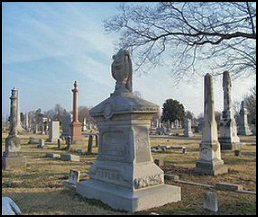
The Unknown Confederate Soldiers monument is tall, but another obelisk nearby is as tall as the roof of a two-story house.

The ground cover that is creeping over the steps grows throughout the old parts of the cemetery. It has a fuzzy heart-shaped leaf and a slightly purple tint to its green color. I have seen it before, but I don't know what it is. It's not an herb, or at least, its leaves don't have any particular fragrance when crushed. Apparently it's evergreen, at least in mild winters like the current one. This plant is the prevailing ground cover, other than grass.

I walked by the chapel and looked at it from the outside. Of course, it's locked, and there's not even a window to peer through. It was built around 1900 and then restored in the 1960 's. (It's probably about due for another restoration.) It is dedicated to the memory of about 40 Revolutionary War veterans who are buried in Riverside Cemetery.

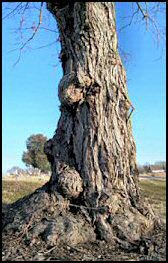
Old tree at Riverview Cemetery, Hopkinsville, KYI am not good at identifying trees in winter when they have no leaves, but I think this particularly gnarly trunk may be a maple. I've noticed that the bark on old maple trees is often shaggy.

I did make a positive identification of a ginko tree -- the ground under it is littered with its squishy little fruits. I'm surprised that animals haven't cleaned them up yet. Around here, the country folk speak of persimmons as "possum trees," but apparently ginkos don't fall into that category.

Related posts:
A Walk In Riverside Cemetery
Camp Alcorn at Hopkinsville, KY
Civil War Graves at Riverside Cemetery in Hopkinsville, KY

Monday, January 09, 2006

A Walk in Riverside Cemetery

I'm tired of walking my usual routes, so this morning I decided to walk in Riverside Cemetery. Riverside is, by my estimate, about 1/4 mile wide and perhaps a little longer. It's on Hopkinsville's Main Street, just north of the Little River. Its boundaries are formed by Main Street, Little River, the railroad tracks, and the road to the Hopkinsville water plant.

As a rule, I'm not depressed by cemeteries (at least not by old ones.) I enjoy the names and dates on the tombstones and I wonder what those people's lives were like. Riverside Cemetery dates back to pre-Civil-War days, so walking there is a stroll through local history.

I noticed an interesting thing. In the decades from 1870 to 1910, many of Hopkinsville's fine old homes and buildings of commerce were constructed, and during the same years, a number of markedly large and tall gravestones were installed in Riverside Cemetery. It's quite obvious in Hopkinsville, as in most Kentucky towns, that some families prospered during the Reconstruction -- enough to build big ornate buildings and to erect big monuments to their families in the graveyard.

I used to come to Riverside Cemetery once in a while during my lunch break to walk, but I was always on a tight schedule and I didn't want to perspire much, so my visits were brief. Maybe that's why I had never walked past the Camp Alcorn Confederate Cemetery in a section near the river.

I saw the rows of identical stones this morning from a distance , and I wondered at first if it was Hopkinsville's "potter's field" for the indigent. As I came nearer, I was surprised to see that the rows of identical stones bear the names, ranks, and companies of Confederate soldiers.

The Jefferson Davis Camp #1675, Sons of Confederate Veterans, provided the granite grave markers and a monument that tells a bit about the men. The soldiers were stationed at Camp Alcorn in Hopkinsville, and most of them died from measles, typhoid fever, pneumonia, and other diseases. Over 300 died during the winter of 1861-1862. The remains of a few were taken back to their homes, but over 290 were buried in Hopkinsville. Many of them were from Kentucky but others were from Mississippi, Texas, and probably elsewhere as well. (This paragraph updated 1-02-10.)

One gravestone has an inscription on both sides. The front of the stone identifies the grave of Private Washington Hall of Hills Company, Gregg's Regiment, 7th Texas. The back of the stone notes that Washington Hall was a "man of color." The following is in quotation marks as if it might have come from the hospital records or perhaps a letter -- "This old man was a faithful servant to his master and died much beloved to his company."

550 feet to the northwest, there is another monument to unknown Confederate soldiers.  Some remains were moved there in 1887. I did not see this monument, but  I read on a historic marker near the front entrance that over 100 unknown Confederate soldiers are buried in Riverside.

Edgar Cayce, the famous psychic healer, is buried somewhere in Riverside, but I didn't see his grave. Also, there's a Union general buried there. I didn't read all the historic markers at the entrance in detail because some of my rambling needed to be a walk-for-exercise instead of a leisurely stroll. If I walk there again this week, I'm sure I'll be making additions and corrections to this report.

Related articles:
More About Riverside Cemetery
Civil War Graves at Riverside Cemetery in Hopkinsville, KY
Camp Alcorn at Hopkinsville, KY
Related Posts Plugin for WordPress, Blogger...

CONTENTMENT: Keep your heart free from hate, your mind from worry, live simply, expect little, give much, sing often, pray always, forget self, think of others and their feelings, fill your heart with love, scatter sunshine. These are the tried links in the golden chain of contentment.
(Author unknown)

IT IS STILL BEST to be honest and truthful; to make the most of what we have; to be happy with simple pleasure; and to be cheerful and have courage when things go wrong.
(Laura Ingalls Wilder, 1867-1957)

Thanks for reading.