Showing posts with label what I think. Show all posts

Monday, July 22, 2013

Messages from our Mennonite Neighbors

Bible verses along the roads


"Remember thy Creator in thy youth."


"Choose this day whom you will serve."
Over the past year or so, several signs with Bible verses have been posted along local roads by our Mennonite neighbors. I don't know whether the signs are a church project or individual efforts. Some of the signs are similar in size and style, so maybe they came from the same supplier.

The signs are written in English so they can be read by most people who pass by.  But actually, the Mennonites usually read the Bible in German.  Their Heilege Schrift (Holy Scriptures) is/are written in "Bible German," a form of High German that's different from the Pennsylvania Dutch they speak at home. Mennonite children learn Bible German along with English, as part of their education.

"Honor thy father and mother."
A young Mennonite neighbor lady once told me that "sometimes we look in the King James Bible" if a passage in the Mennonite Bible is hard to understand. I am not sure if she was speaking for all or just speaking for her own household.  The archaic English of the King James Version is surely as difficult as Bible German, but the Mennonites probably assign extra virtue to the KJV simply because it is old.

But let me get back to the signs around the neighborhood. I respect our neighbors for trying to "be a good light". (A Mennonite neighbor lady, telling me how Mennonites should live, used that phrase.) But I do wish they'd put the signs on posts instead of nailing them to trees. These trees growing wild in the fence rows aren't particularly valuable, and they'll probably survive the nails, but it still bothers me. I hate to see things nailed to living trees, no matter who does the nailing.

"Repent & be converted that your sins may be blotted out."
"God will judge the world in righteousness."

Tuesday, May 01, 2012

Old Movies for Me!

How a man I never knew changed my life forever


When I was a little kid, Brent was my dad's best friend. Mom will tell you that Brent was Dad's best friend many years before I came along, and that he is the one who introduced them to each other. Mom will also tell you that I met Brent, but I was too little to remember.

Even though I don't remember meeting him, I know that Brent loved movies -- especially old movies. He was an aficionado. He knew why a movie was unique, or what crazy stuff had happened during shooting. He knew what actors and actresses liked each other and which ones didn't.

Brent knew that Isaac's and my education in the great classic movies was being neglected. When I was about 10, he started sending us movies that he thought we should see, that were appropriate for kids. I remember being so excited to get Brent's boxes. Isaac and I would look up all of the new movies in Dad's movie books to see what they were about. Even though I never watch VHS anymore, I still have all of the movies he sent us, because they bring back such happy memories.

I watched those videos hundreds of times over the next ten years. I can recite huge swaths of several of them. Our favorites were the "Road to..." movies, and the Marx Brothers. I still have to restrain myself from quoting them to people who will have no idea what I'm talking about. I've even gone so far as to infect my husband with my old movie love. He still swears that he doesn't like black and white movies, but he loved Harvey.

Brent is the reason that I sing Marx brothers songs. He's the reason that when all of the other little girls in my class had a crush on a member of Hansen or Leonardo Dicaprio, I had a crush on Errol Flynn. And the reason that I view the new Flight of the Phoenix movie with much skepticism. How can you replace Jimmy Stewart? All of these years later, I still don't like modern horror movies. Give me Vincent Price or Boris Karloff any day over these movies with all of their blood and gore.

Brent passed away when I was in high school. Mom tells me that we're his legacy, because he was the last of his line. He passed on his love of those movies to both me and my brother. He also passed on the knowledge that the truly great stories never get old.

- - - - - - - - - - 
Thank you, Keely. Here's Brent  in about 1979, in the kitchen of the first apartment Dennis and I had after we were married. I can't believe it, but he appears to be washing dishes!

Brent has a starring role in many funny, happy memories of our college and newly-wed years in Warrensburg, Missouri. He had juvenile (Type 1) diabetes, and he died at the young age of 38.  G.L.N.

Friday, March 02, 2012

Recreational Mowing

Unfriendly to wildlife


Kentucky Living, a little magazine we receive from our electrical cooperative, has a great column about recreational mowing this month. Dave Baker, the author, writes that unnecessary mowing removes cover and food that wildlife needs to survive.

Baker talks mostly about the regular mowing of pastures for no reason except appearance (vanity.) Clipping a pasture all the time makes it an inhospitable place for the little creatures who share the land. Wildlife needs the cover of tall vegetation for protection and the seed heads of full-grown vegetation for food.

And, though Baker didn't mention it, all that recreational mowing burns a lot of gasoline for no good reason, too.

I know people who mow several acres --even five acres or more -- around their house a couple times a week during the grassy months of the year. If everyone who's doing that would mow half as much, half as often, think of the many, many gallons of gasoline that would be saved.

And think of all the wildlife habitat that would be created on the half that was allowed to grow. Yes, even in your yard, wildlife appreciates vegetation that's allowed to grow and mature.

A freshly mowed expanse,  photographed by Tim Ebbs.

Sunday, January 01, 2012

Fly Problems in the Good Old Days

Typhoid in the Spanish American war


Occasionally, I hear someone waxing nostalgic about the good old days, and I admit that I, too, sometimes grow wistful for simpler times.

However, I don't feel a deep yearning to return to animal-powered transportation -- such as horses and buggies. They didn't create air pollution problems like cars do, but the manure on the streets was a huge sanitation problem. In warm weather, street manure was a prime breeding ground for flies as well as a source of stench. Pedestrians had to watch their step at all times, and in wet weather, they ran the danger of being splashed with raw sewage from the street. (I'm not exaggerating.)

I don't get nostalgic about outhouses, either, having had the joy of using one at school through the eighth grade. People like to decorate their bathrooms with cute privy pictures and to send around amusing e-mail poems about outhouses, but those outdoor toilets really weren't very pleasant places. They were cold in the winter, and in warm weather, well... they smelled bad and the flies liked them.

The following is from a health textbook of the 1920s:

In the Spanish-American War, about one out of every five of our volunteer soldiers had typhoid fever, and it was found that the fly was one of the principal agents in spreading the disease. In Jacksonville, Florida, flies used to cause a great deal of typhoid, until a campaign for the screening of outside closets reduced the typhoid death rate of the city to less than one fourth of what it had been.

Typhoid fever is by no means the only disease that is carried by flies. Studies made by the Association for Improving the Condition of the Poor in New York City showed that babies which were carefully protected from flies had only one half as much diarrheal disease (summer complaint) as babies not protected in this way.


Source: Healthy Living (p. 264), a textbook by Dr. Charles-Edward Amory Winslow, published in 1924 by the Charles E., Merrill Company of New York and Chicago.

Monday, May 16, 2011

The Excellence of the Ordinary

The beauty of the typical


Last winter, I read It's Not the End of the Earth, But You Can See It from Here: Tales of the Great Plains, a book of stories about small town life in central Nebraska. What a good book! I enjoyed it immensely because I grew up in rural Nebraska, because the stories are entertaining, and because they contain truths, wisdoms, and observations about life that resonate with me.

The author is Roger Welsch of Dannebrog, Nebraska, whom you may remember from the series, "Postcards from Nebraska" on the CBS News Sunday Morning television show. He is a native of Nebraska, born, raised, and educated in Lincoln. His primary area of study, teaching and writing is folklore. He's the author of about two dozen books, many of them about rural life in Nebraska. I intend to read more of them.

The following passage from the introduction to It's Not the End of the Earth, But You Can See It from Here: Tales of the Great Plains  has returned to my mind many times since I read it.  I decided to look it up and share it with you.

My academic training and most of my teaching experience was in folklore, so I learned quite early in my intellectual history to appreciate, to appreciate profoundly the importance, the charm, the beauty, and the value of the typical. That's what folklore is. While the university art departments dwell on the exceptional and unique, the history departments focus on the significant and singular, the English departments examine the best, we in folklore are interested in what represents the typical, the ordinary, the everyday.

The ballet is not typical; the small-town wedding dance is. The events of a Harlequin romance or a soap opera are anything but everyday; the gossip and anecdotes told over the breakfast table in the cafe in Centralia are precisely everyday; they are indeed the very definition of "everyday." Is the everyday of less value or attraction than the exceptional? That has most certainly not been my experience. Nor, probably yours. Virtually every homemade quilt you have ever seen, for example, is superior by many times to 90 percent of the art that currently insults the walls of the galleries. We have all at one time or another, perhaps on a regular basis, eaten roast beef, mash potatoes, and gravy in a humble kitchen that put to shame the finest gourmet meal we have ever enjoyed. Medical science still sorts through folk medicine for the truths it may yet have in its pharmacopoeia.

Source: Welsch, Roger. It's Not The End of the Earth, But You Can See It From Here: Tales of the Great Plains. New York: Villard Books, 1990. (See pp. xiv-xv).

Here, Welsch is describing the focus of folklore studies, but that's not what I remembered. What stuck with me was the truth that many great masterpieces never become famous. They're created by ordinary people in the course of their ordinary lives. We should recognize and treasure these common works of art for the precious jewels that they are.

Image by Molly DG. Some Rights Reserved.

And I wish to add that some of the best music is made on the back porches and in the living rooms of very ordinary people -- and in rural and small-town churches, too. I remember with pleasure many examples of fine, homemade music.

Tuesday, March 29, 2011

Cranky Old People

Mind games


My son Isaac works part-time as a stock person in a grocery store, and he sometimes talks about "cranky old people". Usually, he's frustrated that they've scolded him about things that are totally outside his control.

At my job today, I met one of Isaac's "cranky old people".  I asked a white-haired fellow if I could help him with anything, and he launched into a passionate complaint about my misleading labels. 

My labels? I was taken aback, but when he paused, I spoke as politely as I could. "I'm sorry it's confusing, sir," I said. "I will pass along your complaint, but the store really has no control over that product's labels. The packages and the information that's printed on them come from the manufacturer."

My words only made him angrier. He spat out a few more paragraphs about "my" labels and "my" sizes and "my" products and "my" store, and I stood there meekly and heard him out. Finally he bought the only thing we had that resembled what he really wanted, and strode away, a thin, stiff, angry, elderly man.

This incident reminded me of my mother-in-law, who is now in her mid-90s. For the past few years (since breaking a hip), Mama N. has lived in an assisted-living home. She doesn't go out to shop anymore, which is probably just as well. The last few times I shopped with her, she had conversations with clerks that were quite similar to the one I had this morning.

Portrait of a Elderly Lady
(Mary Cassatt)
Those unfortunate clerks didn't know that Mama suspected they would cheat an old lady like her, every chance they got.  Mama tried to be extra feisty, to show them that she was no easy mark. That's sort of like my angry man today. He was sure that the labels were intended to trick him.

If I make it through another decade or two, I hope that I don't go paranoid in the process. Being suspicious all the time surely must be exhausting. And it makes a person cranky, which certainly is hard on other folks.

Saturday, February 19, 2011

Overheard

For every stereotype, there is someone who fits it all too well. I overheard this amazing conversation in the line at the grocery store:

Lady 1: How's your oldest son doing?

Lady 2: Oh he's doing a lot better now that they have him locked up.

Lady 1: Well, that's good, I guess. And how's Bobby? Where's he at?

Lady 2: Bobby's in Louisville. He's doing all right.

Lady 1: Do you have any grandbabies?

Lady 2: (laughing) Oh, my goodness, yes. Bobby's got ten kids.

Lady 1: TEN kids?!

Lady 2: Ten kids in eight years. He had two girlfriends pregnant, most of the time.

Lady 1: (sputtering)

Lady 2: Oh, he's paying for it now. His child support bill is $800 a month.

- - - - - - - - - -

The words "moral decay" come to mind.

Saturday, February 12, 2011

Winter, Continued

Spring has not sprung -- yet.


The view from our side porch, about 7 AM Thursday

This photo of our snowy landscape is for the folks who live far away and wonder what's happening in Christian County. If you live here, you should ignore this post! You already know that it snowed again and again this week. (Yes, two significant snows.)

The schools were in session for most of Monday, and that was the only day of school for the week. The school buses had a little trouble on the slick roads, Monday afternoon,. According to the Kentucky New Era, a bus went off Highway 800, somewhere near Crofton.  A Christian County Schools spokesperson reported about a half-dozen other minor accidents. No one was hurt.

I've been pondering why our buses have trouble in ice and snow when, in some states, the school buses travel in ice and snow without incident, day after day. Part of the problem surely is that our drivers aren't experienced with such conditions. But some of the problem, I think, is the roads our buses travel. Even in good weather, narrow, winding, hilly backroads are challenging for a big vehicle. Taking a bus on those roads when they are slick with ice and snow is just asking for trouble.

In central Kansas where my brother lives, many of the rural roads are straight as an arrow. From the air, they must look like lines on a piece of graph paper.  In Christian County, our backroads are like the C. W. McCall song, "Wolf Creek Pass".
Well, from there on down, it just wasn't real purdy:
It was hairpin county and switchback city.
One of 'em looked like a can full'a worms;
Another one looked like malaria germs...

I'm exaggerating, but only to make my point.

I am so ready for spring. Next week, we are supposed to have much warmer temperatures -- in the low 60s on a couple of days. If we have a few days like that, the daffodils will start blooming.

About 2 PM on Weds. as I drove home from work

Tuesday, November 09, 2010

Growing Older

Accepting what you cannot change


An old woman feeding birds in Kazimierz
the old Jewish district in Krakow, Poland.
Photo from Wikimedia Commons.

I clipped this stanza of verse from an old book, because this is how I would prefer to grow old -- with a zest for living.

At sixty-two life is begun;
At seventy-three begin once more.
Fly swifter as you near the sun,
And brighter shine at eighty-four.
At ninety-five
Shouldst thou arrive,
Still wait on God, and work and thrive.

Uncredited poet, quoted by Mrs. Henry Ward Beecher, in All Around the House, or, How to Make Homes Happy. Published in New York, 1881, by D. Appleton and Co.

That's upbeat, don't you think? But apparently, the book's author, Mrs. Henry Ward Beecher, thought it was an inadequate,  shallow vision of old age.

In a long, depressing commentary that follows the poem, Mrs. Beecher says that old age is often not the easy experience envisioned in the poem. She describes how someone can be doing very well as they clip along through life. Then, suddenly and unexpectedly, a serious illness can transform robust maturity into helpless dependency.

Mrs. Beecher concludes her lament with this paragraph:

But to be stopped in the midst of usefulness and stricken down helpless — to become a burden where once one was most looked to for help — to meet this mysterious dispensation with patience and courage, and, without a murmur, cheerfully wait God's own good time — is an attainment which none acquire but those who live near to Heaven — whose "life is hid with Christ in God."

Mrs. Henry Ward Beecher, in All Around the House, or, How to Make Homes Happy. Published in New York, 1881, by D. Appleton and Co.

Mrs. Beecher is not wrong, but I'm not sure why she makes this point. Maybe she wants people to better understand the suffering that some endure. Or maybe she thinks people should better appreciate the saintliness of some who endure suffering.

Or is Mrs. Beecher reminding us that such suffering could be in our own futures? If so, this is my comment: God doesn't want His children to obsess and prematurely grieve over the infinity of ills that the future could hold. In the Sermon on the Mount, Jesus talks about worry and asks, "Can any one of you by worrying add a single hour to your life?" and "Therefore do not worry about tomorrow, for tomorrow will worry about itself. Each day has enough trouble of its own." 


Related:
The Lord is My Shepherd

Tuesday, April 06, 2010

Scrabble Rule Change

Proper nouns allowed


Well, this is earthshaking news. Mattel has changed the rules of the board game, Scrabble.

The rules of word game Scrabble are being changed for the first time in its history to allow the use of proper nouns, games company Mattel has said.

Place names, people's names and company names or brands will now count.

Source: "Proper nouns come into play in Scrabble rule change", BBC News, April 6, 2010.

Later in the article, Mattel (a Mattel spokesperson, surely) says that there will be no rules about right or wrong spellings of proper nouns. It's hard for me to understand how that will work, but I guess it will be all right for those who want to play by those rules.

Keely and I have already decided that we will continue to play by the traditional rules. In our house, that means that no proper nouns at all are allowed.

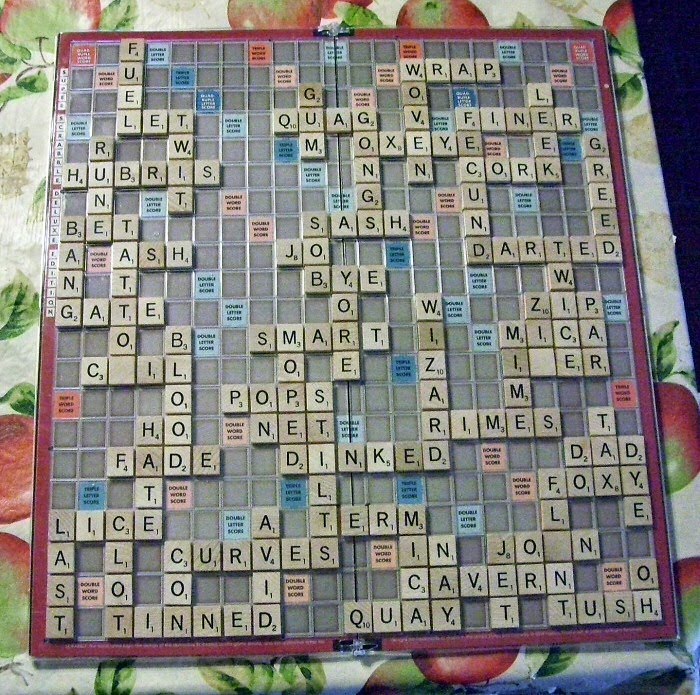
The appearance of Scrabble in world news gives me an excuse to share our Easter afternoon Scrabble game. It was a good one! At the end of the game, we both had three letters left, and the score was 680 (Keely) to 756 (me). In a stunning moment of pure genius, Keely saw that she could play all three of her letters (E, I, and W) in the following location on the board.


The blank letter is a T. Do you see the place where Keely played? Click here to see the word that earned her 102 points and moved her to the lead, 782 to 770. (In anatomy, an iter is a passage or canal, particularly in the brain.)

I played my last three letters and got another 27 points, making the final score 809 to 782 in my favor. Looking at the completed game now, I don't even remember the places where I played. I won, but it hardly seemed a victory after Keely's spectacular coup.

That's how Scrabble is supposed to be played. Proper nouns would spoil everything!

UPDATE: It turns out that the U.S. version of Scrabble, owned by Hasbro, has not changed its rules. See the comments below for a link.

Wednesday, March 24, 2010

Picking and Stealing

Collectors compared


Isaac and I visited Hopkinsville's recently re-opened Peddler's Mall this afternoon. It's an indoor flea market, located in part of the old WalMart building. I've shopped there several times in the last couple of months, and I've purchased something each time. I'm trying to help the Peddler's Mall vendors and owners pay their rent.

Today, Isaac found a movie and a cache of Harry Turtledove hardbacks, and I found a little concrete statue for my flowerbed.

Soon I was standing in line behind a talkative, 60-ish woman at the checkout. She mentioned that she was paying $8 for a little glass candelabra that was worth quite a bit more. "What's it worth?" I asked her. "Twenty dollars?"

"More like fifty or sixty," she opined.

I asked if she watches the "American Pickers" show on History Channel. (In this show, Mike and Frank drive across the U.S., visiting people's hordes of old junk and collectible stuff. Whenever they like some object, they try to buy it at a cheap price.)

"Oh, yes!" she cried. "I love that show!"

Then she told me that when she was younger, she guessed she had done some picking. Back then, she said, farmers didn't care if you went into an abandoned house or barn and took what you liked. Nowadays, farmers were likely to shoot you if they caught you.

I was reminded of a yard sale I attended some years ago. Dozens of old wooden and cast iron tools, horseshoes, and other odd pieces were arrayed on the walls of the patio. When I commented on the collection,  the owner told me where it came from. When her kids were little, she drove out to the countryside with them on Sunday afternoons, and they went into old barns. The display on her wall was what they brought home from their raids.

I cringe when the "American Pickers" get great deals from people who don't know the value of their own junk. However, I give Mike and Frank (and their producer) credit for finding the owner, asking permission to look, and then making a cash offer. They are paragons of virtue, compared to the old heifer I met today and her kindred spirit with the cast iron collection. 

There's picking and there's stealing, and it's not hard to tell the difference.

Saturday, February 27, 2010

Scanning Family Pictures

My concerns about scrapbooks


In 1995, as my parents' golden wedding anniversary approached, they decided that they should organize their photos. So Mama and Daddy spent many hours, looking through their photos and newspaper clippings and arranging many of them in chronological order. They taped (yes, taped!) them into scrapbooks, and for a few of the photos, they wrote captions. They enjoyed making the scrapbooks, and they enjoyed showing them to the friends and family who gathered to celebrate their 50th anniversary.

My parents have both been gone for over a dozen years, but my brother, my sister, and I haven't divided the family pictures yet. I hope that day will come eventually, but for now, I'm scanning photos from a couple of scrapbooks that I brought home from my brother's house last fall.

The scrapbooks and the taped-down photos are a bit of a problem. I can't remove the photos from the pages for scanning, so I opened the hinges of one of the scrapbooks and took out the pages. I have to make two scans for each side of each page. Then it takes a fair amount of time with image processing software to crop the individual photos, straighten them, and save them. I have an older Canon scanner. It works well, but it doesn't do many things automatically.

The worst problem is that we can't divide the photos in the scrapbooks without destroying the scrapbooks. For example, it would be nice if I could have some of the photos in which I appear -- the original photos, not just scans of them. Pictures of me as a child won't mean much to my five nephews and their descendants, whereas my own children and grandchildren might value them. Is that more important than keeping the photos in the scrapbooks that my mother and father created?

The photographs probably should be cut loose from the pages, whether or not we ever get them divided among the three of us. I am very sure the scrapbook pages are not made of acid-free paper.

Scanning these photos has made me wonder about the scrapbooks that many hobbyists enjoy creating today. How will their children share the family photos and memorabilia that are embedded in fancy scrapbook pages? No one will want to ruin the pages, so one person will inherit each book and its contents. I hope that the scrapbook crafters are saving duplicates of the photos or creating similar scrapbooks for each child.

People like to decorate their scrapbook pages with embellishments that they purchase at scrapbooking shops. Little doodads of any thickness would be a problem on my scanner. If a page doesn't lie flat, I don't get a well-focused scan. I'm glad my parents' scrapbook pages are not lumpy!

I think I'll try to write some information on the backs of my own photographs, instead of putting them in scrapbooks. If the kids want them organized chronologically, they can do it themselves.

Sunday, January 24, 2010

Handwriting is Still Important

My opinion on the cursive writing debate


Spencerian handwriting sample from The Graphics Fairy.

This morning, I learned on Michael Leddy's blog that today is John Hancock's birthday and National Handwriting Day. I suppose that's why I thought about handwriting, as I was making a mental list this evening of some large and small changes during my lifetime. In the last half-century, I've seen schools nearly give up teaching cursive writing.

My grade-school teachers in the 1950s and 60s had nice handwriting, and they were determined that we would learn a similar longhand script. We had daily assignments to complete from our Palmer's Penmanship books, and we were graded on our efforts.

How I detested penmanship!  But the agonies of penmanship practice were worthwhile. By the time I was a young adult, I had developed a personal, legible, and fairly fast style of handwriting. Because my teachers insisted on mastery, I've never been handicapped or embarrassed by my handwriting skills or an inability to read (most) handwriting.

Today's teachers still "cover" cursive during spelling classes in second or third grade. However, the necessary practice to develop a smooth, flowing script is no longer required. Many students never give up printing. Some young adults can't read cursive handwriting. Some cannot even sign their names with connected letters. I don't blame the students. If schools no longer insist on a mastery of handwriting, most children will not choose to master the skill on their own.

Yes, times have changed. I realize that today's schools have a lot to teach. I realize that we're all typing and texting on our various electronic devices and not writing by hand as much. However, cursive handwriting remains a skill that's worthy of practice. In the adult world, neat, clear handwriting lends dignity and authority to every pen-and-paper communication. This is especially true of an attractive, distinctive handwritten signature. Consider John Hancock's famous signature. Then imagine his name, hand-printed in manuscript letters. Need I say more about the gravitas of good handwriting?

A person who cannot read and write in cursive is not as well-educated as a person who is fluent in cursive. It can't be denied. I think it's a shame -- yes, shameful -- that schools are doing such a poor job of teaching the handwritten form of the language.


Interested in improving your handwriting? Here are two good articles to read:

Op-Art: The Write Stuff
Tips for Improving Your Penmanship

James of the The Heelers Diaries recently told an interesting story about handwriting -- see #3 in his list of nuns from Planet Zorg.

Wednesday, December 23, 2009

Growing Up Fast

All my children


A few days ago, a young man came through my checkout line at work. As I began ringing up his purchases, I realized I knew him. I hadn't seen Adam (not his real name) for at least five years. He was my daughter's schoolmate, a good student and an athlete.

I visited with him for a few minutes. He was wearing the uniform of a plant in Hopkinsville's industrial park. "You're at -----," I commented. "Yes, and I'm glad to be working!" he exclaimed. The fervor in his voice suggested a personal experience with unemployment.

Adam did not finish high school. He and his girlfriend married when they learned that she was pregnant. Adam dropped out of school and got a job. I used to see him pumping gas at one of the full-service stations in Hopkinsville.

Not long after their baby was born, his wife became pregnant again. I last saw his children when they were chubby toddlers. I'm sure they are in school by now.

Adam is probably 25 years old. His eyes are clear and honest, and he has a smile in his voice as he speaks of his family. I'm proud of him for "manning up" to his responsibilities.

I hope his job stays stable. I hope he's had a chance to get his G.E.D. I hope he can learn some skills on the job that will improve his qualifications. He's had a rough start, but he has ability and potential and many years of life ahead of him.

Thoughts cannot always be spoken. "Have a good Christmas, Adam," I said. "It's great to see you! Take care of yourself."

"I will," he promised.

Tuesday, November 10, 2009

Berlin Wall Remembered

We watched The Wall come down.


Dennis and I lived in West Berlin from 1988-1991. Dennis was working as a manager for the Army-Air Force Exchange System (PX system), and I was a busy mother of one, then two small children. Keely turned three shortly after we moved to Berlin in 1988, and Isaac was born there in June, 1989.

In honor of the 20th anniversary of the Fall of the Berlin Wall, this post and its photos will tell a little about Berlin from the viewpoint of an American who was there when the Wall was opened.

Monday, September 21, 2009

Musical Talent Appreciated

A willing audience


It seems to me that, when I was young, older people genuinely enjoyed a live musical performance of the amateur sort. I grew up in the country, so I'm talking about older country folks. I would include people the age of my parents (born in the 1920s) in this group of music appreciators as well as the elders of the community who were born as far back as the 1880s and 1890s.

Those older people valued homegrown musical talent. They loved to hear someone play a toe-tapping tune on the piano, or the guitar, or the accordion, or the fiddle. They admired someone who could stand in front of a group and sing a song. They were thrilled to hear a trio or a quartet sing in harmony. Music was a treat for them!

For us today, music of a thousand genres is available 24/7. We are sated with music. If we don't hear the music we like on the radio, it's available on the television, internet, CDs or ITunes. We pipe it into our brains with our headsets. We don't need to make our own music in our parlors-- and that surely means that a lot of modest musical talent is never noticed, developed, or appreciated.

Thursday, March 26, 2009

Core Values and the Golden Rule

In accord on what's important


Tonight while driving home from work, I heard Jim Bohannon visiting with David Armstrong, president and CEO of Armstrong International and a fifth-generation member of the family that owns the firm. His company specializes in steam, air, and hot water systems and has been doing business for over a century.

Armstrong credits the firm's success and longevity to a corporate culture of honesty, integrity and decency. When they hire an employee, he explained, they consider it more important to find someone who will fit well into their culture than to find someone who has a set of skills that exactly match the job description.

What is the culture of Armstrong International? The company's motto is the Golden Rule: "Do unto others as you would have them do unto you." Every employee must share and live the company's core values; these include honesty, fairness, respect, trust, and faith in God, family, and job. See their website's statement of mission, core values, and guiding principles for more about what they consider important.

I suppose all this traditional morality could get a bit "preachy", but David Armstrong teaches by telling stories, not by lecturing. He believes stories (and their morals) can motivate, strengthen bonds, and convey principles so that a workplace culture is built over time, and its values are internalized and exemplified by every employee.

Armstrong is a motivational speaker, as well as a successful CEO and author. His latest book is Hanging by A Thread : The Erosion of the Golden Rule in America (available at Amazon, Abebooks, and dozens of other places).

The Armstrong International website has a free download (PDF) of a little book of Armstrong company proverbs. You can also read a sampling of David Armstrong's stories at his website and watch video clips from his talks.

For me, it was refreshing to learn about a company whose high standards of conduct have enabled it to persevere and prosper. What a contrast to the sad stories of slipshod, self-centered, reckless business mismanagement that I've heard too often recently.

Saturday, March 07, 2009

How to Eliminate Daylight Savings Time

Never "spring forward" again.


This is the night that we switch to Daylight Savings Time. I've already set my watch an hour ahead. It will take a week or two for my internal clock to synchronize. The anticipation of losing an hour's sleep is making me cranky already.

Keely has a good idea. Instead of setting the clocks an hour forward in spring and an hour backward in fall, how about this? Everyone sets their clocks forward half an hour and leaves them there permanently. We'll split the difference between the two time seasons and call it Standard Half Time (SHT). A brilliant idea, no?

It's true that people in other countries would need to add or subtract 30 minutes to go from their time to SHT. However, it should be an easy calculation for them. They already have to do conversions for many American units of measurements -- miles, inches, quarts, gallons, pounds, etc. In comparison to some of these, the SHT time conversion would be a few seconds of simple mental math.

Did you know this? Our nation's annual change-over to Daylight Savings Time probably isn't saving any energy, according to a study at the University of California, Santa Barbara. The small energy savings from an extra hour of natural light is offset by the extra hour of air conditioning that most people require in the summer, and the extra hour of heating in early spring and late fall.

Of course I'm spoofing about SHT, but really, why do we put ourselves through this annual unpleasantness if it's not accomplishing anything?

Tuesday, November 25, 2008

The Lord Is My Shepherd

A favorite psalm


Yesterday in church, we sang "The Lord's My Shepherd". It's one of my favorite hymns.

Our hymnbook uses the melody "Belmont" (by William Gardiner, 1770-1853), but several melodies are associated with the hymn. You can hear a very nice recording of " The Lord's My Shepherd" sung to the hymn tune "Crimond" at Psalm 23, a British site.

During his sermon, Pastor talked a little about the comfort that many Christians find in the words of Psalm 23. He brought unexpected tears to my eyes, because I immediately thought of my mother reciting the 23rd Psalm as she went under anesthesia for surgery.

I think I was about five years old when my mother helped me memorize Psalm 23. Then, I best understood the part about the shepherd and the water and the green pasture. Those were things I could easily imagine, having seen the cows in my father's pasture.

Now many years later, the rest of the psalm is within my experience, too. I understand why paths of rightousness are better for me. My soul has needed restoring countless times. I have had enemies who wished me ill. I have passed through the valley of the shadow of death a few times, and I have had times of great happiness when my cup overflowed with God's blessings.


David wrote the Shepherd's Psalm 2000 years ago (or thereabouts). His world was vastly different from mine, but his words are still intensely meaningful to me. Timeless truth underlies each image in the psalm. Like the parts of the Iliad that made me cry when I read them, the setting may be ancient, but the truths are eternal.

Wednesday, September 10, 2008

Bad Morning Blues

Memorable coffee spills


Yesterday morning, the alarm rang, and I struggled out of my bed, slapped the clock until it shut up, and staggered to the kitchen with my eyes half-shut.

Dennis had left the coffee plugged in for me, so I got a cup, set it on the counter, and poured some coffee in it. That is, I intended for the coffee to go in the cup. Unfortunately, the cup was upside down, so I actually poured some coffee over the cup.

I cleaned up the spill with a few paper towels, turned the cup over, and tried again with my eyes open.

Some years ago, I had a memorable bad morning of this sort. I came out to the kitchen and discovered that I'd forgotten to fix my coffee the night before. I cleaned out the old coffee grounds, washed the pot, filled the coffee basket with new coffee, and turned on the coffee maker. Then I went to take a shower.

When I came back to the kitchen, I found I'd forgotten one important step in the coffee-making process -- setting the coffee pot in its proper place on the coffee maker. The coffee had come out of the maker and flowed wherever gravity took it. I had a huge mess to clean up -- and I still didn't have a cup of coffee. Now that was a bad morning.

I do hate having a mess to clean up, first thing in the morning.
Related Posts Plugin for WordPress, Blogger...

CONTENTMENT: Keep your heart free from hate, your mind from worry, live simply, expect little, give much, sing often, pray always, forget self, think of others and their feelings, fill your heart with love, scatter sunshine. These are the tried links in the golden chain of contentment.
(Author unknown)

IT IS STILL BEST to be honest and truthful; to make the most of what we have; to be happy with simple pleasure; and to be cheerful and have courage when things go wrong.
(Laura Ingalls Wilder, 1867-1957)

Thanks for reading.