Wednesday, March 14, 2007

Dafodils Along the Country Roads

Life in Christian County, Kentucky... Life in The Upper South...


Daffodils along the roadside

In spring here in western Kentucky and across the region, daffodils bloom along the roadsides. Their bright yellow flowers often mark the site where a farmhouse sat years ago. One can only speculate what the farmhouse might have looked like, but it's safe to say that in Christian County, many of them were log houses.

The daffodils in the photo above were planted within the last ten years or so, but they mark an old homesite. An old two-story farmhouse used to stand here and a young couple lived in it. She loved flowers and planted daffodils, iris, and much more. They moved away when the land changed hands, and the new owner recently tore down the old house and the little sheds that had stood around it.

Unlike most of the daffodils that spring up in such places, these are large-blossomed double daffodils. You can tell by their fat buds.

I was amused yesterday to see a photo of old-time simple daffodils in our local newspaper with a caption labeling them as "wildflowers". They are certainly common enough along the roadsides to be a native wildflower, but they were all planted here by human hands, and they don't spread over much of an area naturally. For efficient propagation, the clumps have to be dug up, and the bulbs separated and transplanted.

Bar

Technorati tags:


Tuesday, March 13, 2007

Civil War Graves at Riverside Cemetery in Hopkinsville, KY

Camp Alcorn Cemetery and Unknown Confederate Soldiers Monument, Hopkinsville, KY..



Robin at south gate of Riverside CemeteryI sometimes walk in Riverview Cemetery in Hopkinsville. It's very quiet there and I always hear birds singing. The perky little robin at right was squabbling with another robin near the cemetery's south gate. They didn't break it up until I came very close. Maybe they were male robins, arguing about a female?

I find cemeteries very interesting when they contain graves from long ago. I read the stones and ponder the lives of people who lived before my time. The details on some tombstones hint at tragic stories, but others record long and apparently prosperous and happy lives. All this reading and pondering makes for a leisurely stroll instead of a brisk walk-for-exercise!

Riverside Cemetery is interesting because it contains many graves of Civil War soldiers. At the main gate, several historic markers document the burial of Civil War soldiers within, including a Union General. Another marker documents the fact that Colonel Nathan Bedford Forest spent the winter of 1861-1862 in Hopkinsville.

Historic marker of Union general's grave Historic marker of Confederate general's grave


About 300 Confederate soldiers are buried in the Camp Alcorn Cemetery within Riverside Cemetery, and apparently the vast majority of these men -- perhaps all -- died of disease in camp near Hopkinsville. How sad to leave home and family and die in such circumstances.

The identities of 101 of the Confederate soldiers are unknown, but their burial is commemorated with a historic marker at the main gate and their grave is marked with a large monument erected by John C. Latham, a contemporary from Christian County who survived the War and became a wealthy businessman.

John C. Latham is the same man who donated Peace and Latham Parks to the city of Hopkinsville. Mr. Latham's tombstone is located in the same general area as the Unknown Confederate Soldiers' monument, and it is about the same size as the monument with a long description of his impeccable character inscribed upon it.

Historic marker about grave of unknown Confederate soldiers Monument to unknown Confederate soldiers, Riverside Cemetery, Hopkinsville, KY


Here are the inscriptions on the four sides of the monument for the Unknown Confederate Soldiers (pictured above right):

East side (seen above with emblem)
AROUND
THIS COLUMN
IS BURIED
ALL OF HEROISM
THAT COULD DIE.


(North side)
WHILE MARTYRS
FOR CONSCIENCE SAKE
ARE RESPECTED,
THE VALOR AND DEVOTION
OF THE CONFEDERATE SOLDIER
WILL BE ADMIRED
BY THE GOOD
AND THE BRAVE.


(West side)
BENEATH THIS SOIL
IS MINGLED
THE SACRED DUST OF
ONE HUNDRED AND ONE
UNKNOWN SOLDIERS
WHO WERE ATTACHED
TO THE FOLLOWING COMMANDS:
FIRST MISSISSIPPI REGIMENT
THIRD MISSISSIPPI REGIMENT
SEVENTH TEXAS REGIMENT
EIGHTH KENTUCKY REGIMENT
FOREST'S CAVALRY
WOODWARD'S KENTUCKY CAVALRY
GREEN'S KENTUCKY ARTILLERY
-----
WAR BETWEEN THE STATES
1861-1865


(South side)
THIS MONUMENT IS ERECTED
AT THE PLACE OF HIS BIRTH
BY A SURVIVING COMRADE
TO COMMEMORATE THE VIRTUES
OF THE CONFEDERATE DEAD
-----
A.D. 1887

The Camp Alcorn Confederate Cemetery is located in a separate area of Riverside Cemetery near the river. Each gravestone tells the name of the soldier, his rank, and his military unit. A large sandstone slab with a engraved plate gives a bit of the story. I originally thought that these gravestones marked actual graves of soldiers, but I now believe that it is a memorial to all the (known) deceased Confederate soldiers whose bodies remained in Hopkinsville. Careful reading of the engraved plate seems to confirm this. (This paragraph updated 1-02-11.)
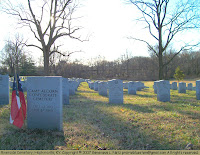
Camp Alcorn Confederate Cemetery

Marker at Camp Alcorn Confederate Cemetery Camp Alcorn Confederate Cemetery


Riverside Cemetery also contains graves of Civil War veterans who lived out their natural lives. They are buried with their families, and their gravestones sometimes carry a notation of their rank and the regiment with which they served.

I have posted some photos of Riverside Cemetery before. I didn't look back at the previous posts, but probably some of the photos in this post are another look at the same scenes. I hope that these posts about Riverside Cemetery will be of interest to the visitors who come here regularly seeking information about it.

Bar

Google search for information about Camp Alcorn


Related articles on this blog:
A Walk In Riverside Cemetery
More About Riverside Cemetery
Camp Alcorn at Hopkinsville, KY

Monday, March 12, 2007

Cedar Waxwings Update

More About Birds and Animals...


Our cat watching birds through the window

Skittles tried to jump through the window a few minutes after I took this photo. Ordinarily, she understands and respects glass, but she was momentarily carried away by her instincts as she watched the cedar waxwings hopping around in the branches just a few feet from her.

I took this photo Saturday morning, and that was the last day that I saw the waxwings. The pyracantha bushes are now completely stripped of berries, so I'm sure they have moved on. It will be interesting to see if they come back next year.

Bar

Technorati tags:


A year ago on Prairie Bluestem, I wrote about "A Beautiful Old House" and "The War-Time Guide Book."

The Southern Buffalo

North America's native cattle


Buffalo (American Bison)USDA photo by Jack Dykinga

This seems to be Bovine Day on the blog, so I will post a link to an interesting article about North America's native wild cow, the buffalo: "Bison herd a link to Texas' history". (Note: When I checked this link on 4/3/11, it was extinct. The article may be purchased from the Dallas Morning News.)

The article tells the story of a small herd of southern buffalo that were rescued from certain extinction by Charles Goodnight, a Texas rancher of fame and legend, and his wife Mary Ann Goodnight. Descendants of the herd are now the official Texas Bison Herd.

Through the years, some of the buffalo in this herd have been cross-bred with cattle and have picked up some cattle genes. Others in the herd are still 100% buffalo. The genetically pure animals are a particularly important gene pool for the buffalo species because they carry some bison genetic markers that are rare or non-existent in other herds.

From the article, a comparison of the southern buffalo:
Characteristics : North American bison males may reach a length of 10 1/2 to 12 feet, while females may be 8 to 10 feet long. Weight ranges from 1,800 to 2,000 pounds for males and 700 to 900 pounds for females. Southern bison are generally smaller than northern bison and lighter in color. Some bulls may reach 6 feet at the top of their hump. Both males and females have short black horns curving upward then inward with narrow tips.

The eastern buffalo has been extinct since 1825. It too was a smaller animal than the Plains buffalo. Neither the southern nor the eastern buffalo were true subspecies. However, there were obviously regional differences in size and coloration.
TAXONOMIC NOTES Two subspecies are recognized: the plains bison (B. b. bison) was once widespread from the Rocky Mountains to the Appalachians, and from the Canadian prairies to northeastern Mexico; the larger, darker and warier wood bison (B. b. athabascae) lived farther west, extending northward as far as the Northwest Territories and possibly as far west as the Bering Sea coast of Alaska. Two other races were listed at one time but no longer are considered valid, and are extinct in any case. They were the pale-colored mountain bison (haningtoni) of Colorado, and the eastern bison (pennsylvanicus) of Pennsylvania, Maryland and Virginia, which was almost black with a grizzled face and smaller hump. There are large numbers of plains x wood bison hybrids in Yellowstone (U.S.) and Wood Buffalo (Canada) national parks and elsewhere. The only remaining pureblooded wood bison are found in sanctuaries in the Northwest Territories and Alberta. (Source: "Bovids", an informational page from Safari Club International.)

I found the following quote about buffalo on a page titled, "Old Mobeetie Texas Association: Red River War.
The southern buffalo were long and tall and slabside. They were like the Texas cattle in build while the northern buffalo were more like the Hereford. They were probably the same specie, but the northern bison had longer, blacker, and better wool. The southern buffalo’s wool turned yellow in the fall. (Attributed to J. Wright Mooar, Buffalo Hunter)

Here is another comment on the various appearances of American buffalo from someone who lived much closer to the age of the buffalo than we do:
Had the bison remained for a few more centuries in undisturbed possession of his range, and with liberty to roam at will over the North American continent, it is almost certain that several distinctly recognizable varieties would have been produced. The buffalo of the hot regions in the extreme south would have become a short-haired animal like the gaur of India and the African buffalo. The individuals inhabiting the extreme north, in the vicinity of Great Slave Lake, for example, would have developed still longer hair, and taken on more of the dense hairyness of the musk ox. In the "wood" or "mountain buffalo" we already have a distinct foreshadowing of the changes which would have taken place in the individuals which made their permanent residence upon rugged mountains. (Source: The Extermination of the American Bison, by William Temple Hornaday (1854-1937), published in 1889 by the Government Printing Office in Washington D.C.)

In an article titled, "The West: Buffalo Hunting on the Great Plains: Promoting One Society While Supplanting Another" by historian and lecturer Keith Miller, three major causes are cited for the final near-extinction of buffalo on the American continent in the late 1800's. First, a very efficient process had been developed for tanning the hides. Second, gun technology improved during and after the Civil War, so the rifles used by buffalo hunters were more accurate and more powerful than ever before. Third, the railroads made it possible to ship massive quantities of buffalo hides.
In the period 1872-1874 the bison hunts in the southern plains peaked, for example, with a buffalo death toll of 4,374,000. To that level of killing by white hunters must be added the 1,215,000 bison taken by Indians on the southern plains.

Such an horrendous slaughter had prompted the action of Congress. First, in 1872, that legislative body voted for a measure to limit buffalo hunting, and then, in 1874, passed a much more restrictive bill. But, to no avail, because President Ulysses S. Grant declined to sign either proposed law. So, the killing continued unabated. With this result--by 1875 the southern buffalo herds ceased to exist.

Source: "The West: Buffalo Hunting on the Great Plains: Promoting One Society While Supplanting Another" by Keith Miller

Sunday, March 11, 2007

Cattle Breeds in the U.K.

Native cattle of the British Isles


Highland cowA Highland cow (Image courtesy of Wikipedia)

For my readers who are interested in such things, here are some interesting facts about cattle in the U.K. The following figures show the predominant cattle breeds in the U.K. currently and the number of registered cattle in each breed.

Beef Breeds:
687,382 -- Limousin
332,098 -- Charolais
222,290 -- Aberdeen Angus
221,670 -- Simmental
186,730 --Belgian Blue
307,387 -- Other breeds

Dairy Breeds:
579,617 -- Holstein Friesian or Holstein Friesian crosses

Source: "Limousin is UK's Largest Numerical Cattle Breed" by staff, published March 10, 2007 on Trumpline Stackyard.

I suppose that the registration of every animal is part of their program to eradicate Bovine Spongiform Encephalopathy (BSE), more commonly known as mad cow disease.

The article where I found these statistics quotes the president of the British Limousin association. He says that the Limousin are "easy care, added value cattle" and that the "flexibility and predictability of Limousin cattle is providing a marked and demonstrable premium" for farmers. He almost sounds like a politician. Smile

In the list above, the only truly native UK breed is Aberdeen Angus, a black cattle from Scotland that is also a popular U.S. cattle breed.

Limousin and Charolais cattle are of French origin. Simmentals are from the Simme valley of Switzerland. The breed is the result of crossing the native cattle of the area with larger cattle from Germany.

Belgian Blues were developed in Belgium, but their bloodlines go back to a cross of Shorthorns (of the British Isles) and Friesian cattle.

I decided to compile a list of some of the UK's other native cattle breeds that didn't make the popularity list. Here it is, and each link should open a new window with images of that cattle breed.

  • Ayrshire - a dairy cattle breed from the County of Ayr in Scotland.
  • Chillingham - One of the old breeds of white cattle. This one is a wild native cow from Northumberland, small with upright horns and red ears. A very rare breed, with only about 100 animals left.
  • Devon - a cattle breed from the Devonshire, England area, once used as draft animals as well as for dairy and beef.
  • Guernsey and Jersey - dairy cattle breeds from the channel islands, Guernsey and Jersey
  • Hereford - a breed of red cattle that originated in western England and Wales. Once used as draft animals. Has been a popular beef breed in the U.S. for many years.
  • Highland - a hardy, shaggy, long-horned native breed from the highlands of Scotland. There were once two strains of this breed (Kyloe and Highlander), but in modern times they are all known as Highland cattle.
  • Shorthorn - an old breed mentioned in recorded history as early as the 1500's, probably descended from a short-horned ox known to be in England in the days of the Roman Empire
  • Lincoln Red - probably brought to the British Isles by the Vikings.
  • English Longhorn - Brindle cattle with long horns, once used as draft animals.
  • British White - An old breed of white cattle with "dark points" that can trace its history back 800 years; originally from the wild white cattle of Great Britain.
  • White Park - Another old breed of white cattle, smaller with larger horns, that can trace its history back to the Druids of pre-Christian Ireland. The White Park breed also has a long history in England, Scotland and Wales.
  • Dexter and Kerry - descended from the Celtic black cattle of the highlands of southern Ireland.
  • Galloway and Belted Galloway - a old breed descended from the long-haired black cattle of the Galloway region of the Scottish lowlands.
  • Welsh Black - an old breed of horned black cattle from Wales, used for meat and milk.
  • There may be other breeds as well. These are just what I came up with fairly quickly.
  • Chillingham Cattle (Image from The Graphics Fairy)
Related Posts Plugin for WordPress, Blogger...

CONTENTMENT: Keep your heart free from hate, your mind from worry, live simply, expect little, give much, sing often, pray always, forget self, think of others and their feelings, fill your heart with love, scatter sunshine. These are the tried links in the golden chain of contentment.
(Author unknown)

IT IS STILL BEST to be honest and truthful; to make the most of what we have; to be happy with simple pleasure; and to be cheerful and have courage when things go wrong.
(Laura Ingalls Wilder, 1867-1957)

Thanks for reading.