Tuesday, April 28, 2009

Modesty on the Clothesline

Hanging out the laundry


A lady told me about her recent vacation in San Francisco. She was shocked, she said, to see underwear hung out to dry on balconies above busy streets. She guessed she was old-fashioned because she would never pin her underwear to a clothesline and put it on display to the world. It wasn't modest.

This amused me a little because this lady is no shrinking violet. She spent a number of years driving 18-wheelers all over the nation with her husband. She's a plain-spoken person without airs, and she's about 15 years younger than me. Of all the things that she might have been shocked at in San Francisco, I wouldn't have predicted underwear on clotheslines.

When I thought about it, I couldn't remember seeing any sort of underwear hanging on the clotheslines at Mennonite and Amish homes. I can say with certainty that they hang cloth diapers outside to dry, but beyond that, I'm not sure.

When I used a clothesline faithfully for a number of years, I hung out the whole family's underwear. I usually hung the undergarments on an inside line, behind the sheets or towels.

We live in the country. The clothesline was barely visible from the road, but someone who drove into our yard might have seen the laundry well enough to identify individual pieces. To be honest, I wasn't too worried about it.

I asked Isaac (my 19-year-old son) what he thought about underwear hanging in plain view on the clothesline. He says that if he ever sees anything like that, he's going to lodge a complaint with the board of governors immediately. He also says that the only good weapon for fighting something like that is satire. Whatever, Isaac.

Laundry day at a Mennonite home

Monday, April 27, 2009

Grasses of the Nebraska Prairies, 1903

Grasslands of Brown County, Nebraska


The Charlie Youngman Ranch, Brown County, Nebraska,
about 1900. Photographer: Solomon Butcher

In a century-old book digitized by Google, I found an interesting fact about Brown County, Nebraska.

At the 1903 state fair, Brown county exhibited over 160 varieties of native grasses, which was twenty-five more than were shown by any other county. For the most part these were forage grasses, and they indicate that Brown county was intended by nature to be the home of cattle and horses. It is not uncommon for them to go through the winter entirely upon the range, though this is not to be depended upon. Probably, the largest single interest in the county is its cattle, and for several years past they have brought to the county a large income.

Source: Resources of Nebraska (page 25), by the Nebraska Bureau of Labor and Industrial Statistics, published in 1904.

It should be noted that buffalo, elk, deer, antelope and many other forms of wildlife made good use of Brown County's grasslands long before they were "intended by nature" as a home for cattle and horses.

Science, a 1901 publication of the American Association for the Advancement of Science, states that 170 different species of grass had been identified in the Nebraska Sandhills. What a wealth of grass! Brown County's exhibit of over 160 different grasses may have represented a variety of Sandhills grasses along with other native grass species. The terrain of Brown County is varied.

Brown County is located in north central Nebraska, near the South Dakota state line. It borders on the east with Rock County, where I grew up. My father grew up at Moon Lake, in southwestern Brown County.

Related:
2.4 MB high definition version of the Solomon Butcher photo at the top of this post
Photos from the O'Hare Ranch in western Brown County

These photo tours have some nice shots of the Sandhills prairie, though no images from Brown County:
Photo tour of the Sandhills and northwestern Nebraska
Another photo tour of the Sandhills

UPDATE:
The primeval prairies of Brown County are described in a little book published in 1937, Days of Yore, Early History of Brown County, Nebraska, compiled by Lillian L. Jones. The following quote is from the section about "Early History".

Let us try to imagine what this portion of Nebraska was like before the coming of the white settlers. A great expanse of prairie, slightly rolling, spread out on every side as far as the eye could reach, most of it covered with a rich growth of grass. Some varieties of this grass were tall with stiff, straight stems, some of low growth with delicate, curling blades. Here and there were running streams which were hidden in canyons or ravines where trees and shrubs were found, but until the edge of the canyon was reached the entire country appeared to be "a sea of grass," which stretched ever on and on toward the setting sun.

In the section titled "Ainsworth, Reminiscent", Jones mentions another first prize won at the State Fair for a native grass collection. The winning collection of "nearly one hundred varieties of native grasses found in this county" was made by C. W. Potter, W. H. Peck and J. E. Stauffer.

Saturday, April 25, 2009

One Room School

Old-fashioned education


While wandering the roads of southern Todd County (KY) a few days ago, I drove through an Amish community. I think there are probably several little schools like this in the general area. The area served by the school is limited by the distance the students can travel on bicycles, and also by the size of the building.

A schoolbell tops the building. Playground equipment, including a slide, provides recess entertainment.  The little square building in the corner of the playground is probably the outhouse. A woodshed may be somewhere out of view. I don't see a chimney on the building, but it looks like there is a stovepipe coming out of the wall beside the porch. There is no electricity.

One teacher teaches all eight grades in little schools like these. In many ways, it's very similar to the one-room school I attended in Nebraska as a child, except that we had a telephone, fuel oil heat, and electrical power.

Related posts:
Lunch Hour at a One-Room School
Three Old Schools in Christian County, Kentucky
St. Elmo School Revisited
Some Memories of Duff, Nebraska
Duff Valley
Teaching in a One-Room School

Tuesday, April 21, 2009

Door to Yesterday

Side entrance to an old building in Hopkinsville, KY


This door, a side entrance to one of Hopkinsville's 1880s buildings, probably opens to a staircase. Perhaps the merchant's family once lived above the store, or perhaps the space was rented.

The window above the door enhanced the airflow to the second floor in hot weather. I believe a window above the door like this is called a "transom window."

The metal awning is too high and short to provide much shelter for a person opening the door in the rain. It probably did prevent rain from coming through the transom window, if the wind wasn't strong. The awning was surely added sometime after the building's construction. I doubt if it dates back to the 1880s.

Update:
This doorway is a side entrance to the Klein Building, on the corner of 6th and Main Streets. The front of the building, as seen from 6th Street, is pictured below. The Alhambra Theater on Main Street is visible in the background. The main entrance of the Klein Building sits diagonally at the corner, behind the black post that's supporting the second floor.


The Klein Building in Hopkinsville, KY, was built in 1883.

Saturday, April 18, 2009

An Old Barn Falls

I told you so.


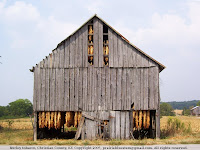
Tobacco barn, Christian County, KYFall of 2007


A couple of years ago, I wrote that I was surprised this barn had tobacco hung all the way to the top in it. I hoped they had checked the old barn's stability before climbing to the top tier with heavy tobacco-laden sticks because the barn was in poor repair.

Sometime after that, an angry man from eastern Kentucky wrote an impassioned comment on that post. He said that falling out of the tops of barns was just part of growing tobacco. I, an ignoramus, should mind my own business because I knew nothing about barns, tobacco, or farming. He added a number of obscenities for emphasis.

He may have been right (I don't know a whole lot about tobacco farming), but nevertheless, the barn collapsed sometime recently, probably in one of the wind storms. Or maybe the farmer pushed it over. Anyhow, nobody will be hanging tobacco in it anymore.

Spring of 2009
Related Posts Plugin for WordPress, Blogger...

CONTENTMENT: Keep your heart free from hate, your mind from worry, live simply, expect little, give much, sing often, pray always, forget self, think of others and their feelings, fill your heart with love, scatter sunshine. These are the tried links in the golden chain of contentment.
(Author unknown)

IT IS STILL BEST to be honest and truthful; to make the most of what we have; to be happy with simple pleasure; and to be cheerful and have courage when things go wrong.
(Laura Ingalls Wilder, 1867-1957)

Thanks for reading.